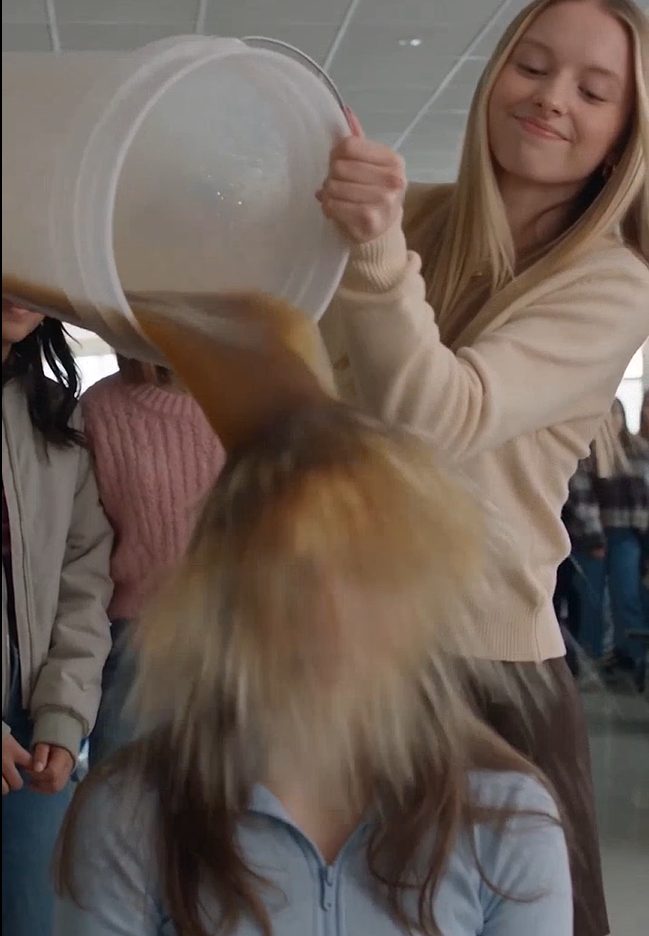
Sloane was tall, with the sharp, aristocratic profile of an equestrian and hair the exact color of unrefined clover honey, cut into a blunt, swinging bob that never seemed to lose its parting. She wore the regulation Ashford navy blazer, but hers had been recut by a Georgetown tailor in four-ply Italian wool, the brass buttons replaced with flat horn toggles. She moved flanked by Brynn Hale, whose family owned six auto dealerships along the Beltway, and Paige Collins, whose mother chaired the hunt club gala.
Their first exchange had been small—a skirmish over territory outside the third-floor biochemistry lab.
Mara had been kneeling by her locker, trying to work a stubborn tumbler mechanism that had seized from years of grease buildup. Her worn, navy-blue canvas sneakers—purchased for twenty-six dollars at an outlet two summers prior—stuck out into the corridor.
A pair of polished black horsebit loafers came to a dead stop two inches from her rubber soles.
“Are those orthopedic?” Sloane’s voice was smooth, pitched in that sweet, crystalline register that sounded like a compliment until the consonants landed.
Mara had not looked up immediately. She worked the dial: 24, 18, 36. The latch clicked. “No.”
Brynn let out a short, nasal bark of laughter from behind Sloane’s right shoulder. “They look like they were pulled out of an estate sale in West Virginia.”
Sloane had tilted her head, her pale blue eyes taking in the olive jacket, the cotton hair-tie on Mara’s wrist, and the frayed strap of the gray backpack. There was no rage in her expression—only the clinical, dissecting curiosity of an entomologist observing a beetle that had somehow crawled onto the linen tablecloth.
“Doesn’t your mother buy you clothing, Mara?” Sloane asked softly. “Or does Ashford have a clothing pantry we aren’t told about in the handbook?”
“They keep the rain off,” Mara had replied, standing up, shutting the locker door with a firm, metal snap that echoed down the hall. “That’s what shoes are for.”
Sloane had smiled—a slow, terrifying unfurling of pale pink lips that signaled the opening of an account. “How delightfully rustic.”
From that morning forward, the tax was levied daily.
It was never loud enough to summon a proctor, and it was never crude enough to leave an obvious mark. It was the art of ambient degradation. When Mara walked down the central hall between second and third period, Sloane and her circle would fall into step behind her, mimicking her stride with exaggerated, heavy-footed stomps while whisper-counting her paces: “Clump, clump, here comes the ward of the state.” In AP English, whenever Mara raised her hand to analyze a passage of Wharton or Fitzgerald, Paige would lean across the aisle and loudly whisper to the boy beside her, “Let’s ask the scholarship committee how the working poor interpret leisure class dynamics.”
The other students—even the ones who winced, even the ones whose fathers weren’t on the board—looked away. They looked away because Sloane’s father hosted the annual winter mixer at his Potomac estate; they looked away because to step between Sloane Whitaker and her quarry was to invite the searchlight onto yourself.
By October, Mara’s world had narrowed to the small, square table in the far corner of the Great Hall, behind the structural brick pillars that supported the north gallery.
The Great Hall was Ashford’s pride: a cavernous, pseudo-Gothic dining commons with sixty-foot timbered ceilings, stained-glass medallions depicting the liberal arts, and tall, diamond-paned casements that looked out over the rugby pitch. Long trestle tables of solid quarter-sawn oak ran in four parallel lines down the room.
At Mara’s table sat Tessa Nguyen, a brilliant, rail-thin girl who lived in Annandale and had won the state junior violin competition twice, and Eli Santos, a quiet freshman who carried an oversized portfolio case like a shield and rarely spoke above a whisper.
On a Tuesday three weeks before the storm, Eli had arrived at the table with his eyes red and his hands shaking so violently he couldn’t uncap his thermos.
Across his lap lay his drawing pad—a heavy spiral-bound volume containing forty ink-and-wash architectural studies he had prepared for the National Scholastic Arts submission. The first twelve pages had been torn across the center, the heavy rag paper shredded with the jagged, deliberate violence of someone who had used a pair of office shears.
“What happened, Eli?” Mara had demanded, her pulse jumping.
Eli had stared down at the ruined ink. “Brynn took it off my desk during homeroom. She passed it to Sloane. Sloane said… she said an academy student shouldn’t be glorifying public housing projects in a private portfolio.” He swallowed, the sound clicking dry in his throat. “She dropped the scraps in the ceramic disposal sink in the studio and turned on the tap.”
“Did you go to Lane?” Tessa asked, her voice tight with a cold, impotent fury.
Eli gave a miserable, shuddering shake of his head. “I went. She told me… she told me that art was subjective, and that leaving valuable personal property unattended on a studio desk was an invitation to loss. She said Sloane had an exemplary citizenship record and that making unsupported allegations against a senior prefect would jeopardize my financial aid review.”
Mara had felt a hot, metallic taste rise behind her tongue.
The next morning, breaking her own rule of silence, Mara had walked into the administration wing.
The office of Evelyn Lane, Dean of Students and Senior Vice Principal, smelled of lavender reed diffusers and expensive bond paper. Lane was fifty-two, immaculate in a pearl-gray knit suit, her silvering hair cut into an architectural wedge. She had served under three successive headmasters; she was the institutional mortar of Ashford Academy, the woman who handled the donor grievances, the alumni trust allocations, and the delicate, unwritten compromises that kept the school’s endowment growing.
She had listened to Mara with her hands steepled beneath her chin, her gold signet ring clicking softly against her pen.





