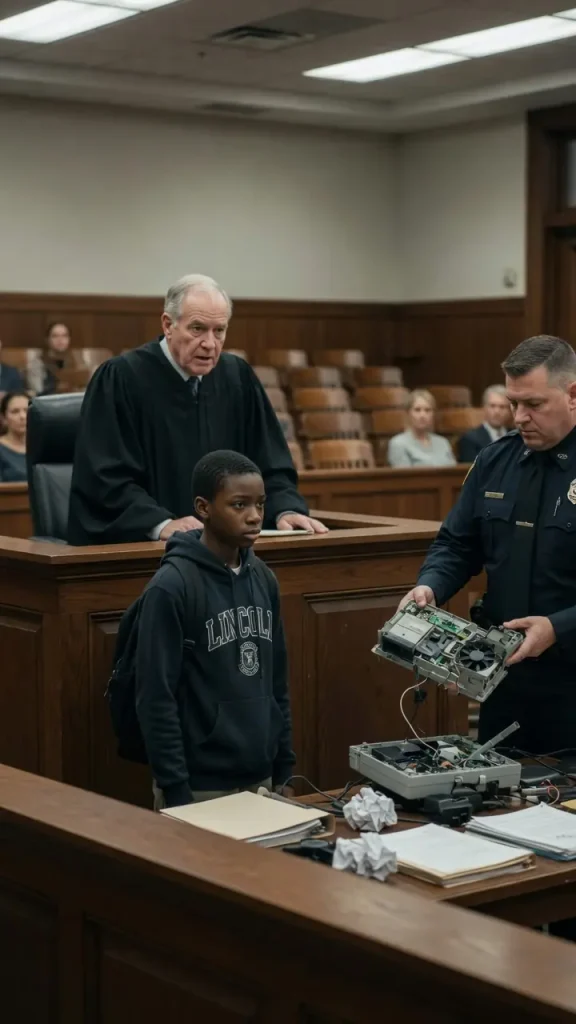
“And before Chicago?” Devon blinks, confused. “My family has been in Chicago for generations.” Judge Harmon makes a dismissive noise.
“Your project will remain confiscated until proper authorities can inspect it.” However, he nods to Dr. Williams. “You can take responsibility for him attending the meeting without his device.”
Dr. Williams protests, but the judge cuts him off. “Should have thought of that before bringing unauthorized devices into a federal building.” The judge’s voice rises.
Devon follows Dr. Williams to the meeting room. His heart pounds as they enter. Twelve committee members sit around a conference table. Several observers line the walls.
“I apologize for the delay,” Dr. Williams announces. “We’ve had an unexpected situation.” Devon steps forward. Every eye in the room turns to him.
“I apologize,” Devon begins, voice steady despite the humiliation. “Judge Harmon has confiscated my project and presentation materials. I’ll do my best to explain my findings from memory.”
Devon stands before the environmental committee empty-handed. He takes a deep breath and begins speaking from memory. “My project measures particulate matter concentrations in low-income neighborhoods versus affluent areas.”
His voice grows stronger with each word. “Over 6 months, I documented levels three times higher in minority communities.” Despite the absence of visual aids, committee members lean forward.
Devon sketches air particle distribution patterns on a borrowed notepad. He explains collection methodology and statistical controls. “I identified correlation between pollution spikes and respiratory emergency room visits.”
He draws another diagram. “The data shows environmental protection laws are enforced differently based on neighborhood demographics.” Dr. Williams watches with quiet pride.
When Devon finishes, the committee applauds. “Remarkable work,” says committee chair Dr. Lawson. “Especially under these circumstances.”
“Where is your project now?” “Judge Harmon is holding it for security reasons.” Dr. Lawson frowns. “That’s unusual. We’ll look into it.”
“Meanwhile, your findings deserve wider attention. Would you consider presenting at the state conference next month?” Devon nods. “I’d be honored.”
The next morning, Devon arrives at school, his mind still on his confiscated project. His physics teacher, Ms. Reynolds, pulls him aside. Devon explains the situation carefully.
Ms. Reynolds expression darkens. “Judge Harmon had no right to keep your property without cause.” During lunch, Devon’s phone buzzes with a text from an unknown number.
“Your project marked for disposal tomorrow morning. Security protocol. Sorry, friend at courthouse.” Devon’s heart races. He tries calling his father again. Voicemail.
After school, Devon returns to the courthouse. The security guard stops him. “I need to speak with Judge Harmon.” “Judge left for the day. Come back tomorrow.”
“This can’t wait. My property is scheduled for disposal.” Devon spots Officer Briggs. “My project is scheduled for disposal tomorrow. It contains irreplaceable research data.”
Briggs smirks. “Maybe you’ll think twice before bringing suspicious devices here.” Devon walks outside, fighting frustration. He calls his uncle again.
Early morning, Devon arrives at the courthouse before it opens. He waits on the steps with documentation proving his ownership. Judge Harmon arrives, surprise flashing across his face.
“Mr. Taylor, persistent, aren’t you?” “Yes, sir. I have documentation proving my project’s legitimacy and requesting its immediate return.” Judge Harmon barely glances at the papers.
“File it with the clerk. I have a busy docket today.” “Sir, security plans to dispose of my property this morning.” Devon remains respectful but insistent.
“Your honor, I’ve documented everything that’s happened. If my property is destroyed without due process, I’ll be forced to escalate this matter.” Judge Harmon’s eyes narrow. “Are you threatening me, young man?”
“No, sir. I’m exercising my rights as a citizen.” The judge steps closer. “Let me be clear. You have no power here. I decide what happens in my courthouse.”
“The courthouse belongs to the people, your honor.” Judge Harmon’s face flushes. “You need a lesson in respect.” He calls for Officer Briggs to escort Devon out.
Afternoon at the courthouse. Devon sits on a bench outside Judge Harmon’s courtroom, refusing to leave. Laura Chen, a public defender, approaches and listens to his story.
She makes a call. They hurry to the basement where confiscated items are processed. Through the door window, Devon spots his project on a table.
Judge Harmon emerges from the elevator. Laura challenges him, but the judge orders them escorted out. Devon watches the judge enter the disposal room and pick up a hammer.
Outside the courthouse, Devon paces the sidewalk. Laura makes frantic calls seeking emergency intervention. Devon’s phone rings. It’s his father.
“Dad, they’re destroying my project right now.” “I know, son. I’ve been briefed. Put me on speaker.” His father’s authoritative voice fills the air.
Laura escorts Devon back inside. At security, mentioning the number changes everything. They reach Judge Harmon’s chambers. The judge stands behind his desk with the damaged project in front of him.
Judge Harmon scoffs at the call. But when he dials the number himself, his expression shifts from annoyance to shock. The color drains from his face.
“Your property will be returned immediately, Mr. Taylor.” “In its original condition, with all data intact,” Devon specifies. Judge Harmon nods, unable to meet his eyes.
Devon’s phone rings again. “Is it resolved, son?” His father asks. Then he requests to speak with Judge Harmon directly.
“Judge Harmon, this is United States Attorney General Robert Taylor. I’ll be in your courthouse tomorrow at 9:00 a.m. to discuss your treatment of my son and the apparent pattern of judicial misconduct in your courtroom.” Judge Harmon nearly drops the phone.
Dawn breaks over the city. News vans surround the courthouse. Devon and his father arrive with FBI agents. In the conference room, evidence of Judge Harmon’s pattern of discriminatory rulings is presented.
The data from Devon’s project correlates directly with the biased sentencing patterns. Neighborhoods with the poorest environmental protections match exactly with where Judge Harmon’s rulings were most severe against minorities.





