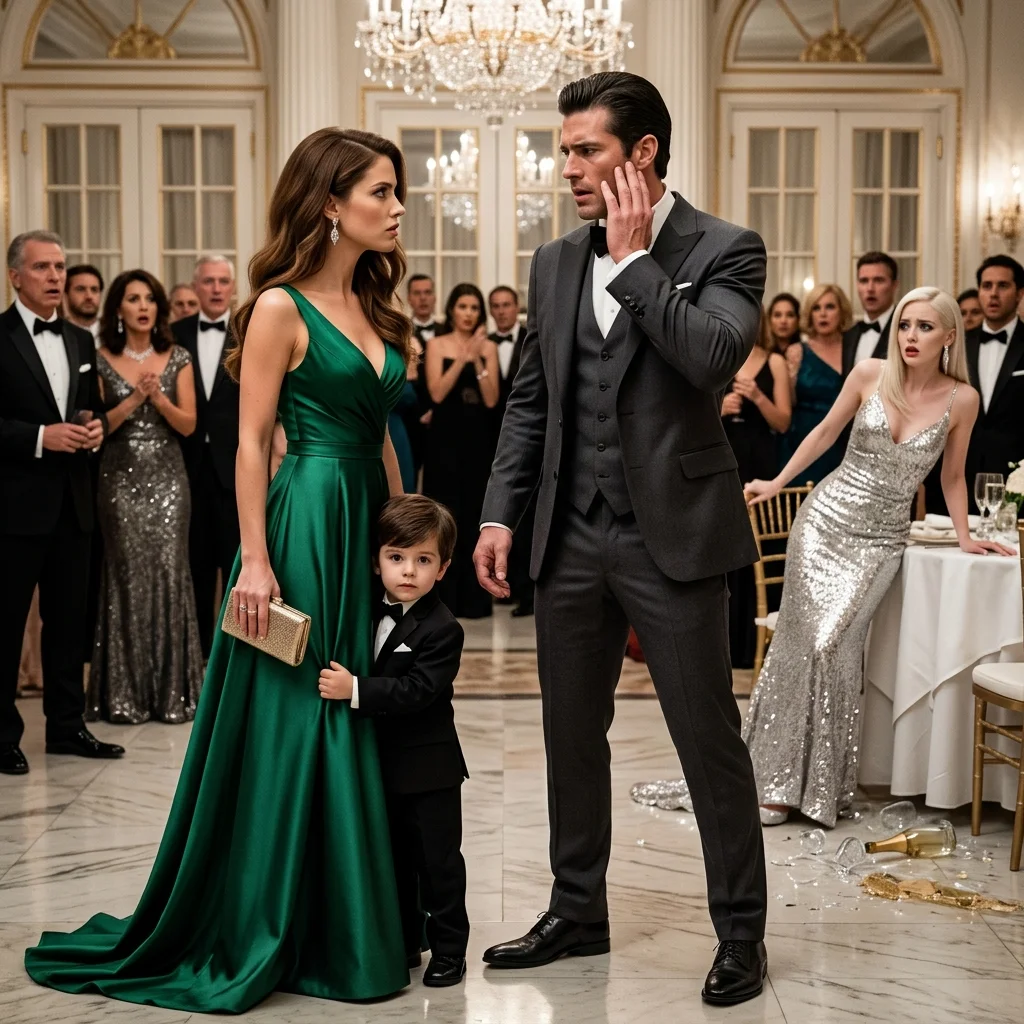
On the far side of the mud embankment, hidden beneath a curtain of black smoke and freezing rain in the service ditch, Elena clamped a trembling hand over a half-conscious Anna’s mouth as an access road ambulance—summoned from a rural clinic outside the airport perimeter—skidded to a halt at the bottom of the ravine.
Through the ringing in her ears, Anna heard Vincent’s distant, agonized scream carried on the wind. Looking up at the tower of black fire consuming the plane where he had left her to die, she felt the warm blood soaking through her dress, looked at the terrified paramedic kneeling beside her in the mud, and whispered two words before the darkness took her:
“Don’t tell.“
Three years can turn a man into a monument, or it can hollow him out until only the armor remains.
In Chicago, they said Vincent Moretti had become both.
The funeral at Holy Name Cathedral had been the grandest, darkest spectacle the city had seen in a decade. Every shipping magnate, senator, and judge in Illinois had watched in hushed terror as Vincent stood beside two mahogany coffins—one full-sized, one unbearably small—buried side by side in the frozen earth of Graceland Cemetery. Because the fire in the center fuselage had burned at temperatures hot enough to calcify bone into indistinguishable ash, the NTSB recovery team had found nothing left in the forward cabin but the melted platinum band of Anna’s Patek watch—which had fallen from her wrist when her head struck the table—and the charred remnants of her cashmere wrap.
Vincent had placed that fused lump of platinum into the casket himself. He hadn’t shed a single tear in public.
Instead, he had stopped sleeping.
For thirty-six months, the master suite of the Lake Forest mansion remained untouched, Anna’s half-knitted baby blanket still resting on the rocking chair by the nursery window. Every night at 2:14 a.m., Vincent would wake in the guest wing, drenched in freezing sweat, smelling jet fuel and white gardenia, hearing the quiet, devastating tremor in her voice: What if there isn’t time?
And his own lie echoing back from the abyss: There will be. I promise.
Yet Sophia Carter had never left.
She had moved into the downstairs wing six months after the crash, positioning herself as the grieving angel who shared his survivor’s guilt. She attended his charity boards, wore subdued black Chanel to his dinners, and wept softly whenever Anna’s name was mentioned—slowly, methodically weaving herself into the vacuum Anna had left behind until Chicago high society began whispering about when the widower would finally make his first love his second wife.
Vincent allowed it. Not because he loved Sophia—whatever boyhood obsession he’d harbored for her had died the second the Gulfstream exploded, replaced by a suffocating, nauseating resentment every time he looked at her unscarred face and remembered the cost of her survival—but because letting Sophia stay was his penance. If he had traded his wife and unborn child for this woman, then looking at her every day was the hell he had earned.
On a crisp Friday evening in November, the grand ballroom of the Art Institute of Chicago blazed with the light of ten thousand Waterford crystal prisms.
It was the inaugural gala for the Global Pediatric Reconstruction Initiative—a fifty-million-dollar endowment Vincent had funded in the name of the child he had never held. Three hundred of the wealthiest men and women in the Midwest filled the marble hall beneath Chagall’s stained-glass windows, the air humming with the clink of Dom Pérignon flutes and the swell of a chamber orchestra playing Vivaldi.
“Everyone is staring, Vinny,” Sophia murmured, slipping her hand into the crook of his tuxedo elbow as they stepped down the grand staircase. She was wearing an ivory silk gown that clung to her figure, a diamond drop necklace glittering at her throat. “Senator Vance asked me twice in the foyer if we’re announcing a spring date in Lake Como. You didn’t even look at him.”
Vincent didn’t look at her now. He took a glass of neat Macallan from a passing waiter’s silver tray and downed half of it in a single swallow, the peat burning his throat without warming the permafrost in his chest. “This evening is for the pediatric surgical wing, Sophia. Not your social calendar.”
“It’s been three years, Vincent,” she said, a sharp, petulant edge briefly piercing her fragile veneer before she smoothed it over. “You can’t live in a mausoleum forever. Even the new European co-chair flew in from Geneva tonight. Dr.Julian Vance said she’s the primary architect behind the Zurich neonatal trauma technology we’re licensing.”
Vincent barely heard her. His eyes were drifting toward the massive bronze plaque unveiled near the stage—In Eternal Memory of Anna & Baby Moretti—when a sudden hush rippled through the crowd near the arched Venetian doors at the far end of the ballroom.
Conversations faltered. Heads turned. Even the first violinist seemed to miss half a beat.
A woman had just stepped under the central chandelier.
She wasn’t wearing the understated, apologetic pastels Anna Bennett used to wear to avoid outshining her husband’s guests. Her gown was the color of dried arterial blood—a sweeping, architectural column of crimson silk that left her sculpted shoulders bare, save for a faint, silvery crescent of scar tissue curving just beneath her left collarbone. Her dark chestnut hair was swept up into a twist secured with white diamonds, exposing the swan-like line of her neck and a profile carved from cold porcelain.
She moved across the parquet floor with a deliberate, unhurried grace—only a trained eye, or the eye of a man who had memorized every millimeter of her body across a thousand nights, would notice the almost imperceptible hitch in her right stride.
The crystal tumbler slipped three inches in Vincent’s palm before his fingers locked around it with enough force to crack the glass.





