Whitaker’s face hardened. He gripped the edges of the podium. “That is a despicable, calculated lie! You are trying to destroy my career because you couldn’t handle a scholarship review!”
Chairman Sterling leaned forward, his face flushed with anger. “Ms. Carter, these are incredibly severe allegations. Making false claims against an administrator will result in immediate expulsion and potential legal action for defamation. You have no proof of this outrageous story.”
“I am not asking you to take my word for it, Mr. Sterling,” I said. I walked the remaining distance to the front of the stage. I reached into my blazer pocket and pulled out my phone.
I looked at Principal Vance. “I formally request that the electronic key-fob access logs for Mr. Whitaker’s office from last Thursday between 5:30 and 5:45 p.m. be pulled and admitted into the record immediately. They will prove I was the only person in that room with him.”
Vance looked at Sterling, completely out of his depth.
“Furthermore,” I said, placing my phone on the edge of the board’s table. “I request to enter this into the record.”
Whitaker let out a sharp, dismissive laugh, though I noticed a bead of sweat tracing its way down his temple. “What is that? A fake recording? Anyone can edit an audio file, Emily. You’re embarrassing yourself.”
“It’s the original file,” I said, staring dead into Whitaker’s eyes. “Untampered. Unedited. And a copy has already been sent to the Chicago Student Rights Advocacy Network, who is currently waiting on the phone line with the Chicago Police Department.”
The color drained entirely from Whitaker’s face. He looked like a man who had just stepped off a cliff and was waiting to hit the ground.
“Play it,” ordered one of the district oversight officials, a stern woman in a grey suit who had remained silent until now.
I tapped the screen.
The audio filled the cavernous auditorium, amplified perfectly by the acoustics of the room.
First, the heavy click of the deadbolt locking.
Then, Whitaker’s voice, smooth, predatory, and unmistakable.
“Close the door, Emily.”
My voice, thin and frightened. “Is there an issue with the donor records, Mr. Whitaker?”
“You are a remarkably intelligent girl, Emily… But you are also incredibly stubborn. You think your grades protect you. They don’t.”
The students in the front row were perfectly still. The board members stared at the phone as if it were a live grenade.
“Play along, Emily. And your future is guaranteed.”
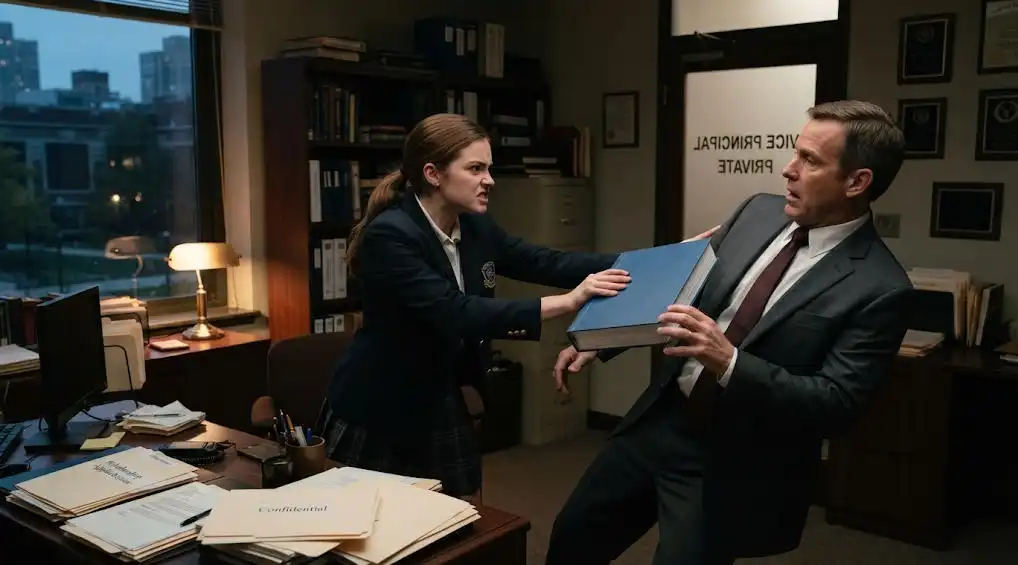
The sound of the struggle. My voice, loud and fierce. “Get your hands off me!”
The loud, violent THWACK of the binder hitting his arm.
And then, the polished, sorrowful administrator completely vanished, replaced by the snarling, vicious monster the entire school was now listening to.
“What the hell do you think you’re doing, you little bitch?”
The recording captured the frantic scrambling, the door unlocking, and my ragged breathing as I ran.
Then, the audio cut off.
The silence in the auditorium was no longer a vacuum; it was a physical weight, pressing down on Grant Whitaker until he looked small, pathetic, and utterly ruined.
He looked wildly at the board. “It’s… it’s out of context! She provoked me! The audio is manipulated!”
Chairman Sterling did not look at Whitaker. He looked at me, a profound, horrifying realization dawning in his eyes. They had orchestrated a public tribunal to crush a scholarship student, and in doing so, they had provided her the perfect stage to publicly execute their star administrator.
The district oversight official stood up, pulling a cell phone from her purse. “Principal Vance, clear the auditorium immediately. This hearing is suspended. Mr. Whitaker, you are to remain exactly where you are. I am calling the police.”
The fallout was catastrophic and absolute.
Grant Whitaker was escorted out of Lakeview Academy in handcuffs by two Chicago police officers before first period even ended.
The electronic access logs perfectly corroborated my timeline. The physical bruising on his arm perfectly matched the mechanism of injury I described. When the police executed a warrant on his office computer, they found a pattern of targeted emails sent to other female scholarship students over the past decade at his previous schools. I wasn’t his first target. I was just the first one who fought back.
Whitaker pled guilty to aggravated criminal sexual abuse to avoid a lengthy, public trial that would expose the depths of his history. He was sentenced to state prison.
Lakeview Academy was thrown into a media firestorm. To save their own reputations, the Board of Trustees initiated a massive, external audit of their student protection protocols. Principal Vance was forced into early retirement.
My scholarship was not just reinstated; it was guaranteed in a binding legal trust, completely insulated from any future administrative review.
Four years later, the heavy wooden doors of the Georgetown University Law Center swung open.
I stepped out onto the stone portico, pulling my coat tight against the crisp Washington D.C. autumn air. The campus was alive with students rushing to classes, holding thick constitutional law textbooks.
My mother was waiting for me at the bottom of the steps. She looked older, her hands worn from years of typing medical codes, but her eyes were incredibly bright.
She reached out and squeezed my hand. “Your father would have been so proud of you, Emily.”
I looked back up at the imposing architecture of the law school. I thought about the terrified eighteen-year-old girl pinned against a locked door. I thought about the people who told me to be grateful, to keep my head down, to let the powerful dictate the terms of my survival.
They were wrong.
Power isn’t a title. It isn’t an expensive suit, and it isn’t an endowment.
Power is the truth, held firmly in the hands of someone who refuses to be broken. And as I walked down the steps to begin my final year of law school, I knew exactly what I was going to do with mine. I was going to make sure that no one in a locked room ever had to feel powerless again.





