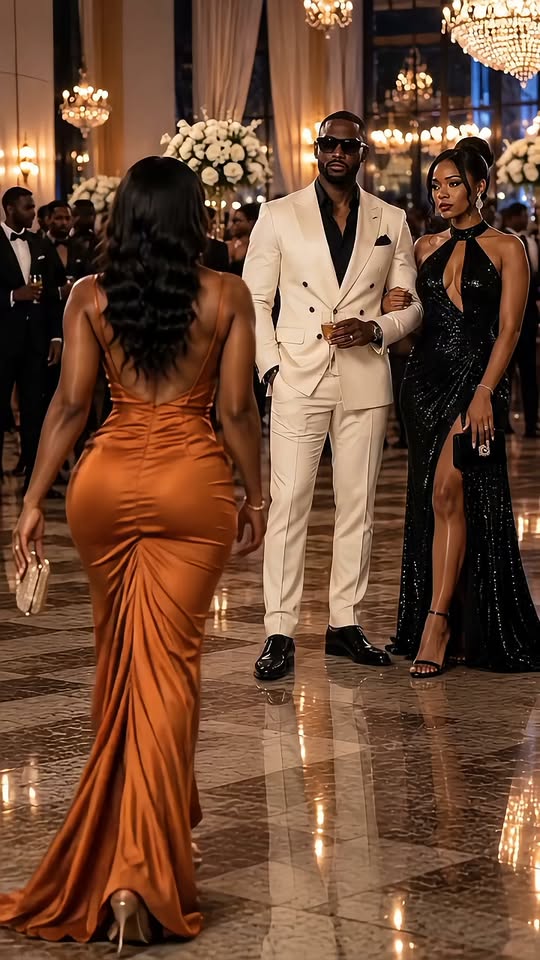
Her knee was bruised black against the marble. Her chest hitched in ragged, humiliating spasms as the cold wine dripped from the hem of her satin skirt onto her bare feet. The diamond teardrop on her right ear hung heavy, while the wound on her left ear bled silently into the collar of her dress.
Around her, the circle of wealthy strangers closed back up. The murmurs began—hushed, dismissive, amused.
Did you see that?
Always so emotional.
Who let her in without an invitation card?
Brianna pressed her bleeding ear into her shoulder. She closed her eyes against the blinding golden bokeh of the chandeliers. The humiliation was an open wound, burning deeper than the slap, deeper than the wrench of Derrick’s hand. She had poured four years of her youth, her intellect, and her soul into a man who had discarded her like wrapping paper the moment the gift was opened, and her best friend had stood over her body to claim the ribbon.
They spend all their time showing off their relationship like it’s a trophy, an inner voice whispered through the ringing in her ears, cold and merciless. Now your best friend has stolen your boyfriend. Go ahead… cry, and make the same mistake next time.
The realization didn’t come as a sob. It came as a sudden, terrifying arrest of her breath.
Brianna opened her eyes.
The tears did not stop, but they ceased to carry grief. Beneath the salt and the stinging alcohol, her gaze locked onto the reflection of Derrick’s cream-white suit gliding toward the dance floor.
She reached down into the puddle of shattered glass. Her fingers brushed past the ruined velvet clutch, bypassing the makeup compact, bypassing the house keys that no longer opened a home. Her fingertips found the small, rectangular leather card-case hidden in the inner slip.
Inside was the secondary corporate ledger token for Vance Logistics.
The hardware key. The encrypted physical signature that authorized the federal banking clearance for the six o’clock automated clearinghouse run. Derrick didn’t understand the software architecture because he had never looked at the back-end code. He thought signatory power was a piece of paper signed at an attorney’s desk. He had forgotten that the software’s master node was registered to her private biometric hash.
Brianna stood up.
Her heels were wet, but her spine snapped straight with the precision of a drawn bow. She didn’t wipe her face. She didn’t adjust her torn hem. She lifted her chin, let the burnt orange silk drape against her bruised ribs, and walked away from the colonnade, leaving a single line of bloody footprints across the pristine marble of the St. Jude Atrium.
The gala was over. The execution had just begun.
The rain over Midtown had stopped an hour before midnight, leaving the black asphalt of Lexington Avenue polished like wet slate under the sulfur glow of the streetlamps. Inside the ground-floor lounge of the St. Regis, the city was reduced to an abstract shimmer beyond two-story panes of acoustic glass. Here, the air did not smell of ozone, diesel exhaust, or wet concrete; it smelled of dried vanilla pods, polished brass, and the dry, climate-controlled chill of extreme wealth.
Maya Laurent stood three yards from the eastern mezzanine balustrade, motionless. Her reflection stared back at her from the bevel of an eight-foot mirrored column: twenty-nine years old, skin the shade of roasted chicory, jawline drawn tight as a drawn bowstring. She wore a sleeveless bodycon dress the color of fresh arterial blood—a vibrant crimson knit that clung to the contour of her spine like a second skin. Chunky gold hoops, heavy and unadorned, brushed the curve of her collarbones every time she tilted her head. Her hair, an untamed cascade of ink-black waves, spilled down her back, coarse and glossy, catching the overhead halogen like spun wire.
Between her thumb and forefinger, she balanced the stem of a crystal balloon glass. Inside swirled three ounces of a 2018 Napa Cabernet—deep, opaque, staining the rim purple.
Beneath her left armpit, wedged securely between her ribs and the fabric of her coat drape, sat a stiff, cream-colored manila folio. It was ninety-two pages long. It bore the embossed blue stamp of the New York County Supreme Court, alongside three certified forensic audits signed off at four o’clock that afternoon by two forensic accountants who smelled faintly of mint lozenges and panic.
Her phone vibrated once against her palm. A silent text from Carter, her lead investigator, stationed outside in an unmarked Audi:
Car just pulled into the portico. Black town car. He’s with her.
Maya did not reply. She slid the screen dark, dropped the device into the small, beaded clutch resting on the cocktail table beside her, and took one slow, deliberate breath. The air entered her lungs cool and left them hot.
For seven years, she had built the architecture of Marcus Vance’s life. When they met at Columbia Law, he had ambition that bled through his cheap off-the-rack suits like sweat through starch, but he had no discipline. She was the one who drafted the corporate charter for Vance Capital Management; she was the one whose signature guaranteed their first half-million-dollar mezzanine loan using the brownstone her grandmother had left her in Crown Heights as collateral. She had spent five years editing his pitch decks, managing his board politics, hosting dinners where old white hedge-fund trustees were charmed into forgetting that Marcus was barely thirty.
And then, four months ago, the anomalies began.
It had started small. A delayed wire from a subsidiary LLC in Delaware. A canceled weekend in the Hamptons masked by a breathless, hurried phone call about a margin call in Chicago. Then came the whispers from the junior analysts—girls with nervous eyes who lowered their voices when Maya walked into the firm’s Hudson Yards offices. Finally, there was the paper trail: corporate cards billed to boutique hotels in Milan, a private lease signed under a shell company for a penthouse overlooking the High Line, and a recurring name on the payroll under “Strategic Advisory”: Elena Ramos.
Twenty-six years old. Former associate at a boutique PR firm. Slender, doe-eyed, with soft, curtained dark hair and an aesthetic built entirely around vulnerability and helpless admiration.
Two hours ago, Marcus had called Maya from what was supposed to be the tarmac at O’Hare.
“Baby, you won’t believe this,” his voice had come through the receiver, muffled by the fake rustle of airport bustle, expertly pitched between frustration and exhaustion. “Terminal three is on total ground stop. System outage. My luggage is locked in the undercarriage, and the airline won’t release the bags until tomorrow morning. I’m going to have to crash at an airport hotel here and catch the first commuter hop at six. I’m so sorry. I know it’s our anniversary dinner.”
“Is the luggage delayed, Marcus?” she had asked quietly, sitting in the silence of their empty penthouse, watching the city rain trickle down the glass.
“Completely fucked, honey. Total disaster. Go to sleep without me. I love you.”
Maya had hung up, walked into the walk-in closet, peeled off her silk loungewear, and pulled the crimson dress over her head. She had slipped her feet into four-inch black patent Christian Louboutin stilettos with heels like surgical needles. Then she had picked up the file.
Now, through the heavy revolving doors of the hotel lobby, the glass spun.
A brass bellman tipped his hat and stepped aside. Into the grand foyer stepped Marcus Vance.
He looked immaculate, the quintessential portrait of Black excellence that financial magazines loved to plaster across their quarter-page profiles. Six-foot-two, broad-shouldered, carrying himself with that relaxed, feline confidence born of having seven figures in a liquid sweep account. His suit was dark navy wool, bespoke, tailored with high armholes and a suppression at the waist that accentuated his physique. Underneath, his crisp white spread-collar shirt was unbuttoned at the throat, the silk knit tie slightly loosened.
He was laughing, his head tilted back, teeth flashing bright under the crystal chandelier.
Draped across his left arm, laughing with him, was Elena.
She wore a cream-white crepe sheath dress that stopped just below the knee, bare-shouldered, delicate, her pale skin glowing softly under the foyer’s ambient spotlighting. Her manicured hand rested possessively against the navy fabric of his forearm. Her small leather weekender bag hung from his other hand, nestled right beside his own Louis Vuitton carry-on.
The luggage had not been delayed at O’Hare. The luggage was right here, tagged for the penthouse suite of the St. Regis.





