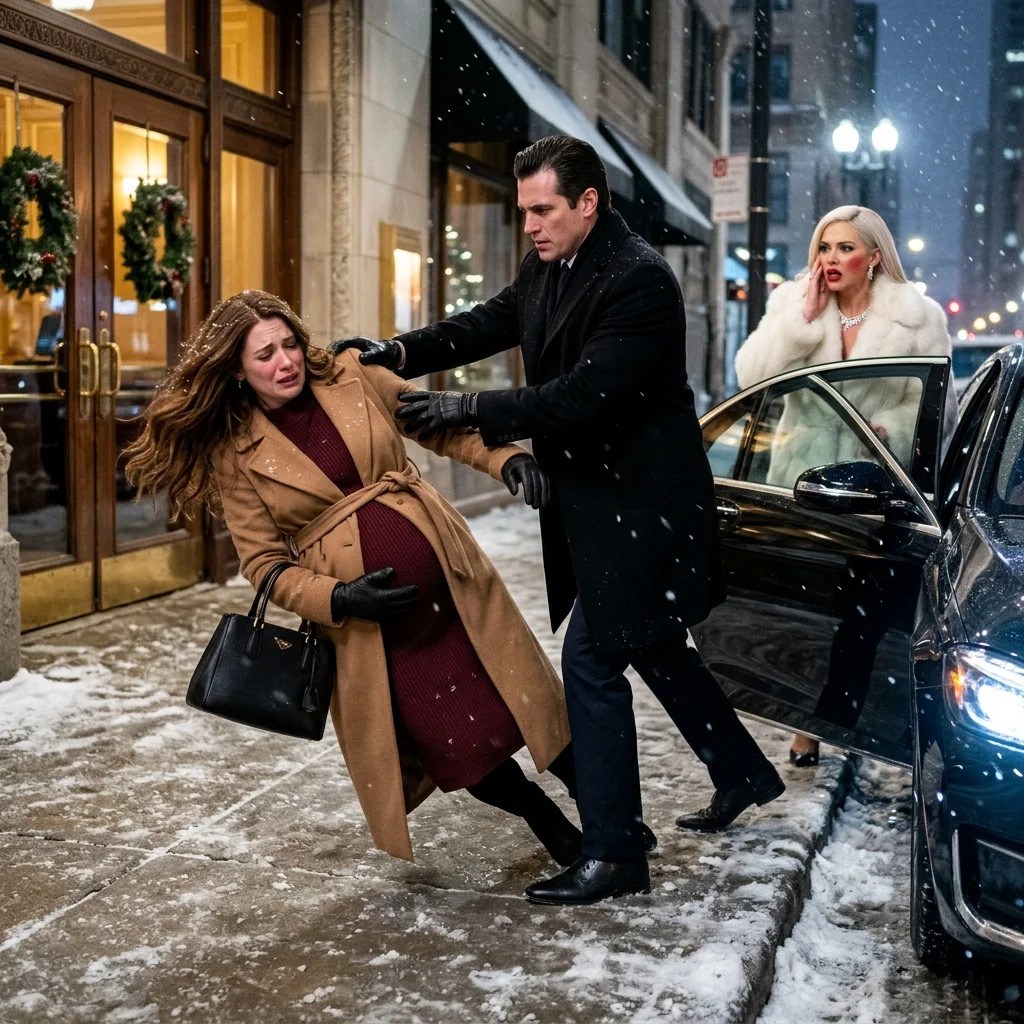
I turned around toward the heavy brass-and-glass outer door of the restaurant.
To reach the brass handle, I had to step across the three-foot apron of sloped granite where the restaurant’s roofline downspout emptied onto the sidewalk—a spot where the heat escaping from the vestibule had melted the afternoon snow into a thin, invisible glaze of black ice just beneath a fresh half-inch dusting of powder.
My right calfskin boot hit the glaze as I shifted my weight forward.
Because my center of gravity was pulled so far forward by the thirty-two-week pregnancy, I had zero recovery margin. Both feet shot out from under me simultaneously with terrifying, sickening speed.
I didn’t pitch backward onto my spine; in a desperate, primal spasm of maternal instinct as the sky tilted sideways, I twisted my torso in mid-air to keep from landing flat on my stomach—driving my left hip, my shoulder, and the side of my ribcage down onto the sharp granite edge of the top step with two hundred pounds of dead-drop force.
The impact knocked every cubic inch of air out of my lungs in a silent, black explosion.
For three seconds, there was no pain—only the cold wet snow against my cheek and the metallic taste of blood where my teeth had bitten clean through the inside of my lower lip.
Then, deep inside my lower abdomen, something tore.
It was not a Braxton Hicks tightening, and it was not the dull ache of a pulled ligament. It was a white-hot, jagged band of iron clamping across my uterus from hip to hip, followed instantly by a warm, terrifying gush of fluid soaking rapidly through my wool dress and the lining of my camel-hair coat against the freezing stone.
“Help,” I tried to shout toward the frosted glass door two feet above my head, but without air in my diaphragm, the word came out as a thin, ragged wheeze that the howling wind swallowed whole.
I braced my right palm against the icy granite and tried to push myself up onto my knees. A second contraction—ten times sharper than the first, like a serrated knife twisting behind my pubic bone—slammed me back down onto my side in the slush. Through the roaring black tunnel closing in around the edges of my vision, I looked down and saw a dark, unmistakable ribbon of crimson blood spreading out from beneath the hem of my camel coat, steaming faintly as it melted into the white snow on the step.
No, I prayed, my bare left hand clawing at the frozen stone while my right hand locked over my rock-hard belly. Please, God, no. He’s seven weeks early. Please.
Above me, the brass door of the vestibule finally swung open as a busboy came out with a bucket of rock salt.
The boy took one look at me curled on the step in a widening pool of dark red snow, dropped his plastic bucket with a clatter that echoed down the empty street, and screamed back into the restaurant:
“CHEF! CALL 911! THERE’S A PREGNANT WOMAN BLEEDING ON THE STEPS!”
The inside of Chicago Fire Department Ambulance 42 smelled of wet wool, diesel exhaust, and cold antiseptic vinyl.
Every time the dual rear tires hit a rut of frozen slush on Fairbanks Court, the gurney springs bucked beneath my spine, sending another blinding wave of agony radiating from the small of my back straight through the front of my pelvis. Above my head, the telemetry monitor was beeping at a frantic, high-pitched one hundred and forty beats per minute—my pulse, while a second transducer strapped tightly across the dome of my exposed stomach emitted a rapid, galloping thump-thump-thump that dipped dangerously low every time my uterus clamped down.
“Stay with me, Claire, look right at my eyes,” the paramedic—a woman in her forties with snow melting in her cropped gray hair—barked over the wail of the siren, jamming an eighteen-gauge IV catheter into the vein of my left forearm while wedging a rolled blanket under my right hip to tilt the weight off my vena cava. “We’re ninety seconds from Northwestern Memorial’s L&D trauma bay. You’re having a suspected placental abruption from the fall. How many weeks did you say?”
“Thirty-two,” I gasped around the clear plastic oxygen mask strapped over my bleeding mouth, my fingers locked so hard onto the aluminum side rail of the stretcher that my nails tore. “Thirty-two and three days. Is his heart—is the baby’s heart—”
“Fetal heart rate is one-ten, dipping to ninety on the contractions—that’s why we’re running hot, honey,” she said, not lying to me, her gloved hand working the roller clamp on the Ringer’s lactate bag wide open. “What’s your husband’s name and cell number? The charge nurse at Prentice Women’s is on the radio patch right now; they need next-of-kin consent on standby if they have to put you under general anesthesia for a crash C-section.”
Through the pain tearing my body in half, I saw the matte-black Maybach pulling away from the curb on Rush Street. I heard Alexander’s flat, icy voice: Maybe we should get divorced.
If I died on an operating table tonight—or if his son was born weighing three pounds in an neonatal intensive care unit—he deserved to hear the phone ring while he was pouring champagne for Olivia over the Atlantic Ocean.
“Alexander Moretti,” I choked out between contractions, rattling off the ten digits of his private encrypted cell phone—the number he kept on a separate SIM card that only his capos, his lawyers, and I possessed, the phone that never went onto Do Not Disturb. “Call him. He’s on his way to O’Hare Private Aviation.”
Ninety seconds later, the rear doors of the ambulance banged open into the heated concrete bay of Prentice Women’s Hospital, and six people in blue surgical scrubs seized the edges of my gurney, running me at a dead sprint down a blindingly lit corridor toward Labor and Delivery Operating Room 4.





