“It’s not even hers,” Mia breathed, a tear slipping under the rim of her glasses and tracking down her cheek. “Not a single paragraph. When I printed the metadata log to show Mr. Henderson, Chloe saw me at the copier. Ever since then…” Mia swallowed hard. “She took my lab notebook yesterday and threw it in the storm drain. She told half the senior class I failed the PSATs. And now she’s going after my dad. If Richard Sterling pulls the district contract from the print shop, we lose the lease on the building before Christmas. My dad has two heart stents, Harper. He can’t start over.”
Harper stared down at the cardstock in her hand. Richard Sterling sat at the head of the school board, chaired the alumni endowment, and played golf every Sunday with half the Mercer Fellowship committee. His daughter, Chloe, moved through Alderbrook like a monarch inspecting a tax farm—untouchable, gilded, and utterly convinced that the rules were written in pencil for people like her and in iron for everyone else.
“Do you still have the original metadata file?” Harper asked, her voice dropping to a low, steady register.
Mia blinked. “On a flash drive. In my backpack. I was going to delete it at lunch so she’d leave us alone.”
“Don’t delete it.” Harper folded the threatening photograph once, crisp and clean, and tucked it into the pocket of her jeans. “Give me the drive.”
“Harper, no—if she finds out you’re involved, she’ll tell her dad to bury your application—”
“Chloe’s already trying to bury my application,” Harper interrupted, her gaze fierce and unwavering. “There’s only one Mercer slot for Alderbrook this year, Mia. If she buys it with a ghostwritten essay, neither of us gets out of this town. Give me the drive.”
Mia hesitated for three agonizing seconds, her fingers trembling against the zipper of her canvas backpack. Then she pulled out a tiny silver USB stick and pressed it into Harper’s palm.
“What are you going to do?” Mia asked.
“I’m going to make a delivery,” Harper said, rising smoothly to her feet. “You go to the cafeteria. Get in the lunch line like you always do. Don’t hide in the bathroom, don’t skip eating. And Mia?”
Mia looked up, her face pale against the dark green wool of her sweater. “Yeah?”
“Put your phone in the front pocket of your sweater before you walk through the double doors. Open the voice memo app. Hit record. And don’t turn it off until lunch is over.”
“Why?”
“Because people like Chloe Sterling are only brave when they think no one is listening,” Harper said. “I’ll be five minutes behind you.”
The administration wing was empty save for the receptionist, who was busy sorting attendance slips behind a frosted glass partition. Harper moved with practiced silence, her black sneakers making no sound on the waxed linoleum. She didn’t go to Caldwell’s office. She went straight to the third door on the left—Conference Room B, where a freshly printed placard on the doorframe read MERCER FOUNDATION INTERVIEWS — DR. E. MORALES.
The door was locked, as expected. Dr. Morales wouldn’t arrive for another forty minutes.
Harper pulled a blank manila envelope from the supply tray outside the guidance office, slipped the silver flash drive and the folded photograph of Miller & Sons Print Shop inside, and wrote three words across the front in neat block letters with a black Sharpie: URGENT — MERCER INTEGRITY. She didn’t sign her name. She knelt, slid the envelope cleanly beneath the gap of Conference Room B’s door until it disappeared completely onto the carpet inside, and stood back up.
Her pulse was steady. Controlled. That was the whole plan. No shouting, no scenes, no disciplinary strikes. Let an outside auditor from Chicago pull the thread and watch the Sterling empire unravel on its own.
All Harper had to do was walk into the cafeteria, sit beside Mia, eat a dry turkey sandwich, and survive the next forty minutes.
She pushed through the swinging double doors of the cafeteria and stepped straight into a wall of bright, blinding November light.
The Alderbrook cafeteria was a cavernous hall flanked by floor-to-ceiling windows that looked out over the frost-bitten athletic fields. At noon, the acoustics turned three hundred teenagers into a low, roaring surf—the clatter of molded plastic trays, the hiss of the espresso machine at the senior bar, the overlapping laughter of a dozen rigidly segregated tables.
Harper scanned the room instantly.
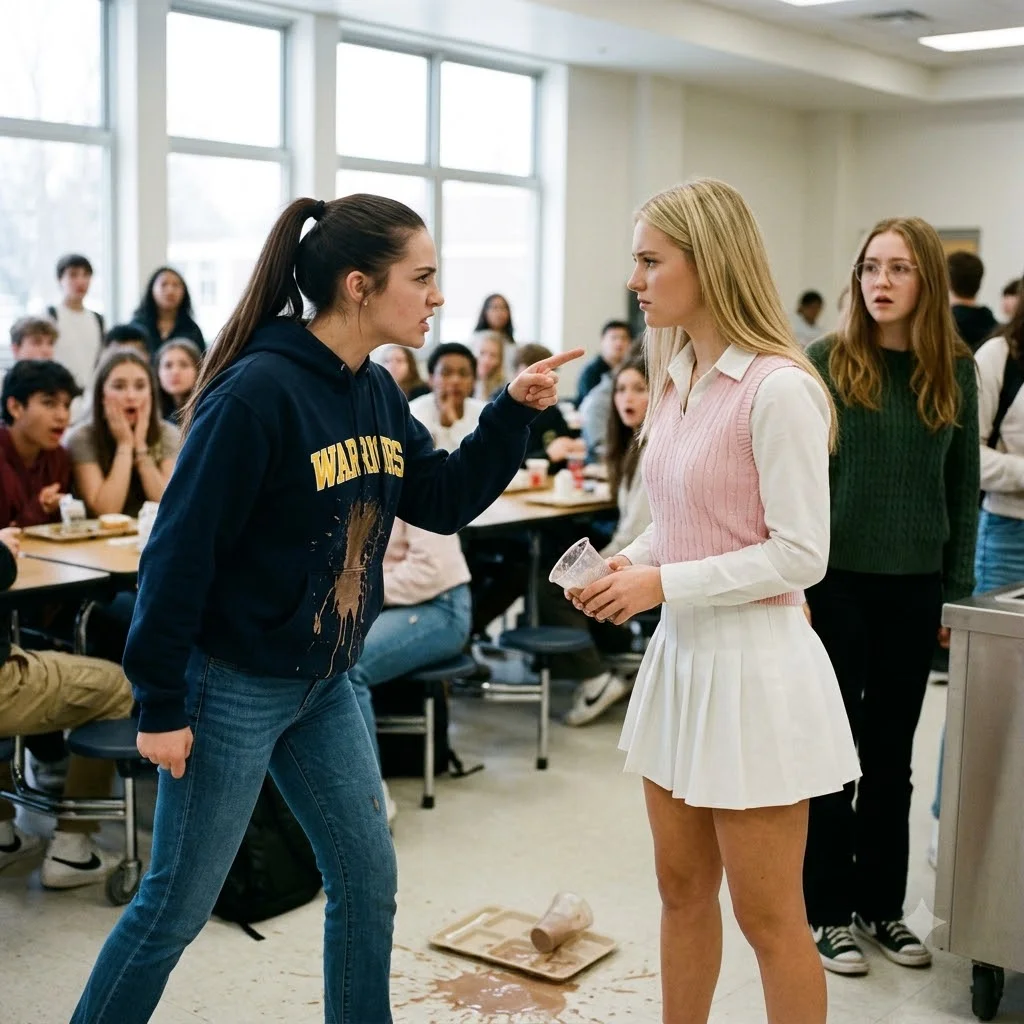
Near the stainless-steel railing of the lunch line, Mia was standing alone, clutching a gray plastic tray against her chest. She looked small in her dark green knitted sweater, her shoulders hunched as she waited for the cashier to ring up an apple and a carton of milk.
And twenty feet away, cutting diagonally across the center aisle like a shark moving through shallow water, was Chloe Sterling.
Chloe was impossible to miss. She had perfected the art of looking like she had just stepped off a private country club court even in the middle of a public high school. Her long, straight blonde hair gleamed under the fluorescent lights, parted with geometric precision. She wore a pastel pink V-neck knitted sweater vest layered over a crisp white collared shirt, paired with a white pleated tennis skirt, pristine white crew socks, and spotless white sneakers. In her right hand, she carried a tall, heavy waxed cup from the snack bar—brimming with thick, dark-brown chocolate milkshake, the lid popped loosely on top.
Two of her usual shadows, Madison and Bree, trailed half a step behind her, already smirking before a single word had been spoken.
Harper’s stomach tightened. She started moving, weaving quickly between the long rectangular lunch tables, keeping her eyes locked on the space between Chloe and Mia.
She didn’t quite make it in time to stop the opening volley.





