She was in her forties, with tired eyes and the efficient movements of someone who had learned that reacting visibly to Sheriff Cleary only encouraged him.
“What happened?”
“Caught ourselves a fake hero,” Cleary said.
Isaiah stared at him.
Mooney looked uncomfortable.
Rachel glanced at Isaiah.
Then at Cleary.
“Charges?”
“Reckless driving.”
“Fraudulent identification.”
“Resisting.”
“Obstruction.”
Rachel’s eyebrows lifted.
“That all?”
Cleary did not hear the sarcasm.
“For now.”
Isaiah emptied his pockets.
Wallet.
Keys.
Phone.
A folded receipt.
Twenty-three dollars cash.
A small silver challenge coin his sister had given him years earlier.
Rachel placed everything into a plastic property tray.
“Fingerprint scanner.”
Isaiah complied.
“Photo.”
He stood against the wall.
The camera flashed.
Cleary watched from behind the desk.
Isaiah felt something unpleasantly surreal about the entire process.
Two days earlier, his photograph had been taken for retirement paperwork.
Now another camera recorded him as an inmate.
Same face.
Different institution.
Rachel asked for emergency contact.
“Danielle Brooks.”
“Relationship?”
“Sister.”
“Phone number?”
Isaiah gave it.
Cleary interrupted.
“Don’t call anybody yet.”
Rachel looked at him.
“He gets a call.”
“When I say.”
“He’s being booked.”
“I know how booking works.”
Rachel stopped.
The room became quiet.
Cleary walked toward Isaiah.
“You still want to tell me who you really are?”
Isaiah’s expression did not change.
“I already did.”
“Wrong answer.”
Isaiah looked toward the wall phone.
“I want my call.”
Cleary crossed his arms.
“To your sister?”
“No.”
“Lawyer?”
“No.”
“Who?”
Isaiah stared.
“That isn’t your concern.”
The sheriff smiled.
“I decide what’s my concern inside this building.”
Rachel looked down at her keyboard.
Mooney moved toward the hallway.
Isaiah saw something in both of them.
Embarrassment.
Fear.
Habit.
Cleary pointed toward the wall phone.
“One call.”
Isaiah walked over.
The telephone was old enough to have a coiled cord.
He picked up the receiver.
Dialed nine.
Then a 703 area code.
Cleary’s amusement faded slightly.
Isaiah entered several more digits.
The call connected.
A recorded voice answered.
“Defense switchboard.”
Isaiah spoke calmly.
“Duty desk.”
“Please identify.”
“Brooks, Isaiah J.”
“Authentication?”
Isaiah gave a short phrase.
Not classified.
Not dramatic.
Simply one of several verification sequences issued during his transition because certain records had not yet fully migrated.
The line clicked.
Another voice answered.
“Duty desk.”
Isaiah continued.
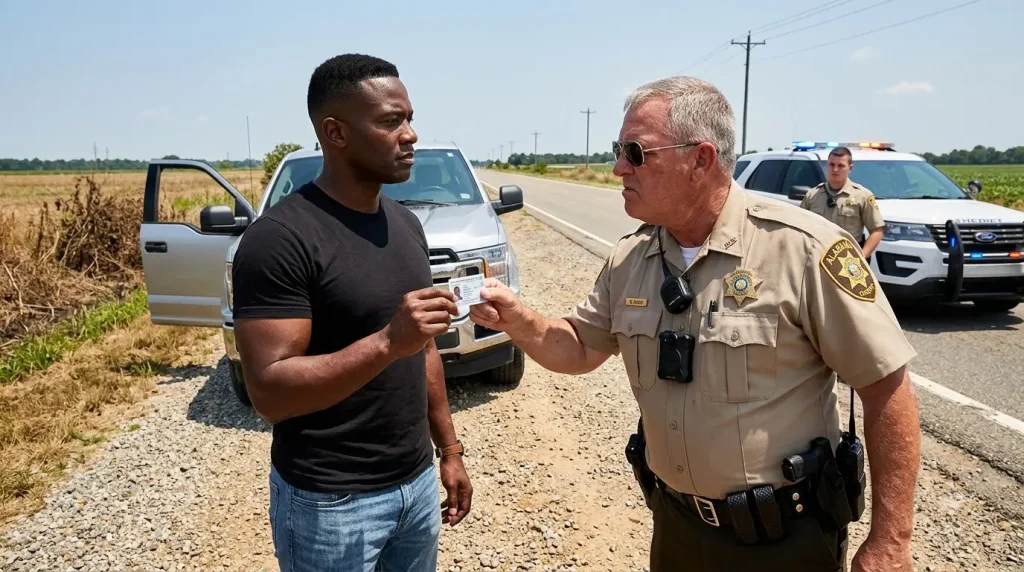
“This is Sergeant First Class Isaiah Brooks, retired effective two days ago. I’m being held at Coopersville County Sheriff’s Office in Alabama. My retirement identification credential has been intentionally destroyed by the arresting sheriff.”
Cleary’s smile disappeared.
Rachel looked up.
Mooney stopped in the hallway.
The voice on the phone became sharper.
“Repeat location.”
“Coopersville County Sheriff’s Office.”
“County?”
Isaiah answered.
“Are you injured?”
“No serious injury.”
“Are you restrained?”
“Not currently.”
“Was the credential confiscated?”
“Destroyed roadside.”
“Name of law enforcement officer?”
“Sheriff Arthur Cleary.”
The sheriff suddenly moved.
“Give me that.”
Isaiah turned slightly away.
Cleary grabbed the receiver.
“This is Sheriff Cleary. Who the hell is this?”
A pause.
Cleary’s expression changed.
He listened.
Then frowned.
“I don’t care what office you’re calling from.”
Isaiah watched him.
Rachel’s fingers had stopped over the keyboard.
Cleary continued.
“This man presented suspicious documents during a lawful traffic stop.”
Another pause.
“No.”
“He’s not being released because some voice on a telephone tells me—”
The person on the other end said something.
Cleary’s face reddened.
“Then send whoever you want.”
He slammed the receiver down.
The entire room became silent.
Isaiah looked at him.
“That was unnecessary.”
Cleary pointed.
“You don’t speak unless I ask.”
Isaiah nodded slowly.
“Okay.”
The sheriff walked away.
Rachel looked toward Isaiah.
“What number did you call?”
Isaiah said nothing.
Cleary turned.
“He called some government office pretending he’s important.”
Mooney spoke from the hallway.
“Sheriff, maybe we should verify this.”
Cleary laughed.
“There’s nothing to verify.”
Isaiah looked at Rachel.
Then Mooney.
Then the clock.
3:58 p.m.
He wondered how long it would take.
He did not know.
But he knew the call had connected.
And that was enough.
Cleary put Isaiah in a holding cell.
The cell contained a metal bench, a stainless-steel toilet, and a scratched plexiglass window.
Isaiah sat.
He had spent nights in worse places.
Far worse.
But those places made sense.
This did not.
He closed his eyes.
Danielle would be wondering where he was.
He had promised to arrive by five.
She would give him until five-thirty.
Then six.
Then she would call.
His phone sat in an evidence tray twenty feet away.
Isaiah had spent years reassuring family members that delays were normal.
This was the first delay of civilian life.
He almost laughed at the irony.
Instead, he thought about Sheriff Cleary.
There was a temptation to imagine men like Cleary as fearless.
They rarely were.
People obsessed with control were often terrified of losing it.
That fear created the aggression.
Every question became disrespect.
Every correction became humiliation.
Every challenge became rebellion.
Isaiah had met versions of that personality in almost every institution he had ever entered.
The difference was that most institutions eventually placed limits around such people.
Cleary had spent too long without one.
At 4:17, Deputy Mooney appeared outside the cell.
He stood awkwardly.
Isaiah looked at him.
“You need something?”
Mooney hesitated.
“Was that ID real?”
“Yes.”
“You really retired two days ago?”
“Yes.”
Mooney looked toward the hall.
“Sheriff says the card format didn’t look right.”
“It changed last year.”
Mooney nodded slowly.
“I thought so.”
Isaiah stared.
“You’ve seen one?”
“My cousin retired from the Air Force.”
Isaiah’s expression changed.
Mooney looked ashamed.
“I should’ve said something.”
“Yes.”
The deputy winced.
Isaiah softened slightly.
“But you can still say something.”
Mooney rubbed the back of his neck.
“You don’t know Cleary.”
“No.”
“He’s been sheriff eighteen years.”
“That doesn’t make him right.”
“I know.”
“Do you?”
Mooney looked through the plexiglass.
Isaiah leaned forward.
“You were there when he broke the card.”
“I got there afterward.”
“You saw the pieces.”
“Yes.”
“You saw the paperwork.”
“Yes.”





