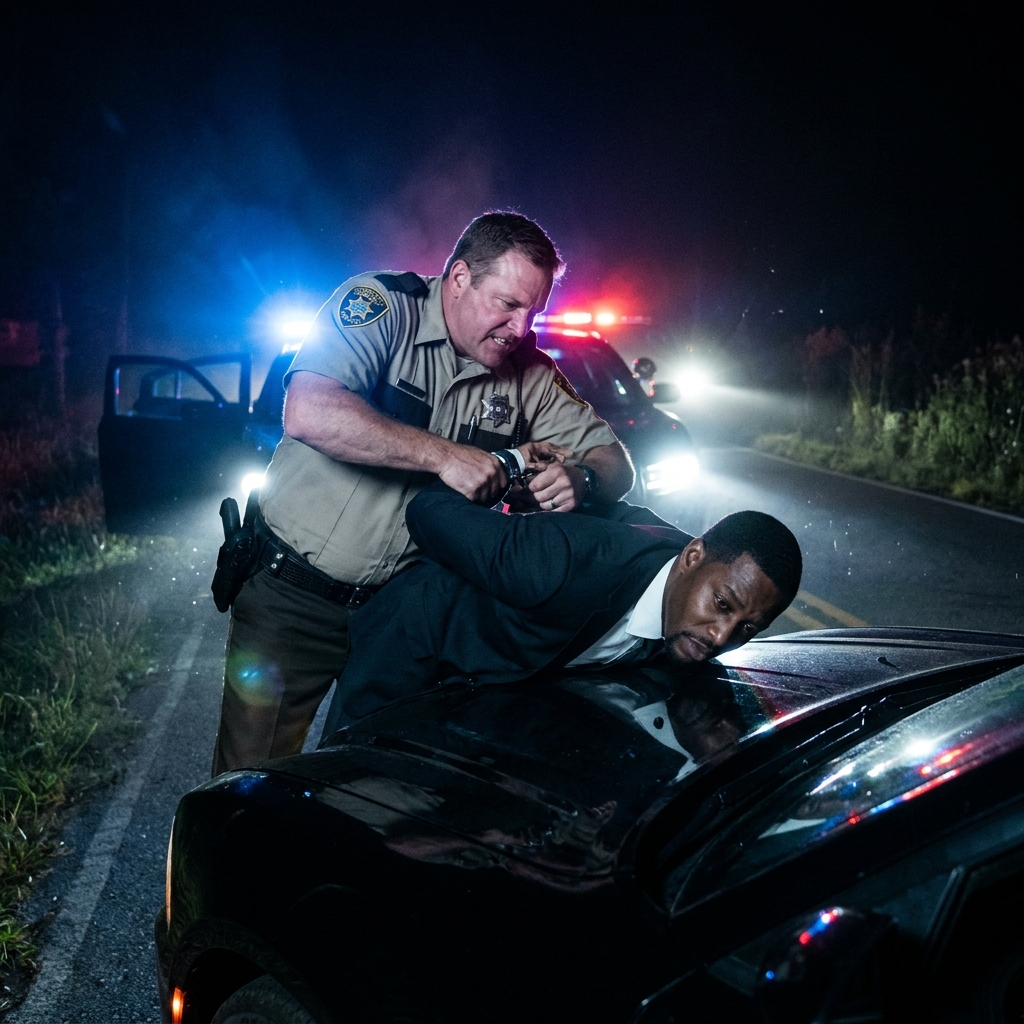
“Your deputy is currently in federal custody,” I said, closing the distance until I was standing right in front of the Captain. “I am the Lead Advance Agent for the United States Secret Service. Your deputy intercepted a restricted federal vehicle, ignored my credentials, physically assaulted me, and established an armed roadblock in the direct path of the Presidential motorcade.”
The Captain’s face went pale. He looked at my suit, my wrists, and then at the shattered window of the cruiser. The severity of the situation hit him like a physical blow. But the shock only lasted a few seconds before institutional self-preservation kicked in. The instinct to protect the department immediately overrode the undeniable facts in front of him.
“If you were speeding in an unmarked car and refused to comply, my deputy had every right to secure the scene,” the Captain countered, his voice dropping to a dangerous, defensive gravel. “I want Mitchell released to my custody right now. We will handle his disciplinary review internally. You can file a formal complaint with my office.”
“There will be no internal review,” I said flatly. “This is a federal civil rights and national security investigation.”
The Captain’s eyes darted past me, locking onto the open trunk of the cruiser where the CAT specialist was working diligently with a flashlight and a heavy pry bar.
“Hey! Get out of that vehicle!” the Captain shouted, taking a sudden, aggressive step forward.
Vance’s hand rested casually on his rifle sling, a silent, terrifying warning that stopped the local supervisor dead in his tracks.
The Captain glared at Vance, then pulled a heavy radio microphone from his belt. “Dispatch, this is Captain Harris. Send a remote zeroize command to unit four-two’s MDT. Authorized by my badge. Wipe the cache. Do it right now.”
He was trying to burn the evidence. He didn’t even know exactly what Mitchell had said on that recording, but he knew enough about his own deputy to realize that whatever was on that hard drive would destroy the department in a federal civil rights court. He was willing to destroy evidence of a federal crime right in front of a Secret Service detail just to protect the local blue wall.
I didn’t move to stop him. I just watched his face.
A long beat of static crackled over his radio. Then the dispatcher’s nervous voice replied. “Captain… I’m pinging unit four-two, but it’s totally offline. The vehicle’s cellular receiver is completely disabled. I can’t reach the drive.”
The CAT specialist stepped out from behind the cruiser, holding a heavy steel rectangular box wrapped in a web of severed black cables. He walked past the Captain and handed it directly to me. The metal was freezing cold against my swollen fingers. It was the entire DVR assembly.
“You have no legal authority to take that,” Captain Harris snarled, his face flushing crimson with a mix of fury and panic. “That is county property. You’re stealing evidence.”
“I’m preserving it,” I replied softly. I held the heavy box against my chest. “Your deputy explicitly confessed on this recording to fabricating a felony charge against me. He admitted to using unnecessary physical force. And ten seconds ago, you attempted to order a remote destruction of this exact data system to cover it up.”
Captain Harris stared at the silver box in my hands. The defensive anger in his eyes finally fractured, replaced by a cold, sinking realization of exactly the trap he had just walked into.
“You just made yourself an accessory after the fact, Captain,” I said, the absolute certainty in my voice locking him in place. “I wasn’t going to look at the rest of this department. But since you were so eager to delete the official record without even asking what happened, I have to wonder how many other hard drives in Augusta County have been remotely wiped during midnight traffic stops.”
“You’re out of your jurisdiction,” Harris muttered, but the fight had completely left his voice. He looked like a man who had just watched his career evaporate.
“I am the jurisdiction,” I corrected. “Vance, put Mitchell in the back of the Suburban. We’re transporting him to the federal holding facility in D.C. ourselves.”
“Understood,” Vance said, motioning for his operators to move the prisoner.
I looked down at the physical drive in my hands. The data was secure, corroborated by the shattered window and the CAT operators who had witnessed Mitchell’s armed standoff. But securing the proof on this dark highway was only the first half of the battle. Now, I had to walk into the exposure arena.
I was going to take this evidence straight to the Director’s desk at dawn. I was going to bypass the bureaucratic instinct to sweep embarrassing jurisdictional clashes under the rug to maintain local harmony. I was going to force Washington to end Officer Mitchell’s career permanently, and I was going to ensure Captain Harris was standing right next to him when the indictment came down.
CHAPTER 3: The Playback They Could Not Erase
The subterranean garage of the United States Secret Service Headquarters in Washington D.C. was a fortress of reinforced concrete and harsh fluorescent lighting. At 5:15 AM, the heavy steel security gates rolled down with a deafening, metallic crash, sealing our armored convoy inside the secure perimeter. We had made the drive from the Virginia highway in under two hours.
In the back of the lead Suburban, Officer Mitchell sat in absolute silence. The zip-ties cutting into his wrists were a stark contrast to the steel ratchets he had used on me. He stared blankly at the Kevlar-clad knees of the Counter Assault Team operators flanking him, his arrogant sneer completely extinguished by the suffocating reality of federal detention. He was no longer a king on a dark rural highway. He was a prisoner in the belly of the most secure law enforcement facility on the Eastern Seaboard.





