The little moon was polished now, a small seam still visible down the middle.
“I couldn’t make it perfect,” he said.
I held it in my palm.
“It doesn’t have to be.”
He nodded.
“No. It just has to still be yours.”
That was when I cried.
Not in the hallway.
Not in the police interview.
Not in front of Caleb.
In the passenger seat of my uncle’s truck, holding the only thing of my mother’s I carried every day.
A month later, the college changed its reporting policy.
Anonymous third-party reporting.
Mandatory outside review for athlete complaints.
Automatic preservation of campus camera footage when a student files a safety complaint.
No more “informal handling” when someone says they are afraid.
Professor Ellis, the woman who helped me file the first report, invited me to speak at a small student safety forum.
I almost said no.
Then I thought of the girl in the hallway who whispered, “Someone should stop this,” but did not move.
I thought of all the people who freeze because they think someone stronger will handle it.
So I went.
My hands shook when I stepped up to the microphone.
I looked at the students, the staff, the parents, the security officers.
Then I said:
“Courage is not always tackling the bully. Sometimes courage is pressing record. Sometimes it is making the call. Sometimes it is refusing to laugh. Sometimes it is saying, ‘I saw what happened,’ even when the person who did it is popular.”
The room was silent.
But this time, it was not the silence of fear.
It was the silence of people listening.
Afterward, a freshman girl came up to me.
She was small, nervous, clutching her backpack straps.
She said, “I reported someone last semester and they made me feel crazy.”
I knew that look.
The embarrassed smile.
The eyes begging not to be a burden.
I gave her the name of Professor Ellis.
Then I gave her my email.
Then I said the words I wished someone had said to me earlier:
“You are not crazy. Write everything down.”
Uncle Ray waited outside the auditorium.
He pretended he had something in his eye when I told him what happened.
“Dust,” he said.
“There’s no dust out here.”
“Could be wind.”
“There’s no wind.”
He opened the truck door.
“Get in before you become a detective.”
That was Ray.
Hard edges.
Soft center.
The old teaching building was renovated the next semester.
Fresh paint.
New lights.
Security cameras.
The hallway looked different, but I still knew exactly where it happened.
One day, I walked through it alone.
No shaking.
No panic.
Just me.
I stopped where my books had fallen.
I touched the silver moon on my keychain.
Then I kept walking.
That was the real ending.
Not Caleb losing his scholarship.
Not his father losing influence.
Not the viral video.
The real ending was that he did not get to turn me into someone who lived afraid forever.
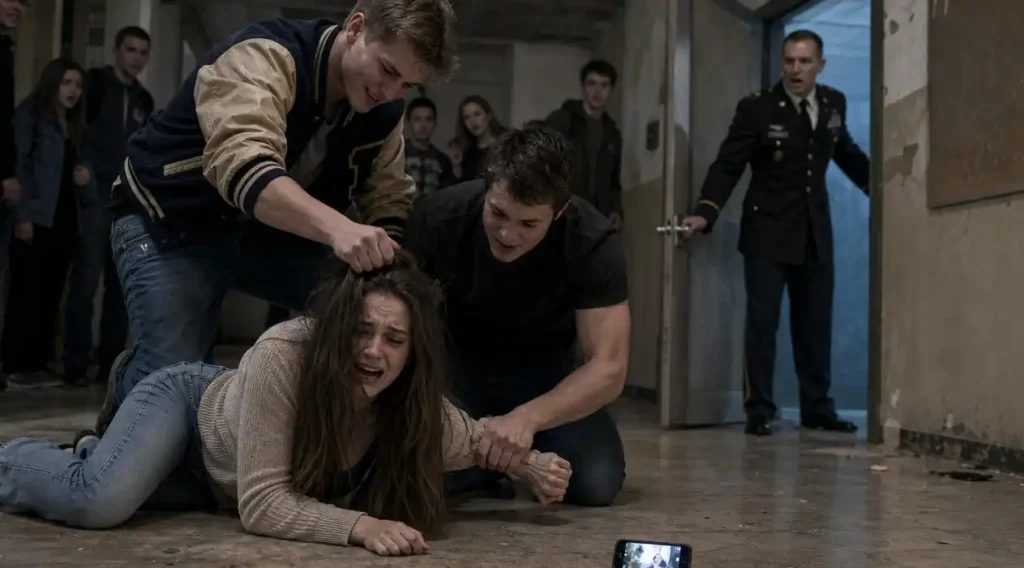
He tried to drag me by my hair in front of everyone.
He thought public shame would break me.
Instead, it exposed him.
And it exposed every person who thought status was the same thing as character.
So here is the side I choose:
Uncle Ray was right to make the truth happen in public, because Caleb made the cruelty public first.
If you think powerful people should face public consequences when they publicly humiliate someone, share this.
And if you think Uncle Ray went too far by stepping in before campus security arrived, say it plainly.
Pick a side: Uncle Ray protected Zoe — or Uncle Ray crossed the line.





