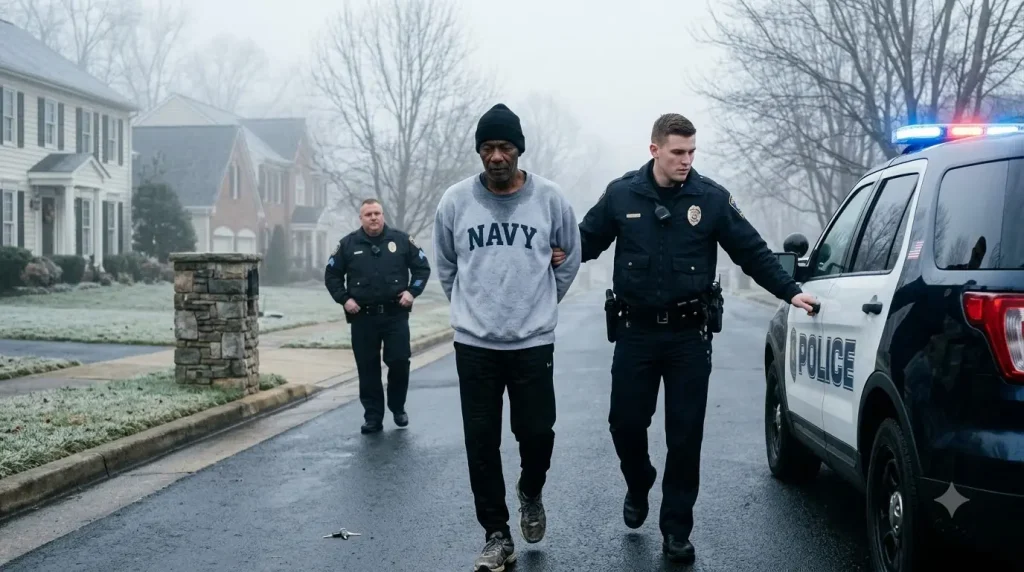
“Any wants?”
“Negative.”
“Any warrants?”
“Negative.”
Carter muttered, “Could still be fake.”
Margaret heard.
“His moving truck was there for three days.”
Carter looked toward her.
“Ma’am, go home.”
She raised her phone.
“No.”
Carter’s eyes narrowed.
“Are you recording?”
“Yes.”
“You need to step back.”
“I’m on my property.”
Carter moved toward her.
Isaiah felt anger for the first time.
Not because she was filming.
Because Carter’s instinct when questioned was again control.
Isaiah leaned toward the cage partition.
“Sergeant.”
Carter turned sharply.
Isaiah spoke through the small gap.
“Leave her alone.”
Higgins looked incredulous.
“You’re giving orders from the back seat now?”
Isaiah did not answer him.
He looked only at Carter.
The sergeant stared back.
Then returned to the cruiser.
He opened the driver’s door.
“Let’s take him in.”
Higgins frowned.
“Shouldn’t we wait for burglary unit?”
“He’s got no ID.”
“No system return.”
“We’ll sort it downtown.”
Isaiah knew the point had arrived.
He could not let them transport him without forcing another verification attempt.
Not for his own safety.
For what would follow once his absence was noticed.
His morning schedule was not flexible.
At 7:00, he was supposed to receive a secure call from his operations chief.
At 7:30, an aide would arrive at 442 with briefing material.
At 8:00, military security expected confirmation before Leah’s transport.
If Isaiah vanished into a local booking process without explanation, people would start asking questions.
Important people.
Quickly.
That was avoidable.
He leaned forward.
“Sergeant Carter.”
Carter looked through the open door.
“Before you move this vehicle, call your watch commander.”
Carter laughed.
“You really like saying that.”
“Yes.”
“Why?”
Isaiah looked directly at him.
“Because if you put this cruiser into gear before verifying my identity, the next hour of your life is going to become extremely complicated.”
Higgins turned.
“Is that a threat?”
“No.”
Isaiah’s voice remained calm.
“It is professional advice.”
Carter’s expression hardened.
“Drive.”
The cruiser pulled away.
Margaret remained on the curb filming.
Isaiah watched 442 Willow Creek Lane pass through the rain-streaked window.
His new house.
The ramp contractor’s truck would arrive at nine.
Leah at two.
He wondered whether she would laugh when she heard.
Almost certainly.
After she became furious.
Five minutes into the drive, Higgins looked back through the cage.
“You nervous yet?”
Isaiah stared out the window.
“No.”
“You should be.”
Isaiah looked at him.
“Why?”
Higgins smiled.
“Pine Valley doesn’t play around with burglaries.”
Isaiah nodded.
“Does Pine Valley normally arrest homeowners without confirming they own their homes?”
Higgins’s smile disappeared.
“Keep talking.”
“I am asking a procedural question.”
“You’re trying to sound smart.”
Isaiah almost laughed.
Carter spoke from the passenger seat.
“Guys like you always think if you talk formal enough, we’ll get intimidated.”
Isaiah looked at the back of Carter’s head.
“Guys like me?”
Silence.
Higgins glanced toward Carter.
Carter realized the phrase had landed poorly.
“You know what I mean.”
“No.”
Isaiah leaned back.
“I don’t.”
The cruiser continued.
At 6:41 a.m., Isaiah’s phone began ringing inside the evidence pouch Higgins had placed up front.
Higgins looked down.
The screen displayed:
COL. ANDERSON — SECURE OPS
He frowned.
“Colonel Anderson?”
Carter glanced.
“Probably fake.”
The call stopped.
Then immediately rang again.
Same name.
Higgins ignored it.
Isaiah said, “You should answer.”
Higgins laughed.
“No.”
“It would help you.”
“Shut up.”
The phone stopped.
Thirty seconds later, another call.
GENERAL STAFF DUTY
Higgins glanced again.
His smile weakened.
Carter looked toward the screen.
“What kind of phone is that?”
Higgins picked it up.
Government-issued hardened device.
No visible commercial branding except small serial markings.
He turned it over.
“What is this?”
Isaiah said nothing.
Higgins looked back.
“Where did you get this?”
Isaiah stared.
Higgins’s voice sharpened.
“Answer.”
“It was issued.”
“By who?”
“United States Department of Defense.”
Carter laughed.
Actually laughed.
“You hear this guy?”
Isaiah returned his gaze to the window.
The phone rang again.
This time:
PENTAGON OPERATIONS CENTER
Nobody laughed.
Higgins stared at the screen.
Carter leaned closer.
The call stopped.
Then a message appeared.
PRIORITY CONTACT REQUIRED. CONFIRM STATUS OF GEN MONTGOMERY IMMEDIATELY.
The car became quiet.
Higgins looked toward the cage.
Isaiah met his eyes.
“Who are you?”
Isaiah answered with the same calm he had used from the beginning.
“Isaiah Montgomery.”
Higgins’s face tightened.
“No.”
Isaiah waited.
“What do you do?”
Isaiah looked toward Carter.
The sergeant had stopped smiling.
Isaiah said:
“I serve in the United States Army.”
Carter turned.
“You’re wearing a Navy shirt.”
Isaiah almost admired the stupidity of the observation.
“Yes.”
“What rank?”
Isaiah looked toward him.
“General.”
Higgins laughed once.
Nervously.
“What kind?”
Isaiah said nothing.
Carter’s eyes moved toward the phone.
Then back.
“What kind of general?”
Isaiah waited.
Higgins pulled toward the curb.
The cruiser stopped.
He turned fully.
“What rank?”
Isaiah answered.
“Four-star.”
Silence.
Not dramatic.
Not immediate understanding.
The mind often rejects information when accepting it would require reinterpreting the previous fifteen minutes.
Carter stared.
“You expect us to believe you’re a four-star general?”
“No.”
Isaiah shifted his wrists against the cuffs.
“I expected you to verify my identity when I first asked.”
The phone rang again.
PENTAGON OPERATIONS CENTER.
Carter reached for it.
Isaiah’s voice changed.
“Do not answer that phone unless you are prepared to identify yourself accurately.”
Carter froze.
That was the first command Isaiah had given.
It sounded different.
Not louder.
Heavier.
The sergeant looked toward Higgins.
Higgins whispered, “Call dispatch.”
Carter lifted the radio.
“Dispatch, Unit 23.”
“Go.”
“We need federal verification on Isaiah Montgomery.”
Pause.
“What kind?”
Carter looked at Isaiah.
Then away.
“Military.”
Dispatch answered.
“Stand by.”
The waiting lasted forty-seven seconds.
Isaiah counted.
Higgins tapped his fingers against the steering wheel.
Carter looked through the windshield.
Then dispatch returned.
The voice had changed.
The normal dispatcher was gone.
A supervisor came on.
“Unit 23, confirm subject name Isaiah Nathaniel Montgomery, DOB August fourteenth, nineteen sixty-eight.”
Carter swallowed.
“Affirmative.”
Another pause.
Then:
“Hold position.”
Carter frowned.
“We are holding.”





