The center occupied an old neighborhood workshop with high windows and a stubborn leak above the back door. Isaac had loved it because the room could be divided into classrooms without making any of them feel like cupboards.
Maya went there a week after the bank incident. The check had been safely deposited elsewhere through the appropriate process, but she still found herself checking the receipt as though money could become unreal again if she stopped watching it.
Naomi unlocked the front door. Inside, donated monitors waited under dust sheets, and a child’s drawing of a robot had curled at one corner on the noticeboard.
Isaac’s measuring tape lay on a windowsill. Maya picked it up, pressed the lock with her thumb, and cried before she could decide whether she wanted to.
Her father had imagined a place where people could learn without feeling ashamed of what they did not know. After the bank, the idea felt less like a generous ambition than a description of something urgently missing.
The first person outside the incident to ask for a conversation was a retired bus driver named Walter Kent. He contacted Lena, not Maya’s office, and said he had watched the video with his wife.
Something similar had happened to him at Rivergate the previous year. His pension-related payment had eventually been verified, but only after police arrived and he spent an afternoon convinced he would be taken away.
He had no dramatic recording. He had an old receipt, an email, and a wife who remembered how he shook when he came home.
“They didn’t put cuffs on me,” he told Lena. “I keep thinking that means I shouldn’t make it sound as bad as hers.”
With his permission, the account went to the investigators. Lena told him he did not need to compete with someone else’s pain to describe his own.
Maya met Walter only after the interviews that could be affected by such contact had been handled and her adviser said the visit was appropriate. He came to the unfinished center carrying a box of old keyboards.
“My wife said if I was going to talk about technology, I should bring something that might be useful,” he explained. Maya thanked him without examining whether the keyboards were worth anything.
He looked around the room. “Your father wanted this?” he asked.
“Very much,” she said. Walter nodded slowly.
“Then he understood something.” He touched the corner of a worktable as though checking whether it was solid.
Maya expected him to ask about the badge. Instead, he asked whether there would be chairs with arms for people who found it hard to stand up.
She wrote it down on the back of a building-supply invoice. **For the first time since the arrest, she spent ten uninterrupted minutes solving a problem nobody had invented to frighten her.**
Meanwhile, Priscilla’s account began changing. At first she had described visible irregularities in the check, then uncertainty about the settlement, then concern about Maya’s conduct when questioned.
The recordings made the last explanation difficult. Maya had offered documentation, kept her voice level, and had not done what the phrase increasingly agitated invited a reader to imagine.
The officers’ reports required the same scrutiny. Dwire described relying on a bank manager’s assertion that fraud had been confirmed, while Harland’s initial account referred to resistance that the available recordings did not show.
Brooks arranged separate follow-up interviews. She had known Harland for years, which made the footage harder to watch and more important not to explain away.
“Familiarity isn’t corroboration,” she told the review team. A colleague wrote the sentence at the top of his notes.
The independent bank review found that a regional executive, Calvin Rusk, had encouraged branches to present strong fraud-prevention results. His messages did not instruct anyone to handcuff legitimate customers, but they made inflated certainty a valuable thing to produce.
Investigators examined whether he had known about false entries and whether those entries affected compensation or reports to others. They followed documents and accounts rather than allowing one management slogan to prove an entire scheme.
Then a preserved review record from Maya’s transaction reached the team. Its header showed an approval entered under an old consultant profile.
Elena called Maya to ask one carefully limited question. “What was the date your father died?”
Maya gave it, then stopped breathing for a moment. She knew Elena could obtain the date without her, which meant the call was about something else.
“Is his name in a record?” she asked. Elena paused.
“There is an attribution we need to verify,” she said. “I don’t want you to draw a conclusion before we can support one.”
Maya looked across the center at her father’s abandoned measuring tape. **For the second time, somebody else seemed to be deciding what Isaac Ellison had done.**
Chapter 3: What the Dead Man Approved
The body-camera footage did not arrive as a perfect, uninterrupted explanation. One angle was blocked by Harland’s shoulder, another caught more of the ceiling than Maya’s hands, and voices overlapped near the counter.
But different recordings could be compared. Together with the lobby cameras and witnesses, they established moments that no polished summary could safely ignore.
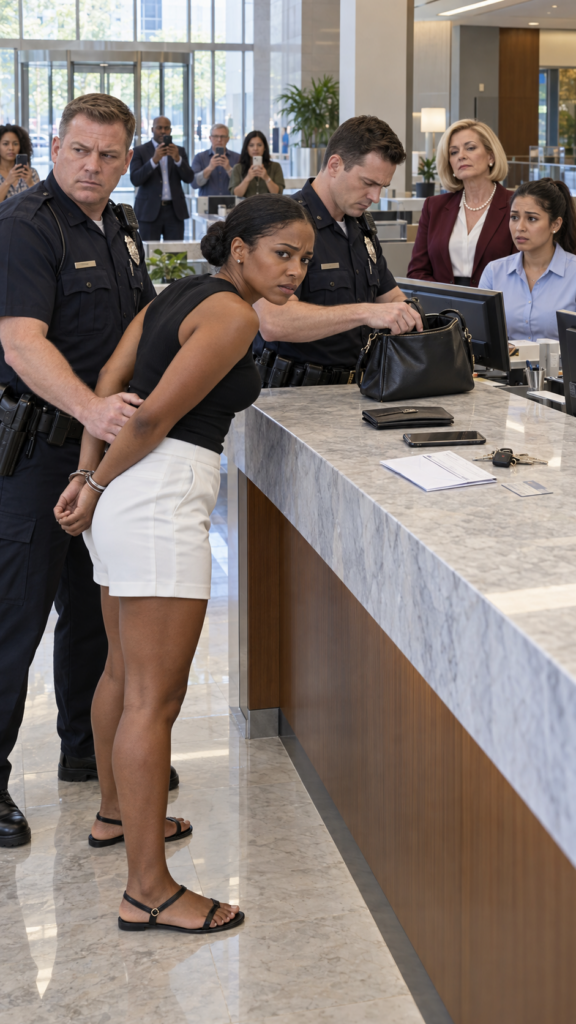
Maya offered her license. She pointed out the paperwork, asked that the issuing information be checked, and kept her hands visible before Harland took her wrist.
Priscilla told the officers that the check had been confirmed fraudulent. Angela, standing only a few feet away, looked sharply toward her terminal when the manager said it.
That movement became important because of what followed. One recording caught Angela starting to speak and Priscilla saying, “Not now.”
It was not proof of every allegation in the case. It was evidence that the claimed certainty and the teller’s unfinished verification were not the same thing.





