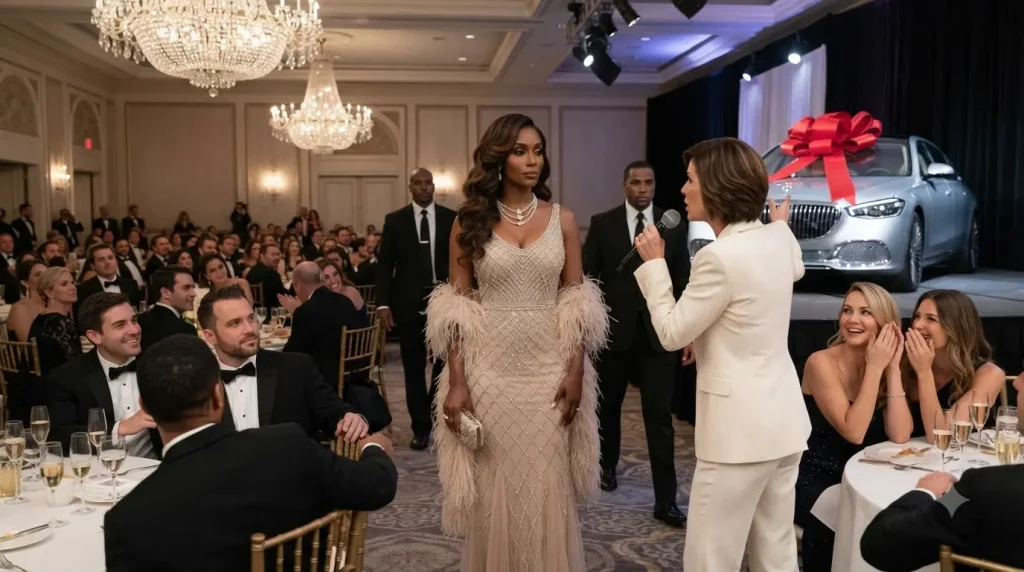
Worse—or better, depending on how the next sixty minutes played out—her handbag contained a slim, black calfskin document case. Inside rested an irrevocable, four-million-dollar matching grant from the Mercer Global Foundation. If HavenBridge hit its operational fundraising metrics tonight, Ava’s foundation would match it four-to-one, effectively funding their regional expansion through 2030.
There were, however, covenants. Covenants regarding third-party vendor transparency, conflict-of-interest bans, and a hard cap on administrative diversion.
Ava had learned that in the nonprofit world, holy missions were frequently piloted by very unholy administrators.
She began walking toward the stage, her heels clicking softly on the parquet. She didn’t care about the sedan; she had inspected the manufacturer’s spec sheets before signing the purchase order. What had caught her eye from across the room was a brass-and-acrylic display stanchion mounted directly beside the front bumper.
From thirty feet away, she could see lettering beneath the HavenBridge logo. Not the neutral phrase Generously Provided by a Friend of the Foundation, which she had approved in writing.
It looked like a corporate crest.
Ava stepped between tables eight and ten. The room was growing louder as the dinner courses cleared and the live auctioneer completed his vocal warm-ups near the wings. A few heads turned as she passed; two women in identical jewel-toned column dresses paused mid-sentence, their gazes dropping to her waist, then flicking up to assess whether her pearls were genuine. Ava gave them nothing, maintaining an even, forward stride.
She stopped two feet short of the crimson velvet rope that cordoned off the dais.
Up close, the brass plaque was unmistakable:
Vehicle Procurement and VIP Logistics Underwritten by the Whitmore Automotive Group. “Driving Hope Forward.”
Ava’s eyes narrowed.
“Excuse me.”
The voice was clipped, carrying that particular, brittle authority common to mid-level gatekeepers who viewed an event’s logistical perimeter as sovereign territory.
Ava turned.
A woman stood three paces away, holding a high-end wireless microphone in one hand and an illuminated clipboard in the other. She was perhaps forty, impeccably preserved in a sharply tailored ivory crepe pantsuit, a substantial emerald-cut diamond ring glittering on her left hand. Her hair was cut into a precise, angular bob that framed a face set in an expression of institutional vigilance.
Her laminated badge read: Claire Whitmore, Gala Chair & Executive Development Director.
“Good evening,” Ava said evenly.
Claire did not smile. Her gaze was swift and surgical. It cataloged the champagne dress, the pearls, the absence of an identifiable corporate pin, and the fact that Ava was standing unaccompanied.
“Can I help you find your table?” Claire asked. The tone was polite, but the cadence made it clear that help was an order, not an offer. “The program resumes in fifteen minutes.”
“I have my table, thank you,” Ava replied. “I was looking at the donor placard.”
Claire’s eyes flicked to the brass plaque, then back to Ava. “Yes. The raffle vehicle is off-limits to viewing until after the drawing. You need to remain behind the perimeter.”
“I am behind the rope,” Ava noted mildly, glancing at her own feet.
“You’re crowding the staging area,” Claire said, her voice dropping into a patronizing register. “We have photographers moving through here in three minutes for the sponsor portraits. The general audience needs to remain at their tables.”
Ava didn’t move. “I only wanted to read the attribution line. The contract for this vehicle specified an anonymous attribution.”
Claire’s posture went rigid. The polite mask slipped, revealing the sharp edge of bureaucratic territorialism beneath. “I beg your pardon?”
“The donor agreement,” Ava said, keeping her cadence entirely neutral. “The vehicle was gifted under the explicit condition that it carry no corporate branding or promotional attribution.”
A short, incredulous laugh escaped Claire’s lips. She shifted her weight, tucking the clipboard under her arm. “And what, exactly, would you know about the vehicle agreement?”
Ava paused. She could end it here, drop the corporate hammer, and watch the color drain from this woman’s face. But years in high-stakes acquisitions had taught her that people under pressure revealed their networks if you gave them enough rope.
“I’m familiar with the terms of the acquisition,” Ava said.
Claire’s gaze traced Ava’s silhouette again, this time with open derision. “Are you with the press pool? Because media credentials were confirmed at four o’clock, and press isn’t permitted in the primary donor tier.”
“I am not press.”
“A guest’s plus-one, then?” Claire’s lips curled in a tight, pitying smile. “Look, Miss… whatever your name is. The gala committee handles donor relations. We don’t need guests who bought an auxiliary ticket offering amateur critiques on our corporate partnerships.”
“My name is Ava Mercer.”
Silence hung between them for a second. Claire’s brow twitched, but no light of recognition broke across her features. To Claire Whitmore, the Mercer name belonged to an abstract corporate entity—a skyscraper in Manhattan, a private equity fund mentioned in the back pages of the Wall Street Journal. It did not belong to a solitary Black woman standing in a champagne dress without an entourage.
“Well, Ms. Mercer,” Claire said, her patience clearly extinguished, “you need to step away from the dais. Now.”
Ava remained perfectly still. “The couple to your left has been leaning against the bumper taking selfies for ten minutes. You haven’t spoken to them.”
Claire didn’t even look. “Mr. and Mrs. Vanderhoof are Platinum Benefactors. They contributed fifty thousand dollars to the capital campaign.”
“And that grants them license to violate the perimeter?”
“It grants them latitude,” Claire snapped, her voice rising just enough to draw the attention of a nearby table of venture capitalists. “Which you do not have. Now, back away from the display, or I’ll have event security escort you to the lobby.”
Behind Claire, two women in couture gowns paused their conversation, observing the confrontation with the detached amusement of patrons watching a minor disturbance at an opera.





