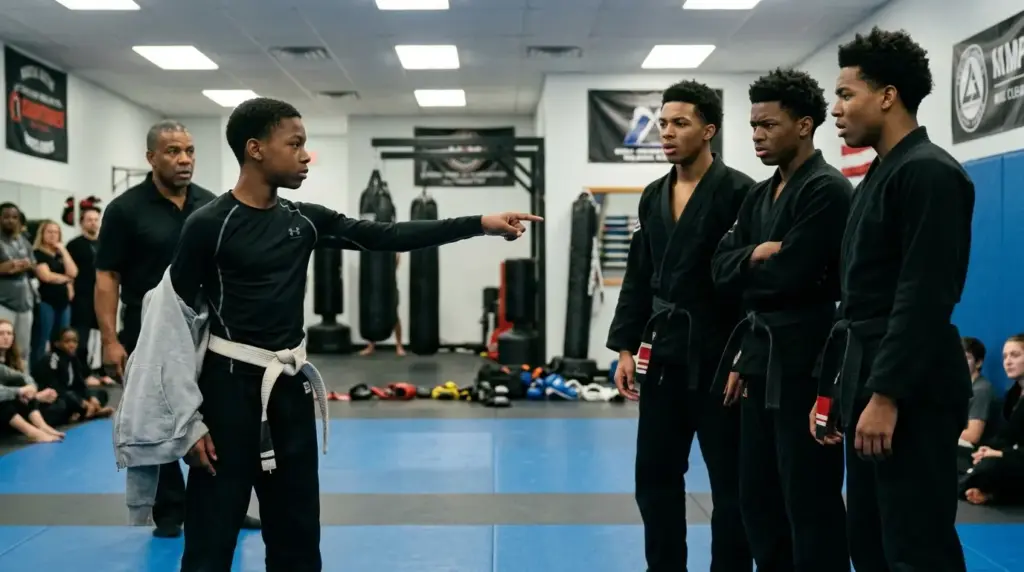
“Because training is not content verification.”
Good.
Then somebody found an old hallway video from Malik’s first week.
Jordan smirking.
Malik pointing at all three.
Clip stopped before results.
Caption:
QUIET KID CHALLENGES THREE BLACK BELTS.
Comments exploded.
Everybody imagined the rest.
Some said Malik destroyed them.
Some said fake.
Some said staged.
Funny.
No one had even seen the drill.
Daniel asked the poster to remove it.
They did.
Then he gathered the teen class.
“If a clip makes you want the ending more than the training, be careful.”
Good.
Jordan said:
“Can we post the full rotation?”
Daniel looked at Malik.
“Your choice.”
Malik said:
“No.”
Done.
Consent.
No reason needed.
At sixteen, Malik entered his first BJJ tournament after returning.
Gray belt teen division.
First match:
Won by points.
Second:
Lost by armbar.
Third:
Lost on points.
No medal.
He was furious.
Renee bought him fries.
He ate silently.
Then said:
“I should’ve won the second.”
“Why?”
“I was ahead.”
“That is not how submissions work.”
He looked at her.
She smiled.
Good.
Monday, film.
He had left elbow exposed while trying to hold top.
Clear.
Work it.
Next tournament, bronze.
One win.
One loss.
One walkover.
Fine.
No undefeated arc.
At seventeen, Malik grew.
Five feet seven.
One hundred thirty-six pounds.
Still not huge.
Stronger.
Better cardio.
Wrist mostly fine.
He earned BJJ blue belt at adult transition under his school’s system after years of total training.
Not because of one drill.
Current work.
Coach Daniel tied it.
Jordan, now nineteen and in college, visited.
He laughed.
“About time.”
Malik said:
“You still talk too much.”
Good.
Eli moved away for school.
Noah became assistant wrestling coach at East Point.
The three black belts from the title changed too.
Jordan stopped competing in karate and focused on BJJ.
Eli earned judo brown belt.
No villains.
No ruined lives.
They had simply been teenagers who laughed too early.
That mattered.
At eighteen, Malik had his first real setback.
Shoulder irritation from a wrestling tournament.
Six weeks no hard grappling.
Then gradual return.
He hated it.
“Current body,” Daniel said.
Malik groaned.
“I’m eighteen.”
“Bodies still count.”
Fair.
He did rehab.
No miracle.
Returned.
Different.
More technical.
Less reckless.
Good.
At nineteen, Malik helped coach beginners.
That created a new problem.
He was good enough to forget what confusion felt like.
A twelve-year-old named Ben kept crossing his feet in stance.
Malik corrected.
Again.
Again.
Third time:
“How many times do I have to tell you?”
Daniel heard.
“Malik.”
He froze.
Daniel said:
“Remember white belt?”
There.
Malik exhaled.
Then apologized to Ben.
Good.
Being underestimated once does not make you permanently patient.
Lessons need maintenance.
Malik slowed down.
Asked:
“What are you feeling when you step?”
Ben explained.
Problem was balance.
Not disobedience.
Different.
Good.
At twenty-one, Malik attended college locally.
Studied mechanical engineering.
Still trained twice a week.
Not athlete schedule.
Life.
Some weeks one.
Exams.
Internships.
Girlfriend.
Family.
Training fit around it.
That was okay.
He stopped competing for two years.
No shame.
At twenty-three, he returned to tournament.
Adult blue belt.
Won first.
Lost second.
Got controlled by someone stronger and more current.
Good.
He laughed afterward.
Renee said:
“You’re taking this better.”
“I’m older.”
“You’re twenty-three.”
“Ancient.”
Good.
Before Malik reached that point, there was a stretch at twenty-four that mattered more than any tournament.
East Point hosted a cross-training day with two nearby gyms.
Thirty-six teenagers and young adults.
Different belts.
Different styles.
Wrestlers.
Judoka.
BJJ students.
Karate athletes who had added grappling.
Daniel started with one instruction.
“No hero rounds.”
People laughed.
He did not.
“Different schools means different assumptions.”
“Ask experience.”
“Ask injuries.”
“Ask intensity.”
“Then train.”
Good.
Malik was blue belt then.
Still quiet.
Less small.
Not famous.
At least not inside his own head.
A visiting student named Devin Cole paired with him.
Eighteen.
Black.
Six feet.
High-school wrestler.
No BJJ rank.
Devin said:
“I’m basically a beginner.”
Malik almost believed him.
Then remembered.
“Beginner at what?”
Devin smiled.
“Jiu-jitsu.”
“How much wrestling?”
“Eight years.”
Malik laughed.
“Thank you.”
Good.
They started from standing.
Thirty percent.
Devin took Malik down twice.
Clean.
Current wrestling.
Malik recovered guard once.
Got back to feet once.
No domination.
Afterward Devin asked:
“You wrestled?”
“Yes.”
“How long?”
“Four years when I was younger.”
“Felt like more.”
“Old habits.”
Good.
Then Malik rolled with a smaller green-belt judoka named Marcus Lee.
Sixteen.
Asian American.
One hundred ten pounds.
People nearby expected Malik to control because he was bigger now.
Marcus foot-swept him twice.
Fast.
Precise.
Malik laughed after the second.
“Again.”
The cross-training day reinforced the same lesson from his first night.
Rank tells something.
Size tells something.
Current sport tells something.
None tells everything.
Daniel gathered the group afterward.
“What surprised you?”
One athlete said:
“Wrestlers with no BJJ rank.”
Another:
“Small judo people.”
Another:
“Old people.”
Daniel stared.
The student corrected:
“Older people.”
Good.
Malik said:
“How much one rule set changes everything.”
Daniel nodded.
That sentence mattered.
A black belt in karate can be a beginner in grappling.
A blue belt in BJJ can be difficult to take down if he wrestled ten years.
A wrestler can dominate standing and get submitted from guard.
Different questions.
Different answers.
That day became the reason Malik later hated “Who would win?” conversations.
Too vague.
Under what rules?
At what age?
Current training?
Injury?
Weight?
Intensity?
People wanted hierarchy.
Training gave conditions.
Good.
A year later, Malik faced a harder problem.
Not physical.
Social.
A younger student named Theo started copying him.
Theo was thirteen.
Black.
Quiet.
Small.
He had seen Malik coach.
He had heard the old “all three” story from other teens.
He liked that Malik did not talk much.
Then Theo started refusing to answer coaches.
Not quiet.
Defiant.
When asked intensity:
Shrug.
Injuries:
Shrug.
Goal:
Shrug.
Daniel noticed.
So did Malik.
After class, Malik asked:
“You good?”
Theo shrugged.
Malik smiled.
“See?”
Theo looked confused.
“That gets annoying.”
Theo laughed.
Good.
Then Malik said:
“Quiet is fine.”
“Making people guess about safety is not.”
Important.
Theo thought Malik’s silence was strength.
Malik explained:
“I answered Coach Daniel.”
“I told him my wrist.”
“I told him my background.”
“I said yes to the drill.”
“Quiet does not mean unavailable.”
That distinction mattered.
People romanticize quiet characters.
Real training requires communication.
Theo improved.
Still quiet.
Answered when it mattered.
Good.
At twenty-six, Malik experienced another correction.
He was teaching a teen wrestling class.
A new girl named Amaya Brooks joined.
Fifteen.
Black.
Five feet two.
Soft-spoken.
No belt.
Malik asked background.
She said:
“Gymnastics.”
He nodded.
Then designed the first round assuming no contact sport.
Reasonable.
Incomplete.
She had also done two years of folkstyle wrestling at a girls’ club.
She forgot to mention because she thought “background” meant martial arts.
During pummeling she moved too well.
Malik stopped.
“You wrestled?”
“Oh.”
“Yeah.”
“How long?”
“Two years.”
He laughed.
There it was again.
Even good questions can get incomplete answers.
So he updated.
No embarrassment.
No:
Why didn’t you tell me?
Just:
“Okay.”
Different pairing.
Different drill.
Good.
That became another coaching lesson.
Asking is not a magic shield against surprise.
People misunderstand questions.
Forget details.
Use different words.
The skill is not never being wrong.
It is updating without ego.
Malik liked that.
At twenty-seven, he worked as a mechanical engineering intern at a manufacturing plant.
That job taught him something martial arts had already been trying to teach.
One machine kept producing parts slightly out of tolerance.
An older technician blamed the sensor.
A younger engineer blamed calibration.
Everyone had a theory.
Malik asked:
“What changed before the problem started?”
They checked maintenance logs.
A fixture had been replaced.
Slightly different alignment.
There.
Not sensor.
Not calibration.
Setup.





