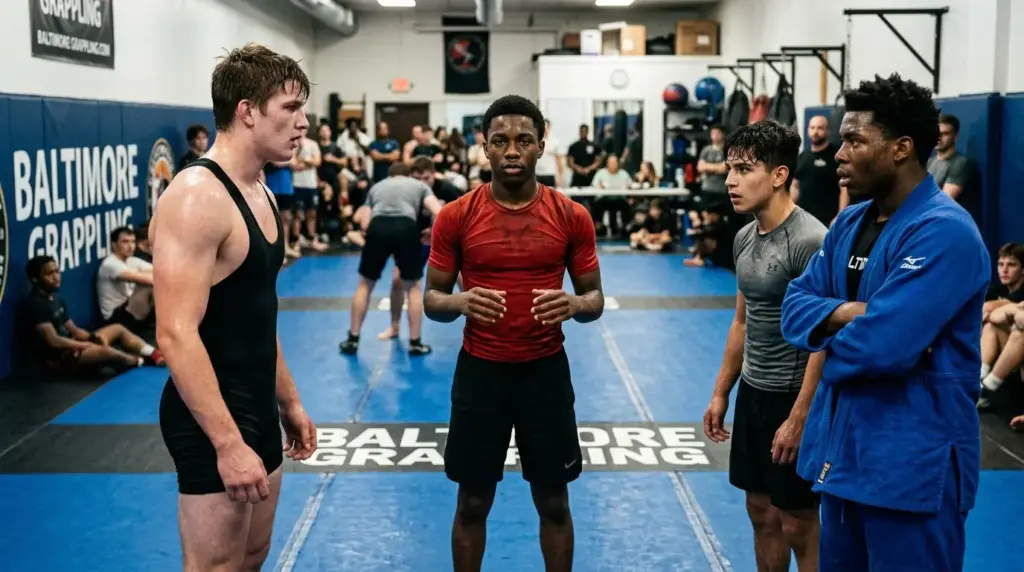
Trevor nodded.
Fair.
Dylan walked over.
“You compete?”
“Yes.”
“Where?”
“Maryland circuits.”
“What division?”
“Intermediate youth.”
Connor said:
“Any medals?”
“Some.”
“How many?”
Malik thought.
“Seven maybe.”
There.
Not huge.
But experience.
Dylan said:
“You could’ve told us.”
Malik looked at him.
“You could’ve asked.”
Good.
No speech.
That line stayed.
Malik returned next Saturday.
Not because he wanted rematch.
Because East Harbor had good rounds.
His gym remained closed another three weeks.
During that time, the four teenagers trained often.
Dylan submitted Malik with a guillotine in week two.
Connor caught him in triangle week three.
Trevor threw him clean enough that everyone stopped to appreciate it.
Malik also caught each of them sometimes.
Armbar on Connor.
Back choke on Dylan.
Kimura on Trevor after scramble.
Balanced.
No mythology.
Then something unexpected happened.
The three champions started training together differently.
Before Malik, they competed constantly.
Every round mattered.
Who got takedown.
Who tapped.
Who won.
Malik did not care enough.
At first, that irritated them.
Then it relaxed them.
They started asking after rounds:
“What did you feel?”
Instead of:
“Who got it?”
Small shift.
Coach Andre noticed.
Good.
A month later, East Harbor held a youth invitational.
Malik’s home gym reopened.
He competed under his own team.
First match:
Won points.
Second:
Lost by submission.
Connor watched.
Afterward he said:
“You okay?”
“Yes.”
“You tapped fast.”
Malik laughed.
“Yes.”
“You could’ve fought longer.”
“No.”
“My arm was done.”
Good.
That mattered.
Champion culture often praises late taps.
Malik did not.
He had seen teammates injured proving nothing.
Connor thought about it.
Two weeks later, Connor tapped early to a tight shoulder lock in training.
Dylan teased.
Connor said:
“I want my shoulder.”
Good.
Culture moves.
At seventeen, Malik moved into advanced division.
Harder.
First tournament:
0-2.
No wins.
The internet version would hate that.
Reality liked it.
He adjusted.
Second tournament:
One win.
Two losses.
Third:
Silver.
Progress.
Dylan won state again.
Connor won regional title.
Trevor qualified for national judo event.
They remained better than Malik in some areas.
Malik remained better in others.
Good.
At eighteen, college choices split them.
Dylan wrestled Division III.
Connor stayed local and trained BJJ seriously.
Trevor entered university judo club.
Malik went to community college first.
Money.
Then transferred to Towson.
Studied physical education.
Why?
He liked coaching kids.
Not because of one viral moment.
There was no viral moment yet.
Then someone posted old footage.
Of course.
The three-minute rotation.
Edited.
Only moments where Malik escaped.
Dylan’s takedown removed.
Connor’s deep choke removed.
Trevor’s top pressure removed.
Caption:
THREE CHAMPIONS CHALLENGE QUIET KID — HE TELLS THEM COME TOGETHER AND SURVIVES ALL THREE.
Technically partly true.
Misleading.
Views climbed.
Another account changed title:
QUIET BOY DESTROYS THREE CHAMPIONS AT ONCE.
False.
Malik hated that most.
“At once?”
He called Connor.
“You see this?”
Connor laughed for a full minute.
“You finally became legend.”
“I hate you.”
Good.
Coach Andre posted full round.
No commentary.
Three minutes.
All exchanges.
Caption:
Fresh-partner rotation. Training. Nobody destroyed anybody.
Good.
Full video got fewer views.
Of course.
Malik did not chase correction.
He learned early:
The internet wants conclusions.
Training gives evidence.
Different products.
At twenty, Malik became assistant youth coach at his home gym.
He was good with quiet kids.
Why?
He did not force them to speak.
One twelve-year-old named Isaiah barely answered questions.
Another coach thought he lacked confidence.
Malik watched.
Isaiah trained fine.
Listened.
Worked.
He just did not like talking in groups.
Malik said:
“Leave him alone.”
Good.
Quiet is not always fear.
Another lesson from his own story.
At twenty-two, Malik earned BJJ purple belt.
No ceremony beyond normal.
At twenty-four, brown.
Then life interrupted.
Knee injury.
Surgery.
Graduate school delayed.
Coaching cut back.
He gained weight.
Lost conditioning.
Returned.
Got submitted by younger blue belts.
Good.
Rank does not freeze time.
At twenty-seven, Malik became a middle-school physical education teacher.
Coached wrestling after school.
His rule:
No “easy match” language.
Not because every underdog hides secret skill.
Because calling someone easy turns a person into a prediction.
He told wrestlers:
“You can think you have an advantage.”
“Fine.”
“You cannot decide the match already happened.”
Good.
At thirty, Malik visited East Harbor.
Andre still coaching.
Older.
Gray beard.
Connor now BJJ black belt.
Trevor judo coach.
Dylan high-school wrestling assistant.
They reunited.
Naturally, someone said:
“Come together.”
Malik said:
“No.”
Everyone laughed.
Then they did another rotation.
One minute each.
For fun.
Malik heavier now.
Slower.
Smarter.
Dylan took him down.
Connor submitted him.
Trevor did not.
Final score?
None.
Perfect.
At thirty-two, Malik earned BJJ black belt.
Twelve years after viral clip.
He did not become professional athlete.
Did not need to.
Teaching.
Coaching.
Training.
Enough.
At thirty-five, a new student at his youth program arrived.
Black boy.
Fifteen.
Very quiet.
No visible athleticism.
Three experienced teenagers whispered.
Malik heard:
“Easy round.”
He walked over.
They froze.
Malik said:
“Maybe.”
They looked surprised.
Then:
“But you don’t know yet.”
There.
He asked the boy:
“Background?”
“None.”
Good.
No secret wrestler.
No twist.
Malik paired him with a patient blue belt.
Technical pace.
The boy struggled.
Tapped twice.
Came back next week.
That mattered more.
A year later, he was still training.
Not champion.
Not hidden prodigy.
Just better.
Malik liked that ending.
At forty, he became athletic director at his school.
Less mat time.
More budgets.
Parent emails.
Bus schedules.
He missed simple rounds.
Still coached twice weekly.
One day a parent complained that Malik’s team did not “teach aggression.”
Malik answered:
“We teach initiative.”
“Different.”
Good.
Aggression without judgment makes stupid athletes.
At forty-five, Connor invited him to speak at coaching clinic.
Topic:
Rotational Training Without Ego.
Malik laughed.
“You made that title up from one round?”
“Yes.”
They taught coaches how to use fresh-partner rotations safely.
Short durations.
Clear rules.
Weight matching.
Tap protocols.
No punishment framing.
Not:
Survive three killers.
Instead:
Manage changing styles.
Good.
The old moment became useful methodology.
Better than legend.
At fifty, Malik stopped hard competition rounds.
Shoulder.
Knee.
Age.
Still technical.
Young athletes could overwhelm him.
Fine.
He no longer needed to prove sixteen-year-old version remained inside his body.
That is another trap.
Stories freeze people at peak moments.
Bodies keep moving.
At fifty-three, Andre Wallace died.
Heart attack.
Sixty-nine.
Malik attended memorial.
Dylan.
Connor.
Trevor.
All there.
Coach Andre’s wife displayed old photos.
One showed the four teenagers after the original rotation.
Sweaty.
Laughing.
Malik barely recognized himself.
Trevor said:
“You look twelve.”





