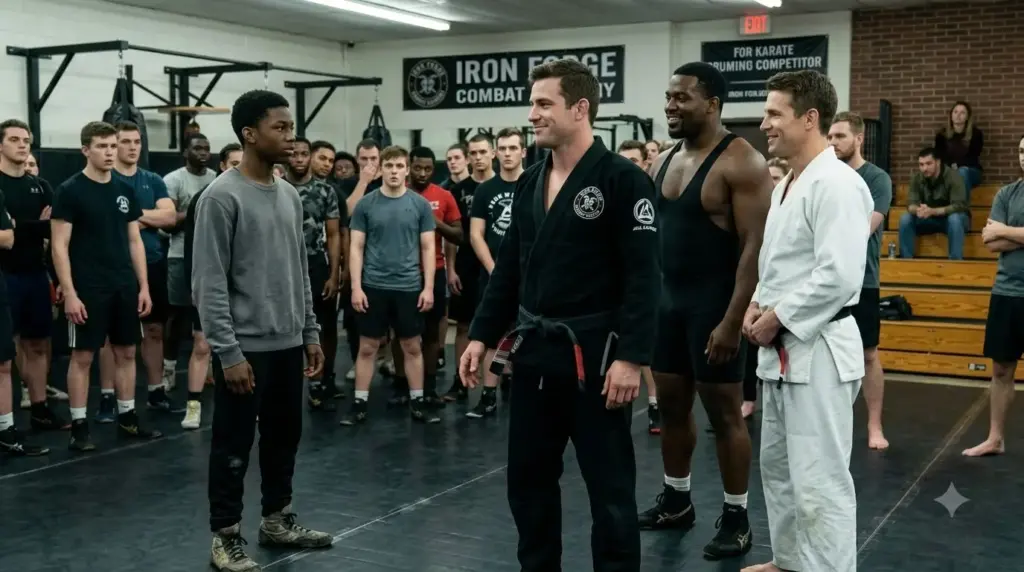
Jonah considered that one of the best things anyone could say about a coach.
One Saturday, a thirteen-year-old named Ethan stood near the wall.
Cole asked:
“Want to demonstrate with Jonah?”
Ethan shook his head.
“No.”
Cole nodded.
“Okay.”
Picked another student.
Nothing happened.
Jonah looked across the room.
Cole noticed.
“What?”
“Nothing.”
“You’re smiling.”
“No.”
“You are.”
Jonah shook his head.
“Good nothing.”
Cole understood.
Years earlier, that simple exchange might have become a challenge.
Now it disappeared into the afternoon.
Progress often looked boring.
Marcus Reed grew older.
His knees failed before his sense of humor.
At seventy-four, he attended one of Jonah’s youth classes with a cane.
A parent recognized him from the old viral video.
“You’re Jonah’s father.”
Marcus sighed.
“Unfortunately.”
The parent laughed.
“You trained him?”
“Yes.”
“You must’ve known he was going to destroy those three guys.”
Marcus shook his head.
“He didn’t destroy anyone.”
“He submitted two.”
“And Cole survived.”
The parent smiled.
“Still.”
“They underestimated the wrong kid.”
Marcus’s expression changed.
“No.”
The parent stopped.
Marcus continued:
“That’s the sentence Jonah spent twenty years trying to kill.”
“What do you mean?”
Marcus pointed toward a beginner class.
A small boy sat near the wall.
“No medals.”
“No famous coach.”
“No secret background.”
“If those three had pressured that boy instead, would it have been better?”
The parent thought.
“No.”
“Then Jonah being good is not what made the pressure wrong.”
The parent nodded slowly.
Marcus smiled.
“Now you get it.”
At seventy-nine, Marcus suffered a stroke.
He survived.
Rehabilitation was slow.
Jonah became part son, part physical therapist, which caused constant arguments.
One morning Jonah said:
“Three more steps.”
Marcus shook his head.
“No.”
Jonah almost said:
“Come on.”
Then stopped.
He knew that sentence.
He knew the difference between clinical encouragement and turning refusal into a challenge.
He asked:
“Are you done because you’re tired, or because you’re afraid?”
Marcus glared.
“Both.”
“Want encouragement?”
“No.”
“Okay.”
They stopped.
Ten minutes later Marcus said:
“Again.”
Jonah smiled.
“Now?”
“Yes.”
Choice mattered even when the person choosing was your father.
Marcus died at eighty-two.
At his funeral, Jonah spoke.
He talked about terrible dad jokes.
Old trucks.
How Marcus put hot sauce on food before tasting it.
Then the famous story.
“People think Dad’s role in the three-on-one round was teaching me how to win.”
Jonah paused.
“It wasn’t.”
“He taught me how to decide.”
Silence.
“When three adult champions pressured me, Dad had the skill and authority to step in.”
“He asked me what I wanted.”
“I said I wanted the round.”
“He let me own that.”
Jonah looked toward the photograph of Marcus.
“He didn’t like my reason.”
“He didn’t have to.”
“He stayed close enough to protect me if the situation became unsafe.”
“But he didn’t confuse protection with control.”
That was the lesson Jonah remembered.
Cole attended the funeral.
Gray-haired now.
Afterward, he approached.
“You know what bothers me?”
Jonah smiled.
“Long list.”
Cole laughed.
“Fair.”
Then:
“The first time I saw you, I thought I was teaching you confidence.”
Jonah nodded.
“I know.”
“I was really teaching myself that someone else’s boundary was negotiable if I thought my reason was good enough.”
Jonah said nothing.
Cole continued:
“Took me years to understand that.”
“Better than never.”
Cole nodded.
They shook hands.
Not because the first day no longer mattered.
Because people could grow without pretending the past had not happened.
Jonah coached until his late sixties.
Then his shoulders stopped cooperating.
He switched to mentoring younger coaches.
One rule remained painted near the entrance of Iron Forge.
ONE INVITATION. ONE ANSWER.
Below it:
A NO DOES NOT REQUIRE A RÉSUMÉ.
And beneath that:
SKILL CHANGES THE ROUND. IT DOES NOT CHANGE DIGNITY.
Cole had added the second line.
Jonah added the third.
When Jonah was seventy-six, he attended Iron Forge’s fiftieth-anniversary open mat.
Most students had no idea who he was.
Good.
He sat near the wall.
Across the room stood three accomplished competitors.
National medals.
Black belts.
Strong.
Confident.
A quiet sixteen-year-old newcomer sat nearby.
Small.
Nervous.
One of the champions walked over.
“Want a round?”
The boy shook his head.
“Not yet.”
The champion nodded.
“No problem.”
Then walked away.
Jonah stared.
Cole, now eighty-nine and using a walker, sat beside him.
“You saw that?”
Jonah nodded.
“Yeah.”
Cole smiled.
“Nothing happened.”
Jonah’s eyes filled.
“Exactly.”
All those years.
All those arguments.
All those policy changes.
All those uncomfortable conversations.
Reduced to three words.
No problem.
The boy remained seated.
Nobody questioned his courage.
Nobody asked his record.
Nobody needed a coach to recognize his name.
He was simply allowed to choose.
Jonah died at ninety-one.
His daughter, Emma, gave the eulogy.
“My father became famous in one small corner of the martial-arts world because three champions smirked at him.”
She smiled.
“They asked which one he wanted first.”
“He said:
‘I’ll take all three.’”
Soft laughter moved through the room.
“It was very Dad.”
Then Emma became serious.
“But he spent the rest of his life correcting the lesson people wanted from that story.”
Silence.
“The easy lesson was:
Don’t underestimate the quiet boy.”
“The better lesson was:
Why are you looking for the correct person to underestimate?”
Emma paused.
“My father really was unusually skilled.”
“He had wrestling titles.”
“Judo medals.”
“Dozens of grappling matches.”
“He really did submit two champions in the same round.”
“All true.”
“That explained the outcome.”
“It did not explain whether his first no deserved to be heard.”
She looked toward Jonah’s photograph.
“Dad also refused to turn himself into a perfect victim.”
“He admitted pride changed his answer.”
“He wanted to prove them wrong.”
“He accepted the round.”
“That decision belonged to him.”
“The pressure belonged to the men who created it.”
“The safety decision belonged to the coach who allowed the round.”
“Grandpa Marcus had his own responsibility as a parent.”
“Different.”
“Not equal.”
“Specific.”
Years after Jonah was gone, Iron Forge still ran Saturday open mat.





