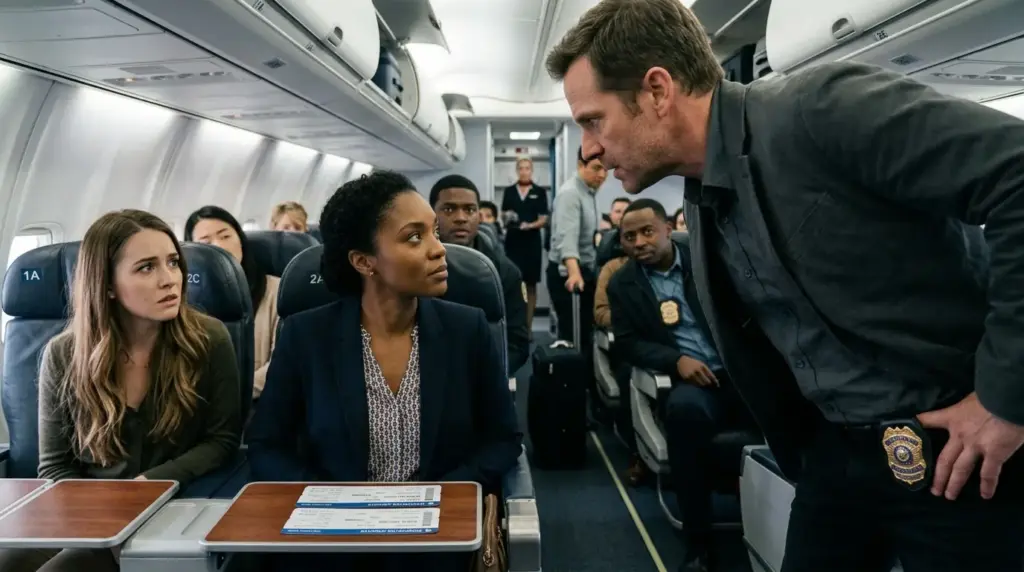
The investigation continued after the passengers were released from the aircraft. The final findings took longer.
Mercer’s database activity was reviewed separately from the seat dispute. Investigators found that he had accessed restricted information without a documented case, dispatch event, warrant, or official assignment connected to Maya or Grace. His reports were also compared with the crew statements, Captain Shaw’s flight log, Cole’s supplemental statement, and the preserved timestamps.
Mercer was placed on administrative leave while the department reviewed his conduct. The inquiry examined his use of department authority for a personal travel benefit, the database searches, and whether the security report had been used to retaliate against passengers after a private dispute.
Cole was also reviewed. He was not cleared simply because he later objected: he had accepted a seat taken from another passenger and remained there after learning the original assignments were valid. His decision to document Mercer’s searches and provide an independent statement was considered separately.
Brent Holloway was removed from gate duties pending an internal review. Northstar examined why an off-duty officer’s request had been enough to trigger a manual reassignment of two confirmed first class seats.
The airline later changed its procedures:
-
An involuntary premium cabin reassignment required a second approval.
-
A passenger’s profession or public position could not by itself justify displacing another confirmed traveler.
-
Original seat records were preserved automatically.
-
A routine customer service dispute could not be classified as a security matter without the involvement of authorized airline or aviation security personnel.
Mercer’s department also tightened its rules: restricted database searches required a documented business purpose, and searches connected to personal disputes became subject to automatic review. Officers were reminded that badges and department identification could not be used to seek private travel benefits.
Several weeks later, Maya and Grace stood together in another airport terminal. Grace still carried the old boarding pass for seat 2C in her purse. She took it out while they waited near their gate.
“We lost the seats even though the tickets were right.”
“Yes,” Maya said.
Grace looked at her. “So who won?”
Maya looked at the worn fold across the middle of the pass. “The record did.”
Grace slipped the ticket back into her purse, and the two women walked toward their gate.
The most serious thing Daniel Mercer brought onto Flight 726 was not the baton on his belt; it was his belief that police authority could turn pressure into lawful authority and an accusation into a fact. Maya never needed to overpower him. She made sure each decision was documented, each threat had witnesses, each search had a timestamp, and every accusation could be compared with what actually happened.
By the time the flight reached Denver, Mercer was expecting the system to punish two women who had refused to surrender their rights. Instead, the system began reviewing him.
Public authority does not make a person the owner of the truth. A badge is not evidence, and justice is not equal if it only begins after someone discovers that the person being mistreated is powerful.
The lesson from this story is simple: authority should never be used to silence the truth, and fairness should never depend on how powerful or important a person appears to be. Real justice begins when facts are respected, records are protected, and ordinary people are treated with the same dignity as anyone else.
This work of fiction was created with the assistance of artificial intelligence. All characters, events, and situations are not real and do not represent any actual people or true stories. The content is intended for storytelling and emotional illustration.





