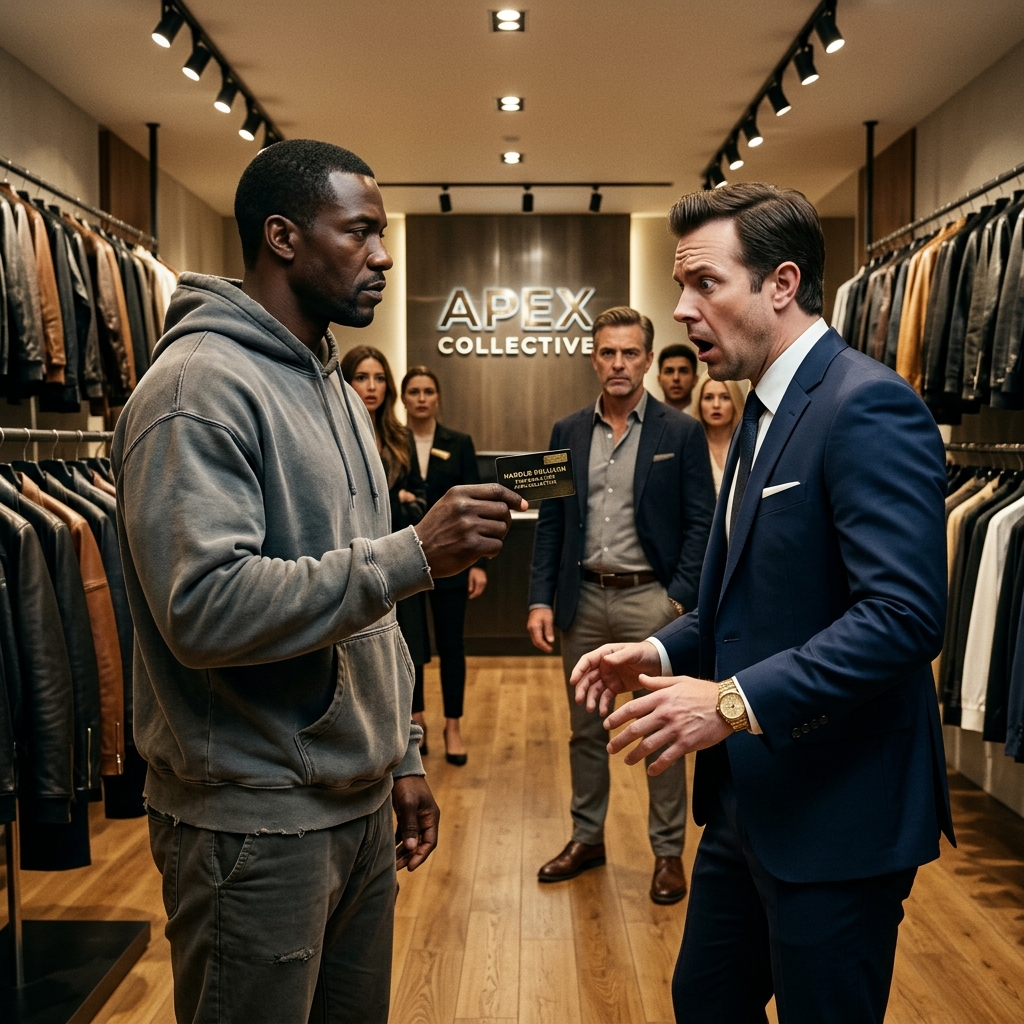
Thirty seconds later, Officer Bradley Moore appeared from the back hallway—off-duty cop, weekend security hire. 6’2”, broad shoulders, buzzcut. His boots thudded heavy against the concrete. His utility belt creaked with each step. His right hand rested near his holster, not on his weapon, but close enough to send a message that didn’t need words. He looked at Harold first, then at Craig, then back at Harold.
“Sir, is there a problem here?”
Harold’s voice stayed calm. “No problem at all. I’m shopping.”
Craig jumped in before Moore could respond. “He’s been handling high-value merchandise and refusing to leave after being asked multiple times. I need him removed from the store.”
Every single word was a lie. Harold had touched one rack of cashmere. He had never been asked to leave. He’d been attacked from the moment he walked in. He had simply existed—a black man in a hoodie in a space Craig decided wasn’t his.
Officer Moore squared his stance toward Harold. Not overtly aggressive, but not neutral either. His body language said everything his mouth hadn’t yet.
“Sir, I’m going to need to see some ID.”
Harold looked at him evenly. “Am I being accused of a crime?”
Moore hesitated, his tongue pressed against the inside of his cheek. He knew the law. He knew the line. But Craig was already pushing from behind. “Come on, Brad. Just walk him out. I don’t have time for this.”
Moore looked at Craig, then back at Harold. The hesitation lasted three full seconds. It should have lasted longer.
“Sir, I’m going to need you to step outside.”
The floor had gone completely silent. The DJ’s baseline still pulsed through the walls, low and soulful, almost mocking against the heaviness of the moment. A teenage girl near the fitting rooms held her phone up, recording. Her hand trembled. A mother by the entrance gripped her son’s shoulders and whispered something in his ear. An older white man in a blazer stood frozen near the sunglasses display, mouth half open.
Nobody moved. Nobody spoke.
And Harold Sullivan—the man who designed this floor, who chose every fabric on every rack, who approved every light fixture, who built this company from $12,000 and a dream—was being told to leave his own store.
Harold didn’t move. He stood exactly where he was, feet planted, hands at his sides. His breathing was steady. His eyes were clear. He looked at Officer Moore the way you look at someone who is about to make the worst decision of their life.
“I haven’t stolen anything,” Harold said. “I haven’t threatened anyone. I’m standing in a store that’s open to the public, so I’ll ask you again. Am I being accused of a crime?”
Moore’s jaw tightened. He didn’t answer the question. He couldn’t, because the answer was no and they both knew it. The silence that followed was deafening. Two men standing face to face in a luxury store on a Saturday afternoon—one with a badge and a holster, one with a shopping basket and a hoodie. And the only crime committed was the color of one man’s skin.
Craig stepped forward from behind Moore’s shoulder. “Brad, why are we still talking? Just grab him and walk him out. I’ve got customers to deal with.”
Moore shifted his weight. He looked uncomfortable—not because he thought Craig was wrong, but because he knew how this looked. Two authority figures cornering a black man who hadn’t done anything. In a store full of witnesses, with a teenage girl pointing a phone at them. But he didn’t step back. He didn’t question Craig. He didn’t ask for a second opinion.
Instead, he moved closer to Harold and lowered his voice. “Sir, I’m going to give you one more chance. Walk out on your own or I’ll escort you out. Your choice.”
His tone had shifted. It wasn’t a suggestion anymore. It was an ultimatum delivered by a man with a badge who was used to being obeyed without question.
Harold looked at him. “And if I don’t leave?”
Moore didn’t blink. “Then we have a different kind of conversation.”
The threat was quiet, but it was real. Harold could feel it in the air. The shift from suggestion to force. The temperature in the room seemed to drop. The music from the DJ booth felt distant now, like it was playing in another building.
Tom Archer stepped forward. His phone was in his hand, camera facing out, recording. “For the record, this man has committed no crime. He’s asked to shop. He’s been refused service, and now he’s being threatened with physical removal. I just want to make sure that’s all on the record.”
Craig’s head snapped toward the phone. His face twisted. “Turn that off. You can’t film in here. Store policy.”
Tom didn’t lower the phone. “There’s no such policy.”
Craig lunged for the phone. His hands shot out fast, fingers reaching for the screen. Tom pulled back just in time. Moore stepped between them, but he positioned himself facing Harold and Tom, not Craig. The positioning told the whole story. Craig was the accuser. Harold was the accused. And Moore had already chosen a side.
“Put the phone away,” Moore said to Tom. “Or I’ll confiscate it.”
“On what grounds?” Tom asked.
Moore didn’t answer. He just stared.
The teenage girl near the fitting rooms kept recording. Her friend whispered to her, “Are you getting this?” She nodded without looking away from the screen.





