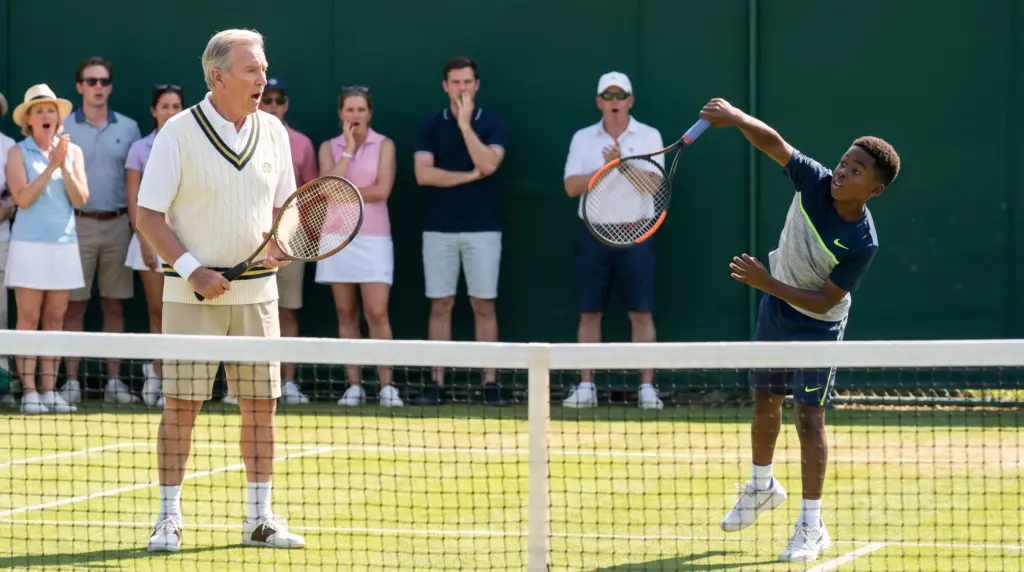
Not loudly.
Not cruelly enough that anyone could accuse him of cruelty.
Just enough.
The kind of laugh wealthy people sometimes use when they believe they are being charming.
It was a warm Saturday morning at the Westbridge Country Club outside Charlotte, North Carolina. The club sat on nearly two hundred acres of carefully landscaped land, with red clay tennis courts, white-columned buildings, a private golf course, and enough flowering dogwoods to make every spring wedding photograph look expensive.
Members had gathered around Court One for the annual Founders’ Weekend exhibition.
There were chilled towels.
Silver trays of lemonade.
Children in white tennis clothes.
Men in expensive polos discussing college rankings as though they personally selected the admissions committees.
And in the middle of it all, Jamal Brooks stood beside a ball cart wearing a faded gray T-shirt, black athletic shorts, and sneakers with a worn left toe.
He was not a member.
That distinction mattered to almost everyone except Jamal.
His mother, Renee Brooks, worked at the club three mornings a week as an events coordinator while finishing a certificate program in hospitality management. That weekend the club needed extra staff, and Renee had no childcare because Jamal’s grandmother had been admitted to the hospital for a minor procedure.
So Jamal came with her.
He was supposed to stay in the employee break room.
He lasted thirty-seven minutes.
Then he found the tennis courts.
Jamal had always found tennis courts.
Public courts.
Cracked courts.
Courts behind schools.
Courts where nets sagged.
Courts with weeds coming through the baseline.
If there was a rectangle painted on concrete and something resembling a net, Jamal noticed.
Westbridge was different.
The surface was perfect.
Freshly brushed clay.
White lines sharp enough to look drawn that morning.
No glass near the fence.
No basketball bouncing onto the court.
No arguments over whether someone had reserved it.
The silence alone made Jamal stare.
One of the club’s assistant pros, Miguel Alvarez, noticed.
“You play?”
Jamal looked toward him.
“A little.”
Miguel smiled.
“A little?”
“Yes, sir.”
That answer was technically true in the way children sometimes use technical truth to protect something private.
Miguel handed him a basket.
“Then help me pick up balls and you can hit for five minutes before the members come out.”
Jamal’s face lit.
“Really?”
“Five.”
“Ten?”
“Five.”
“Seven?”
Miguel laughed.
“Six.”
Deal.
That was how Jamal ended up on Court One when Harrison Cole arrived.
Harrison was fifty-eight, white, broad-shouldered, silver-haired, and still athletic enough to wear tennis shorts without apology. He owned Cole Development Partners, a real-estate company with projects across three states, and served as chairman of Westbridge’s board.
People described him as competitive.
That word performed a lot of work.
Harrison did not like losing.
He did not like being corrected.
He did not like waiting.
And he especially did not like people entering spaces without a category he understood.
He saw Jamal standing beside Miguel’s ball cart.
Then saw the racket in Jamal’s hand.
“New junior member?”
Harrison asked.
Miguel turned.
“No, sir.”
“This is Jamal.”
“His mom is working inside.”
Harrison looked at the boy.
“Oh.”
Not rude.
Not warm.
Just classification completed.
Staff child.
Jamal noticed.
Children always noticed.
Harrison looked toward the racket.
“You play?”
Jamal nodded.
“Yes, sir.”
Harrison smiled.
“You any good?”
Jamal hesitated.
Miguel watched.
“Sometimes.”
Harrison laughed.
There.
The first laugh.
“Sometimes.”
He repeated.
“That may be the most honest tennis answer I’ve heard.”
Two men nearby smiled.
One was Preston Hale, another board member.
The other was Harrison’s friend, Charles Whitcomb.
Jamal looked down at the racket.
Harrison continued.
“You know, we’ve got boys here who’ve been taking lessons since they were four.”
Jamal nodded.
“Okay.”
Harrison looked amused by the lack of intimidation.
“How long have you played?”
“About five years.”
“Lessons?”
“Some.”
“Where?”
Jamal looked toward Miguel.
Then back.
“Mostly public courts.”
Harrison nodded as though that confirmed something.
“Well.”
He picked up a second racket from beside the bench.
“Let’s see.”
“Harrison.”
“What?”
“The juniors are due on court.”
“Five minutes.”
Harrison bounced a ball.
He looked at Jamal.
“You want to hit?”
Several people nearby turned.
Not everyone.
Enough.
Jamal felt his stomach tighten.
He knew this kind of moment.
Not this exact one.
Different versions.
Adults asking him to prove something because they had already decided what his answer should be.
At a park two years earlier, a man told him:
“Show me a real serve.”
At school, a coach once said:
“You sure tennis is your sport?”
At a sporting-goods store, a clerk recommended beginner rackets even after Jamal told him exactly what string tension he used.
None of those incidents were tragedies.
That was almost the point.
Small assumptions accumulated quietly.
Harrison tossed him a ball.
“First to three points.”
Jamal caught it.
Miguel stepped closer.
“You don’t have to.”
Harrison heard.
“Of course he doesn’t.”
He smiled toward Jamal.
“I’m just giving him a chance to say he beat Harrison Cole.”
Preston laughed.
Charles too.
Jamal looked at Harrison.
“Three points?”
“Three.”
“Serve or return?”
The question changed Harrison’s expression slightly.
“You serve.”
Jamal nodded.
He walked to the baseline.
Miguel looked at him.
Really looked.
Something about the way Jamal adjusted his grip made Miguel’s eyes narrow.
Not a beginner.
Jamal bounced the ball four times.
Harrison stood near the opposite baseline, loose and confident.
He had played tennis for forty years.
Club champion twice.
Still competed in regional senior events.
Not professional.
Very good.
He expected a child’s serve.
Fast maybe.
Wild.
The kind talented kids hit when they want adults to notice speed more than placement.
Jamal tossed.
His motion was compact.
Left shoulder turned.
Knees loaded.
Racket dropped behind his back.
Then accelerated cleanly through contact.
The ball kicked wide into the service box and jumped shoulder-high off the clay.
Harrison barely touched it.
The return flew into the fence.
Silence.
Not complete.
A few people kept talking.
But everyone watching the point stopped.
Jamal looked toward Miguel.
Miguel’s mouth had opened.
Harrison stared at the mark in the clay.
“Lucky serve.”
Jamal said nothing.
Harrison retrieved another ball.
“Again.”
Jamal bounced.
Second serve.
This one went down the T.
Less pace.
More precision.
Harrison reached it.
Returned deep crosscourt.
Good ball.
Jamal moved early.
Split step.
Two quick adjustment steps.
Forehand.
Heavy topspin into Harrison’s backhand corner.
Harrison recovered.
Backhand slice.
Short.
Jamal moved forward immediately.
Not rushed.
Recognizing.
He took the ball above the net and sent a controlled forehand behind Harrison.
Winner.
Two-zero.
A man behind the fence whispered:
“Jesus.”
Jamal heard.
He pretended not to.
Harrison’s smile had disappeared.
Miguel folded his arms.
“Jamal.”
The boy looked over.
“Where did you learn that?”
“Public courts.”
Miguel almost laughed.
“No.”
Jamal looked down.
Harrison stepped to the baseline.





