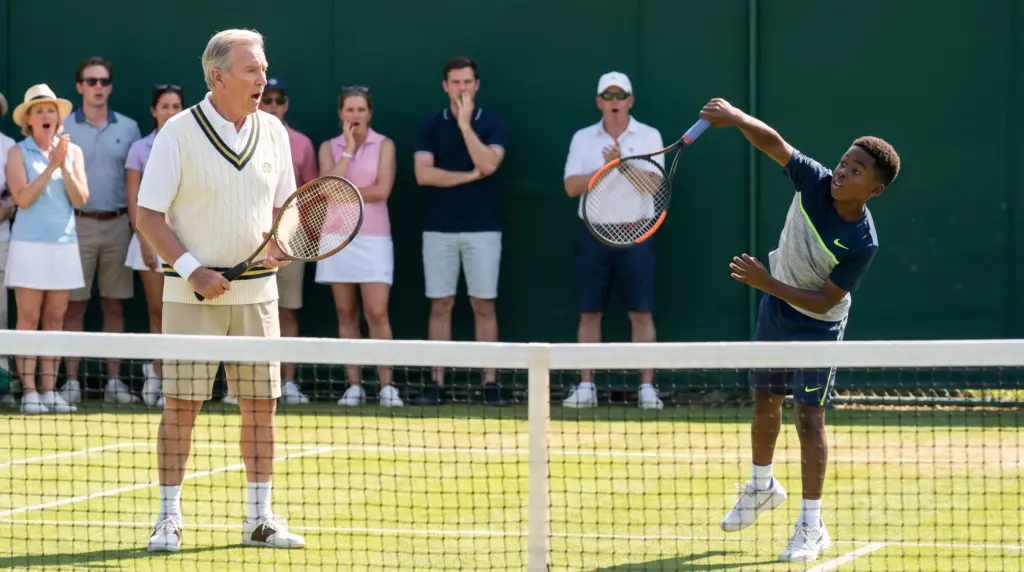
“Rally.”
“Inside-out?”
Jamal frowned.
“How do you know?”
“Because you think inside-out forehand solves world hunger.”
“It works.”
“Until somebody reads it.”
Derrick fed a ball.
“Backhand.”
Jamal groaned.
“Why?”
“Because rich man’s forehand is not paying your backhand debt.”
Training resumed.
Good.
For several weeks, nothing dramatic happened.
Westbridge revised its wildcard process.
The Bennett Tennis Project received the policy draft.
Derrick marked it up in red.
Too much documentation.
Transportation assumptions.
Entry fees unclear.
Uniform language expensive.
He sent it back.
Susan Carlisle changed most.
Harrison wanted to personally cover fees.
Susan said no.
“Why?”
“Because then kids depend on Harrison feeling generous.”
He stared.
She continued.
“Build the waiver into the program.”
“Right.”
Institution, not benefactor.
He was learning.
Slowly.
The next spring, Westbridge hosted an open junior invitational.
Four wildcard spots.
Thirty-one non-club applications.
Jamal qualified based on ranking.
No chairman approval.
Derrick made sure of that.
Jamal arrived wearing a white shirt Renee bought on sale.
Same worn backup sneakers.
New match shoes in his bag.
Renee sat under an umbrella with a thermos.
Harrison saw them.
He did not approach before the match.
Growth.
Jamal won first round.
Lost second.
Badly.
6–2, 6–1.
Opponent named Evan Kim.
Thirteen.
Fast.
Disciplined.
Attacked Jamal’s backhand repeatedly.
By the second set, Jamal was furious.
Afterward he sat behind the court with a towel over his head.
Harrison passed.
Stopped.
Then reconsidered.
He kept walking.
Renee noticed.
She appreciated that more than if he had offered encouragement.
Derrick sat beside Jamal.
“You done?”
“No.”
“Good.”
“What did he do?”
“Backhand.”
“What else?”
“Returned my serve early.”
“What else?”
Jamal hated this.
“He moved me forward.”
“What else?”
“He was better.”
Derrick nodded.
“Excellent.”
Jamal looked offended.
“What?”
“That is the most useful answer.”
Jamal stared at the ground.
“I hate losing here.”
“Why here?”
“People know.”
“Know what?”
“That I beat Mr. Cole.”
Derrick understood.
There.
The hidden consequence of the fun story.
Jamal had become the boy who surprised the rich man.
At Freedom Park, kids joked.
At Westbridge, members remembered.
Some expected another show.
Derrick looked at him.
“You think losing makes that match fake?”
“No.”
“Then?”
“I don’t know.”
“Yes, you do.”
Jamal whispered:
“I don’t want them thinking it was luck.”
Derrick sighed.
“You cannot spend your tennis career arguing with one Saturday.”
Jamal looked up.
“Then what?”
“Play the ball in front of you.”
“That’s corny.”
“Yes.”
“Still true.”
Jamal laughed reluctantly.
Derrick continued.
“You beat Harrison.”
“Good.”
“Evan beat you.”
“Also good.”
“Neither is a prophecy.”
That became the lesson Jamal needed more than praise.
Harrison learned it too.
Members kept bringing up the three-point match.
“You found the next champion.”
“Harrison discovered him.”
“Kid came out of nowhere.”
Every phrase irritated him.
One afternoon Harrison corrected a friend.
“I did not discover him.”
Charles Whitcomb laughed.
“You literally found him on Court One.”
“No.”
“He was already ranked.”
“Already coached.”
“Already playing tournaments.”
“I only discovered that I had not been paying attention.”
Charles became quiet.
Good.
Renee heard about the quote through another employee.
She almost respected him.
Almost.
At fourteen, Jamal grew six inches in ten months.
His coordination vanished temporarily.
Serve timing fell apart.
Knees hurt.
Ranking dropped.
Parents around him panicked more than he did.
One suggested a private academy in Florida.
Another said public training had reached its ceiling.
Harrison heard through Susan.
He offered nothing.
Important.
Then Renee called him.
That surprised him.
“Mr. Cole?”
“Renee.”
“My son needs indoor court time this winter.”
Harrison sat up.
“Okay.”
“Do not sound excited.”
He laughed.
“Sorry.”
She continued.
“Derrick says Westbridge has unused late-night court blocks.”
“Yes.”
“I am not asking for charity.”
“Understood.”
“I want to know whether the Bennett Project can rent them at nonprofit rate.”
Harrison smiled.
Institution.
Terms.
Clear.
“Yes.”
Then corrected.
“I believe yes.”
“Susan decides scheduling.”
“Good answer.”
She noticed.
They worked it out.
Bennett players trained at Westbridge Tuesday nights during winter.
Not free.
Discounted nonprofit rate.
Same policy later offered to three other community programs.
Members complained about parking.
Of course.
Change always encountered parking complaints.
Jamal improved.
At fifteen, he won a regional tournament.
At sixteen, he lost in the state semifinal.
At seventeen, college coaches began calling.
Not Stanford.
Not UCLA.
Not a fairy tale.
Several strong Division I and Division II programs.
He cared about academics more than people expected.
Engineering.
His father had been an engineer before tennis consumed his early twenties.
That connection mattered.
But father required explanation.
Marcus Brooks was alive.
Living in Houston.
He and Renee divorced when Jamal was seven.
Before divorce, Marcus coached his son.
Former college player.
Excellent.
Too excellent.
He recognized Jamal’s talent early and made the mistake talented parents often make.
He confused access with destiny.
Private drills at five thirty in the morning.
Tournament travel.
Video analysis.
Nutrition rules.
Too much.
Renee objected.
Marcus said she did not understand elite sport.
Marriage deteriorated around many things.
Tennis became symbol and weapon.
After divorce, Marcus moved for engineering work.
Contact became inconsistent.
Jamal kept tennis.
That surprised everyone.
Especially Renee.