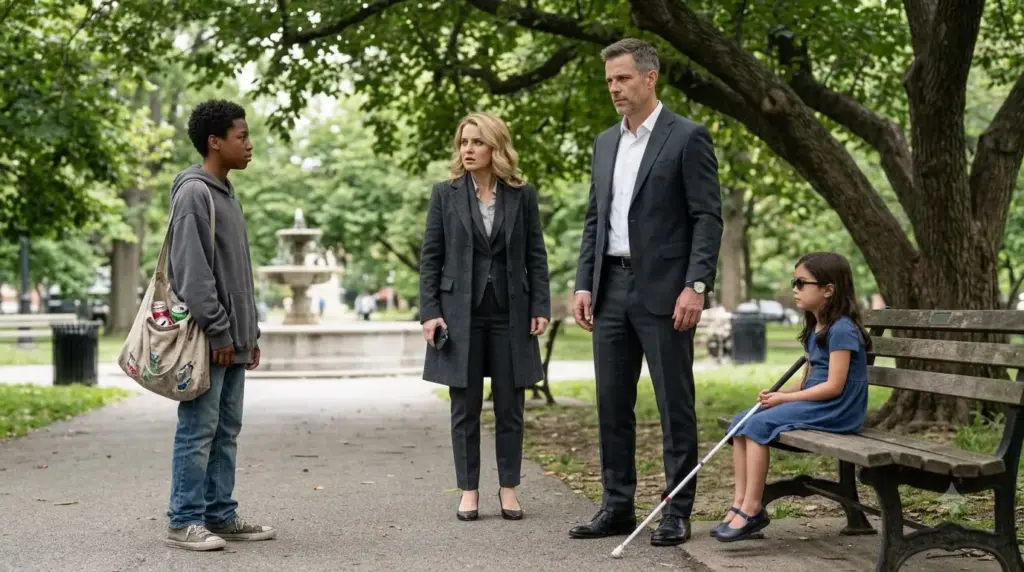
He picked up his fork. No, he watched his daughter eat the food his wife had prepared. And for the first time in weeks, since before the blindness, since before the specialists, since before the park and the impossible boy and the sentence that wouldn’t stop repeating in his chest, Daniel Whitmore sat at his own dinner table and felt genuinely afraid. The next 3 days, Daniel watched. He didn’t say anything.
He went to work in the mornings, came home by 6:00, sat through dinners, helped Lily with her audiobooks before bed, and kissed Evelyn good night with the ordinary care of a man who was not quietly reordering everything he thought he knew. He was careful about it. He had spent 20 years in rooms where showing too much too soon could collapse a negotiation before it had started, and he treated the inside of his own house the same way now, strategic composed. a patient. He watched Evelyn prepare Lily’s meals. He had always known she did it herself.
He had understood it as devotion, as the way a mother who felt helpless channeled that helplessness into something she could control. But observation changes what you see. And what Daniel saw over those three days was not devotion. What he saw was management. Evelyn kept the pantry locked when Lily’s food was being prepared.
She sent the chef, Marcus, who had been with them four years, out of the kitchen on small errands whenever she began. She measured things, not casually, not roughly, but with the precision of someone following a protocol, dipping a small measuring spoon into containers she kept in the back of the refrigerator on a shelf Daniel had never opened because nothing in their marriage had ever suggested he needed to. She prepared Lily’s water separately using a specific filter pitcher she had purchased 8 months ago and refilled herself. On the third evening, Daniel had a memory. He was watching Evelyn stir the evening broth, the pale yellow powder dissolving into nothing the way it always did.
And he remembered a conversation from 10 months ago, a dinner party, a glass of burgundy, Evelyn talking to one of her friends about a documentary she’d watched about neurological plasticity. She had been animated about it in a way he hadn’t seen in a while. She’d said something about the brain’s capacity for rewiring under certain conditions, and her friend had said that sounded terrifying. And Evelyn had laughed and said, “Only if you thought the original wiring was perfect.” He hadn’t thought about that conversation since the night it happened.
But he thought about it now. He also thought about the months before Lily’s blindness began, a period he had spent largely distracted by a company acquisition that had consumed him through the fall. He had been traveling, working late, present in the house, without being present in his own home. Evelyn had been handling everything involving Lily during those months. School pickups, medical checkups, the Tuesday afternoon swim class Lily had loved, the vitamins and supplements she’d started Lily on.
After consulting the nutritionist, the dietary changes she’d made to Lily’s meals. She’d said Lily was showing some early signs of fatigue and nutritional deficiency. She’d said the supplements would help. Daniel had nodded and signed the credit card statement and kept working. He thought about all of that now with the slow, nauseating clarity of a man being shown something he should have noticed much earlier.
On the fourth day, Daniel drove across town to the offices of a private physician he had known professionally but never used personally. Dr. Adele Ferguson had a quiet practice in a building with a secure entrance and no signage visible from the street. She treated executives, politicians, people who needed medical opinions that stayed out of hospital records. Daniel had sent her referrals twice and received her card with the unspoken understanding that the favor was mutual. Before he left, he had a quiet conversation with Marcus, the chef, while Evelyn was upstairs with Lily. He had framed it casually, a question about the kitchen, about supply ordering, about whether there was anything Marcus needed.
Then, as naturally as he could manage, he had asked whether Evelyn was particular about Lily’s meals. Marcus had paused with a dish towel in his hands. “Very particular,” he said, choosing the words carefully, the way an employee chooses words when they’re not sure how honest they’re supposed to be. She prefers to handle Miss Lily’s food herself, even when I offer. Does she ever use ingredients from her own supply?
Things you haven’t ordered? Marcus had looked at a point somewhere above Daniel’s left shoulder. There are a few containers in the back of the refrigerator that she keeps for Lily. I don’t touch those. Has she ever asked you to add anything to Lily’s food when you were cooking?
No, sir. She does all of that herself. Daniel had thanked him and let the conversation move to something else. And Marcus had returned to his work with the expression of a man who was grateful not to be asked anything further. He told her what he knew.
Not all of it, not the boy, not the park, but the facts of Lily’s condition, the tests, the diagnosis. Then he told her he wanted a second opinion conducted quietly without informing his wife. Dr. Ferguson listened without interrupting. Then she said she could arrange it, but that she’d need access to Lily, direct access, and that if what he was describing was what he seemed to be suggesting, they should talk about what kind of testing he actually wanted done. Blood work, Daniel said. Comprehensive and specifically any compounds that aren’t naturally occurring. Dr. Ferguson looked at him for a moment.





