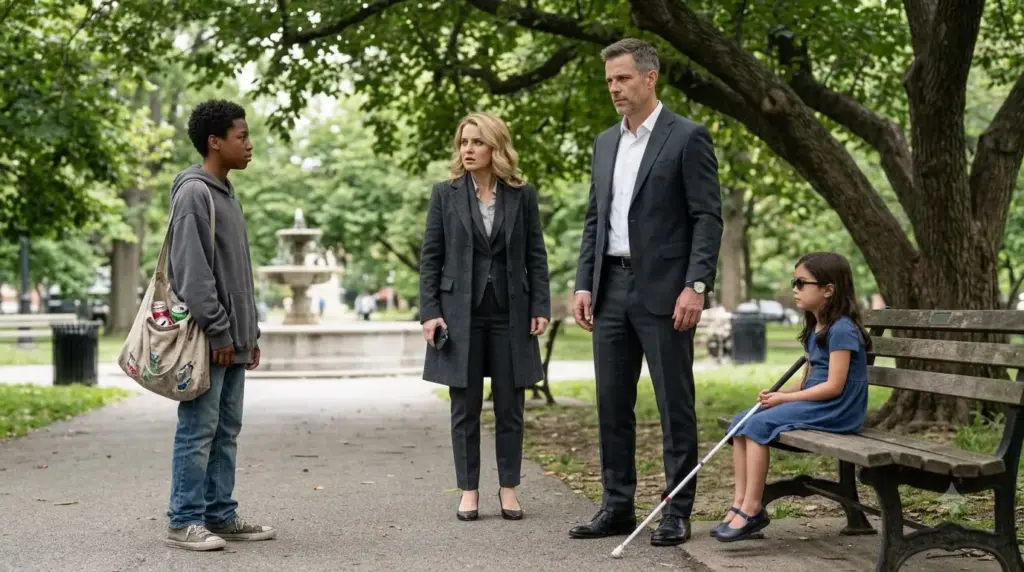
You understand what you’re asking me to screen for? I understand completely. She nodded once. I’ll need 2 weeks to arrange it without raising questions. He told her he’d be in touch.
He was halfway back to the parking garage when his phone rang. It was Evelyn. She said one of Lily’s specialists offices had called about rescheduling and asked if Daniel had recently requested any additional testing. She kept her voice level, curious without being accusatory. But the question arrived 3 hours after Daniel’s meeting with Dr. Ferguson, and Daniel’s brain, which was already performing its own kind of audit, registered the timing without deciding what to do with it yet.
He told her, “No, nothing had been scheduled.” “Okay,” Evelyn said. “I just want to make sure we’re not overloading her. Too many tests can create anxiety, especially in kids her age. Of course, Daniel said, “I agree with you completely.”
He ended the call and sat in his car in the parking garage for 4 minutes. He went back to the park. He went three separate times over the following week, always in the afternoon, always to the east path near the elm trees. Isaiah wasn’t there. He wasn’t anywhere in the immediate area, not at the fountain, not near the trash bins, not on the open lawn where the can collectors sometimes moved in slow patterns.
Daniel asked the maintenance worker who had called the boy’s name at the park that day. She said she didn’t know him personally, that she’d just seen him around before and knew he wasn’t supposed to be in the east section because there were posted rules about commercial collection in that area. He’s not from around here, I don’t think, she said. He comes and goes. I’ve seen him maybe a handful of times.
Daniel described him. The gray hoodie, the faded jeans, the canvas bag. That’s him, she confirmed. Don’t know his name or where he stays. Daniel left his card with her and asked her to call if she saw the boy again.
He drove home and walked through the front door to find Evelyn in the kitchen standing over the counter finishing Lily’s lunch. She smiled at him, warm, natural, the easy smile of a woman comfortable in her own house and asked how his meeting went. Fine, he said. Long. Lily’s been asking about you, Evelyn said.
She wanted to know if you’d be home for lunch. He went to find Lily. She was sitting in the sun room, a children’s audio book playing softly from the small speaker on the windowsill. He sat down beside her and she turned her face toward him and said, “Daddy.” With the particular certainty that children have about voices they’ve known their whole lives.
He put his arm around her and she leaned in small and warm, and they sat together while the audiobook narrator described a girl sailing across an impossible sea. He held his daughter and tried to remember when he had last felt certain about anything. The idea came to him on a Thursday evening. Evelyn had prepared Lily’s dinner as usual, a bowl of chicken soup with small pasta shapes, the kind Lily had always liked, and had stepped away to take a phone call in the study. The soup was on the counter waiting to cool.
Lily was in her room. The chef, Marcus, had left for the day. Daniel stood in the kitchen for 20 seconds. Then he picked up Lily’s bowl. He carried it carefully to the pantry and covered it with a dish towel on the back shelf.
He went to the refrigerator, took out the leftover chicken Marcus had roasted the day before and prepared a simple bowl, plain broth, chicken, the same pasta, without any additives, without anything from the back shelf of the refrigerator. He carried it to Lily’s room and set it on her table. He did not put the pale yellow powder in it. He used the same bowl, the same spoon. He arranged it so that it looked exactly like what it was supposed to be.
Then he sat near the door and watched his daughter eat. Lily had been eating for about 8 minutes when it happened. She stopped with her spoon halfway to her mouth, her face tilted upward slightly, her expression shifting into something uncertain and alert. She turned her head toward the window, but the blinds were half open, the early evening sun cutting thin gold lines across the floor, and Lily was looking, or rather her eyes were moving, toward the light in a way they hadn’t moved in weeks. She blinked three times, slow and deliberate, and each time the muscles around her eyes tightened slightly, like a camera trying to adjust to something it wasn’t sure was really there.
“Daddy,” she said quietly. Is the light on in here? Daniel’s heart did something that wasn’t quite fear and wasn’t quite hope. It was the space between those two things, wide and cold and very still. The blinds are open, baby, he said carefully.





