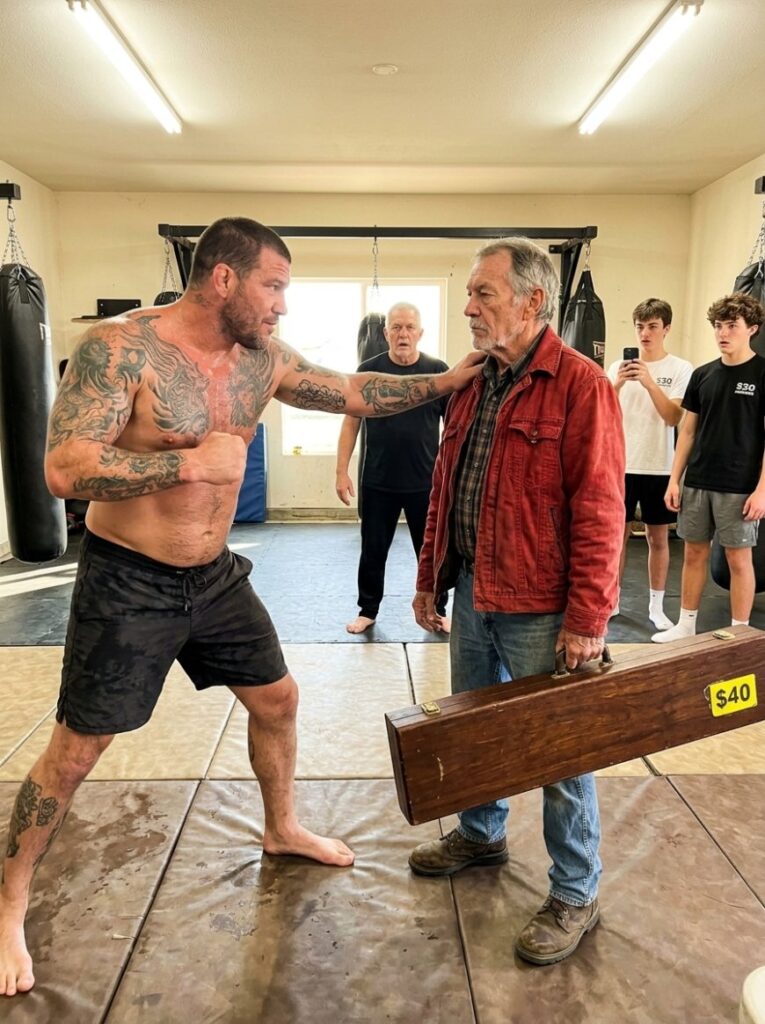
The older grandson—the one who had quoted forty dollars like he was selling a used lawnmower—took a step back and his heel caught the edge of a cardboard box labeled “kitchen.” He stumbled, caught himself on the porch railing, and stood there blinking at Henry like a man who had just watched a ghost walk out of a cornfield. “I don’t understand,” he said. His name, Henry would learn later, was Caleb. Caleb Mercer. Twenty-nine years old, a diesel mechanic from Alcoa, Tennessee, with grease under his fingernails and a tattoo of his daughter’s birthday on his forearm. “You said 1968,” Caleb said. “You said Vietnam. But Grandpa Tom—he worked for Norfolk Southern for thirty-one years. He mowed his lawn. He watched the Vols on Saturdays. He wasn’t—he never—” “He never what?” Henry asked quietly. “He never said anything.” Henry nodded slowly. He knew that answer. He had given that answer himself, hundreds of times, to his own daughter, to his wife, to men at the VFW who bought him drinks and wanted to hear war stories he couldn’t tell. “That’s how it works, son,” Henry said. “The men who did the most talking did the least fighting. The ones who were actually there—they came home and they put it in a box and they buried the box.” The younger brother—Dawson, twenty-three, still holding his paper coffee cup like it was a shield—finally spoke. “Are you saying our grandfather was some kind of hero?” Henry looked at him. “I’m saying your grandfather was a Marine scout sniper. I’m saying he saved my life. I’m saying I’ve spent fifty-six years trying to thank him, and I found out this morning that I’m three months too late.” The wind moved through the maple tree and sent a scattering of leaves across the driveway. Somewhere inside the farmhouse, a clock ticked against the silence. Rachel Mercer, the granddaughter with the clipboard, had not moved from her spot near the butter churn. She was thirty-four, a nurse at Blount Memorial, and she had driven over from Maryville at six in the morning to help her brothers run the sale because her mother couldn’t face it. Her eyes were red and her hands were shaking and she had not said a word since Henry had spoken Tom’s name. Now she said, “How do you know the rifle was his?” Henry turned to her. His pale blue eyes were wet at the edges, though no tears had fallen. “The serial number,” he said. “I memorized every serial number in our platoon’s sniper section. Carried it in a green notebook for thirteen months. Your grandfather’s number ended in 4471. That’s the number on that receiver.” He paused. “And there’s an inscription under the receiver. Hand-punched. My initials and a date. November 18th, 1968.” Caleb’s face went pale. “What does that mean?” Henry was quiet for a moment. Then he said, “That’s the day your grandfather carried me out of a firefight I shouldn’t have survived.” The silence that followed was so complete that Henry could hear the young woman’s breathing across the garage. Dawson set his coffee cup down on the folding table. His hand was not steady. “Okay,” he said. “Okay, I think you need to sit down and tell us everything. Because we buried this man in August and we didn’t know any of this. We didn’t know any of it.” Henry looked at the wooden case. Then at the three young people standing in the garage of a farmhouse that smelled like wood smoke and old cardboard and forgotten lives. “Sit down,” he said. “This is going to take a while.” — They found chairs. Caleb pulled two metal folding chairs off the stack near the lawn mower and set them up in the garage. Rachel brought out a kitchen chair for Henry. Dawson sat on the steps with his elbows on his knees. The estate sale was, for all practical purposes, over. A couple of early bargain hunters had drifted away. The yard was empty except for the maple leaves and the hand-painted sign on Route 411 that said Mercer family estate sale, Saturday 8 to 2. Henry sat down slowly, favoring his left knee. He set his cap on the floor beside his chair. He folded his hands in his lap and looked at the wooden case across the garage, the way a man looks at a grave he has finally found. “I met your grandfather in March of 1968,” Henry said. “I was twenty-one years old. I’d been in-country three weeks and I didn’t know my ass from a hole in the ground. Tom was twenty-two. He’d already been there six months. He was a scout sniper attached to First Battalion, Fifth Marines.” Caleb shifted in his chair. “What’s a scout sniper?” “Two-man team,” Henry said. “One shooter, one spotter. I was the spotter. Your grandfather was the shooter. We carried that rifle between us for thirteen months. He did the killing. I did the looking.” He paused. “Except for one day. One day, I did the bleeding, and he did the saving.” Dawson’s voice was barely above a whisper. “What happened?” Henry closed his eyes. For a moment, he was not in a garage in Tennessee. He was twenty-one years old again, crouched behind a fallen tree in the Quế Sơn Valley, with his blood running between his fingers and the world going gray at the edges. “We were on a patrol south of Hill 425,” he said. “November 18th, 1968. Early morning. We walked into an ambush in a draw—a narrow valley with steep sides. NVA regulars. They had us bracketed before we knew they were there.” He opened his eyes. “Our lieutenant was killed in the first volley. The radio operator went down next. I caught a round through the meat of my right thigh and went down behind a tree. Couldn’t walk. Couldn’t crawl. Couldn’t do anything except bleed and listen to the fire coming in.” Rachel





