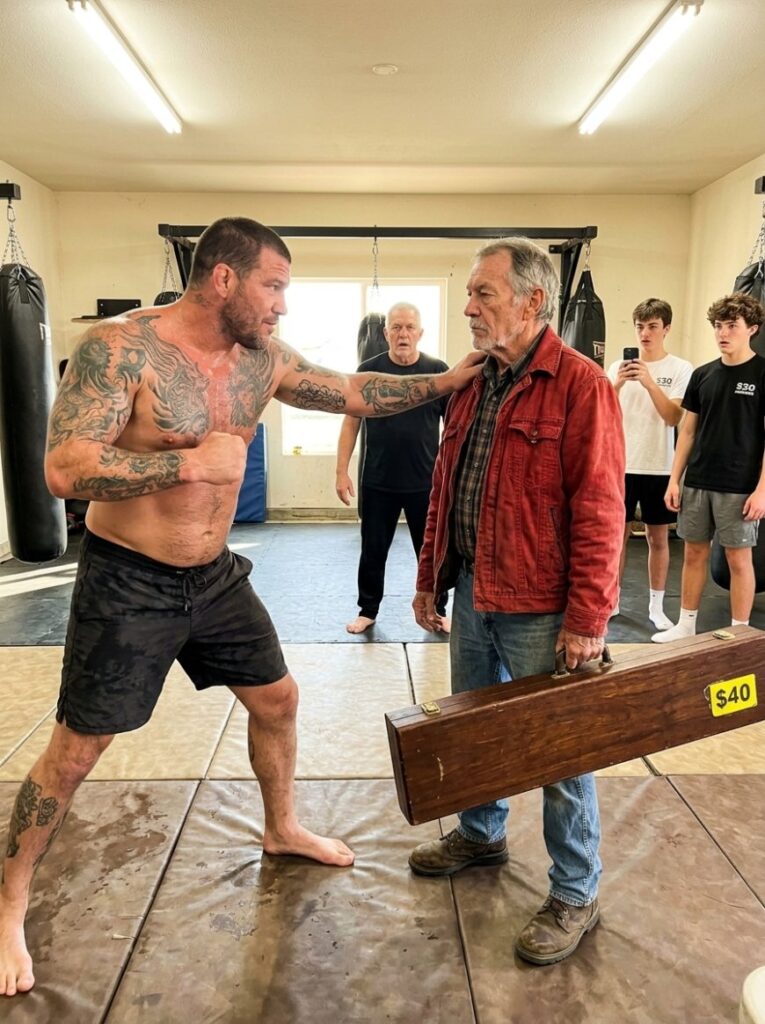
National Geographics had been moved aside. The wooden case, latched, sat alone on the folding table in a small clean square of empty space. Henry Caldwell sat in a kitchen chair in the middle of the garage and told stories until his voice went hoarse. He told them about the time Tom Mercer had traded a pack of cigarettes for a case of beer and shared it with the whole platoon. He told them about the time Tom had carried a wounded Vietnamese child four miles down a muddy road to a field hospital and had never mentioned it again. He told them about the time Tom had given his last canteen of water to a man who was dying, and had sat with him until he wasn’t. He told them about the letters Tom had written home, letters that Henry had never read but had watched him write, night after night, under a poncho with a flashlight in his teeth. He told them about the way Tom had said “Semper Fi” like it meant something, like it was a promise instead of a slogan. And he told them about the morning of November 18th, 1968, and the way Tom Mercer had crawled through the fire to reach him, and the way he had stayed on that rifle for eleven minutes, and the way he had not let go of Henry’s web belt until the chopper came. “He was twenty-two years old,” Henry said. “Twenty-two. I was twenty-one. We were children. And we did things that men three times our age couldn’t do.” He looked at Susan. “You asked me what he was like over there. He was like that. He was like all of it. And he came home and he put it in a box and he never talked about it again. That’s not weakness. That’s not shame. That’s the kind of strength that most people will never understand.” — Henry Caldwell drove home that evening in his 1998 Ford pickup with the windows down and the autumn air smelling of wood smoke and damp leaves. He did not take the rifle with him. He did not take anything with him except a small black-and-white photograph that Susan had pressed into his hand at the door. Two young men in front of a sandbag wall, one of them gone fifty-six years, one of them still here. He drove past the tobacco barns and the small Baptist cemeteries and the country roads that rolled gently toward the mountains. He drove past the places where he had lived his whole life, the places where he had raised a daughter and buried a wife and grown old in a house that was too quiet. He thought about Tom Mercer. He thought about the way Tom had hummed Hank Williams in his sleep. He thought about the way Tom had shared his cigarettes and his water and his silence. He thought about the way Tom had crawled forty meters through the fire to save a man he had only known for eight months. He thought about the way Tom had come home and built a life and never asked for anything. And he thought about the way the world had almost forgotten him. When Henry got home, he sat in his truck for a long time. Then he went inside and called his daughter in Ohio. “Honey,” he said. “I’ve got a story to tell you.” — On Tuesday morning, Henry sat down at his kitchen table and wrote a four-page letter to Susan Mercer. He wrote it in pencil, in the careful blocky handwriting of a man who had not been sure his hand still remembered cursive. He told her every story he could remember about her father—the kind, ordinary, daily stories that mattered the most. The way Tom hummed Hank Williams in his sleep. The way Tom shared his cigarettes when nobody else had any. The way Tom had once carried a wounded Vietnamese child four miles down a muddy road to a field hospital and had never mentioned it again. He wrote until his hand cramped. He wrote until the sun went down and the kitchen grew dark. He wrote until he had filled all four pages and had to find another sheet of paper. Then he sealed the letter, walked it to the mailbox at the end of his gravel driveway, and put up the little red flag. He stood there for a long minute looking at the road. The sky was very blue. Somewhere out past the tree line, a hawk was riding a thermal in slow, patient circles, the way hawks have always done. Henry Caldwell watched it for a while. Then he walked back into his house, closed the door, and sat down in his recliner with the photograph of two young Marines in his hands. He looked at Tom’s face. Young and thin and grinning the wrong kind of grin. “You’re welcome,” he said quietly. “And thank you.” — Six months later, the rifle hangs above the fireplace in Susan Mercer’s living room. It’s in a glass case that Caleb built himself, with the brass latches still working and the inscription HC November 18th, ’68 visible behind the glass. Beside it hangs the photograph of two young Marines, the one that Susan almost threw away. Under the photograph is a small brass plate that Caleb engraved in his own shop. It reads: Sergeant Thomas Mercer, USMC. Quiet man. Hero. We didn’t know, and now we do. Henry Caldwell visits twice a year. Once in November, on the anniversary of the ambush. Once on Memorial Day. He sits in Susan’s living room and tells the great-grandchildren stories until the great-grandchildren beg him for more. Caleb makes coffee. Dawson brings his kids. Rachel brings a pie. And nobody in that house ever calls anything Grandpa Tom a souvenir again. — The lesson, in case you missed it, is the oldest one we have. We keep needing
PART 2: “It’s Just A $40 War Souvenir,” The Grandson Laughed