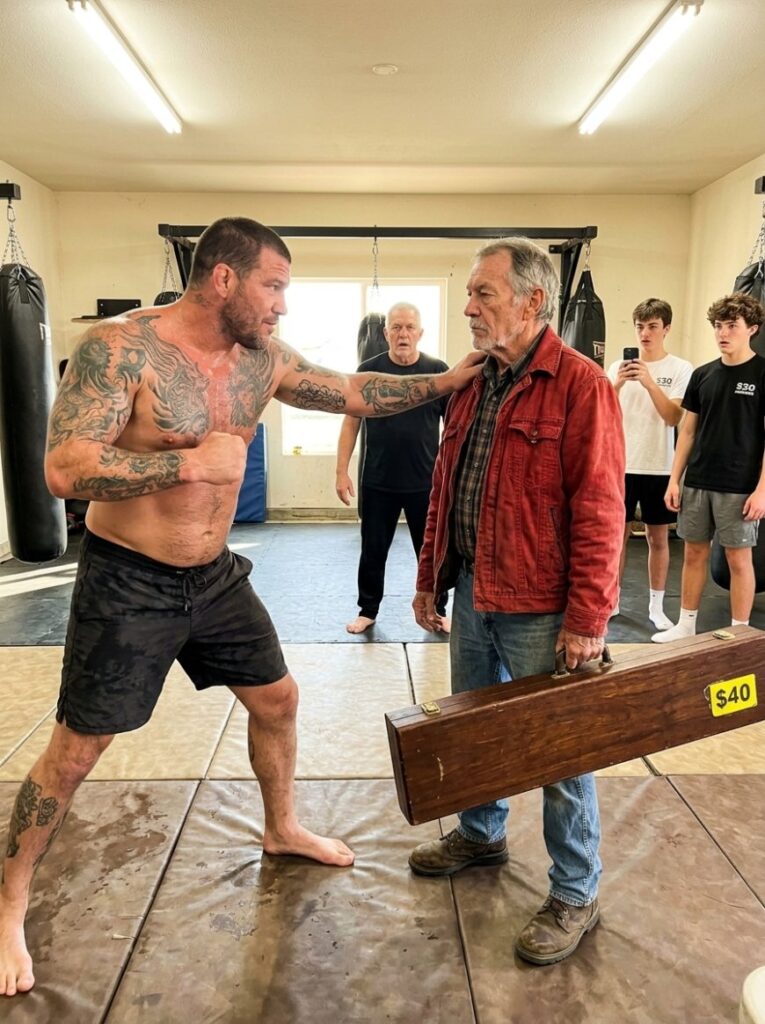
had her hand over her mouth again. Tears were running down her face, but she wasn’t making a sound. “Your grandfather was forty meters away,” Henry said. “Forty meters of open ground under fire. He crawled it. On his belly. With that rifle strapped across his back. When he got to me, he set up on a folded flak jacket and he started shooting.” Henry’s voice did not break. It never did. But his hands, folded in his lap, had begun to tremble. “He silenced four enemy positions in eleven minutes. Two of them were within fifty meters of where I was lying. One of them was close enough that I could see the muzzle flash.” Caleb was leaning forward now, his elbows on his knees, his eyes fixed on Henry’s face. “At dusk, a relief platoon came up the draw,” Henry said. “Your grandfather was still on the rifle. He hadn’t moved. He hadn’t let go of my web belt the entire time. When they finally got me on a stretcher, he walked beside it the whole way back to the LZ. Wouldn’t let go of my belt until they loaded me on the chopper.” He looked at the three young people in front of him. “I was in a hospital in Da Nang for three weeks. When I got back to my unit, your grandfather had already been recommended for the Silver Star. For what he did that day.” “What’s a Silver Star?” Dawson asked. “Third-highest medal for valor in combat,” Henry said. “Behind the Medal of Honor and the Navy Cross. It’s not given out for showing up. It’s given out for doing something that most men couldn’t do and wouldn’t do.” He paused. “But the citation got downgraded to a Bronze Star with V device. Valor device.” “Why?” Henry’s jaw tightened. “Because the lieutenant who died was twenty-two years old. He was engaged to a girl in Macon, Georgia. Your grandfather said the medal belonged on the lieutenant’s mother’s mantel, not on his own chest. He never even pinned it on.” The garage was silent except for the sound of Rachel’s quiet crying. Henry kept going. The words were coming on their own now, the way they always did once he started. “Three weeks after the ambush, your grandfather borrowed a metal stamp from a base armory and he punched those letters into the receiver. HC. November 18th, ’68. He told me he wanted to remember why he was carrying that rifle. He said, ‘I want to remember what it’s for.'” Henry’s voice was low and steady. “That’s why I knew the rifle. That’s why I knew the case. That scuff near the latch—I watched your grandfather kick that case shut on a wet morning in April of 1968 because we were late for a patrol. I remember it like it was yesterday.” — Caleb Mercer sat with his back against the garage wall and his hands over his face. He had spent the last three months cleaning out his grandfather’s house. He had thrown out boxes of old clothes. He had sold the furniture. He had priced that rifle case at forty dollars because he thought it was just some old hunting thing that nobody would want. He had not asked his mother about it. He had not asked his grandmother about it. He had not looked inside the case until that morning, when he had opened it, seen a dusty old rifle, and shut it again because he had a sale to run. Forty dollars. He had put a forty-dollar sticker on a piece of his grandfather’s soul. “I’m sorry,” he said. His voice was muffled by his hands. “I’m so sorry. We didn’t know. We didn’t know any of this.” Henry looked at him for a long moment. “Son, you didn’t know because your grandfather didn’t tell you. And he didn’t tell you because he was doing what men of his generation did. He came home, he put it away, and he built a life. The silence wasn’t a lie. It was how he survived.” Dawson stood up from the steps. His face was wet. “But we should have asked. We should have—I used to go fishing with him. Every summer. We’d sit on that dock for hours and he’d never say anything and I thought—I thought he was just quiet.” “He was quiet,” Henry said. “He earned the right to be quiet. That’s a thing a man earns.” Rachel finally spoke. Her voice was raw. “Mr. Caldwell, my mother is going to want to meet you. She’s going to want to know everything. Can I call her? Can I tell her you’re here?” Henry nodded. “You can tell her. I’ll wait.” Rachel stepped out of the garage, her phone already pressed to her ear. Henry could hear her voice, low and urgent, drifting from the driveway. Caleb lowered his hands. His eyes were red and his face was a mess of grief and confusion. “The rifle isn’t for sale,” he said. “Sir, the rifle isn’t for sale. I’m sorry. We didn’t know.” Henry held up a hand. “I didn’t come here to buy it, son. I came here to walk through your grandfather’s life. I didn’t know he was gone until this morning. I didn’t know I was three months too late.” He looked at the wooden case. “I want you to keep it. I want you to keep it forever. I want your children to have it, and their children. And I want you to tell them what their great-grandfather did with it. That’s the only thing I want.” — Susan Mercer arrived at the farmhouse at 12:20 in the afternoon. She was sixty-two years old, silver-haired, with her father’s blue eyes and a face that had been crying for most of the drive from Knoxville. She was carrying a shoebox that she had pulled from the back of her closet five minutes after Rachel’s phone call. She walked into the
PART 2: “It’s Just A $40 War Souvenir,” The Grandson Laughed