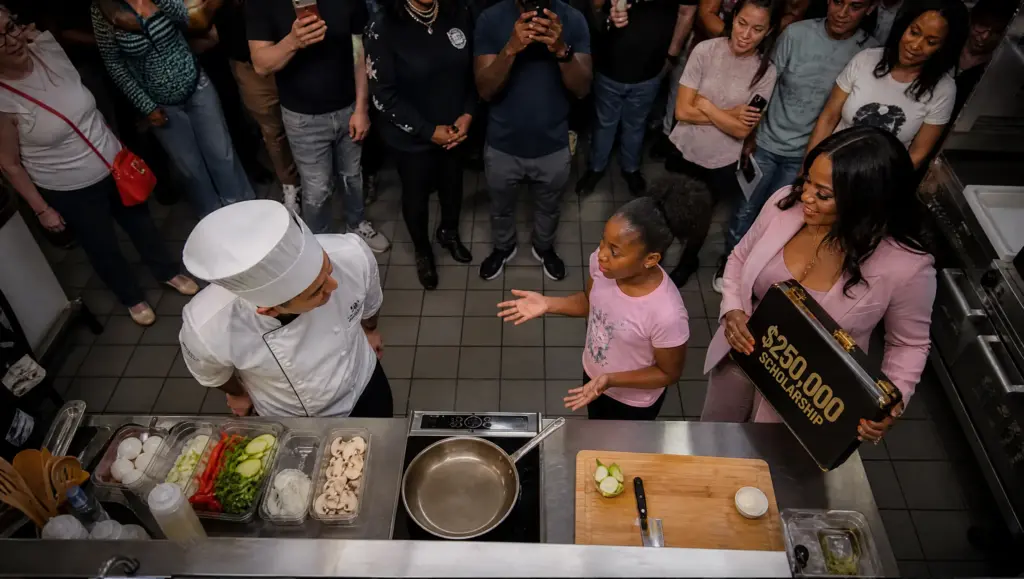
Delia Rowe stood just inside the pass, mustard-yellow crewneck sweatshirt bright against the white coats, blue jeans still carrying a faint crease from the school day, long intricate box braids gathered loosely at her shoulders so they would not swing into anything hot. She was eleven. She did not fidget. She watched the pan the way some children watch a storm through a window—without panic, without theatrically leaning closer, simply refusing to look away from what was already going wrong.
Head Chef Rainer Holst noticed her because the line noticed her, and because stillness in a kitchen during the first rush was a kind of noise. He was in his fifties, salt-and-pepper hair styled back from an angular face, double-breasted white coat buttoned with neat knots that never looked rushed even when the tickets did. He had built Emberwick’s reputation on precision and a certain public austerity. He did not smile for cameras. He did not coo over children. He turned, saw the girl, and spoke as if the floor itself had invited a tourist.
“Kitchen isn’t a playground.”
Delia’s eyes stayed on the sauce. “Your sauce is splitting.”
Theo Padilla, the bearded cook on sauté, almost dropped his tongs. Carmen Ruiz, dark hair pulled back tight under her cap, paused mid-wipe on a cutting board and glanced from the pan to the girl and back again. Someone farther down the line snorted and then stopped, uncertain whether laughter was allowed.
Rainer’s voice cooled. “Excuse me?”
Delia sniffed once, small and deliberate, the way her grandmother sniffed milk before pouring it. “Too much heat after the butter.”
Theo whispered, not quietly enough, “She can tell that from there?”
Rainer’s jaw shifted. The condescension arrived on schedule, polished by years of defending his station. “You cook professionally now?”
“No,” Delia said.
“Then maybe let professionals handle it.”
She did not raise her voice. She did not step back. “You also burned the shallots.”
Carmen’s shoulders went tight. Theo stared into the pan as if it might confess. The shallots at the edge had gone past sweet into a bitter brown that no amount of whisking would hide once the emulsion broke fully. Rainer knew it. Knowing it and hearing it from an eleven-year-old in a sweatshirt were different injuries.
Theo cleared his throat. “Chef… She’s right.”
The hood noise filled the silence that followed. Tickets fluttered on the rail. A runner hovered, waiting for a plate that was not ready. Rainer looked at Delia again—really looked—and something in his expression changed from dismissal to a sharper, more dangerous curiosity. Interest, in a man like him, was never soft.
“What would you do?” he asked.
Delia’s mouth tipped, not into triumph, just into the small private smile of someone who had already run the steps in her head. “Start again and give me ninety seconds.”
Rainer held her gaze for one more beat, then nodded once. He slid an empty pan onto the burner as if the gesture itself were a dare. The line behind Delia arranged itself without being told—Theo angling his body to give her space, Carmen clearing a corner of the board, the other whites becoming a quiet audience that still had to keep cooking. Wide space. Warm light. A child centered where adults usually stood.
That was the beat people would later try to turn into a legend.
It was not the ending of anything.
Delia’s mother, Anika Rowe, was not in the kitchen when the empty pan landed. She was at the host stand near the front door of Emberwick, smiling with the particular professional warmth that made regulars feel remembered and newcomers feel guided. Anika’s black blouse was pressed. Her name tag sat straight. She had already apologized twice that afternoon for the after-school program’s emergency closure—a burst pipe, wet carpets, parents scrambling—and she had brought Delia to work because Ellis, Delia’s father, was still on his warehouse shift across town and their neighbor who sometimes covered evenings had a fever.
“Sit in the office,” Anika had said in the narrow hallway behind the dining room. “Homework. Door open. Do not go into the kitchen. Do you hear me?”
Delia had heard her. Hearing and obeying were cousins, not twins. The office smelled like printer paper, lemon cleaner, and Patricia Guillen’s perfume, a citrus note that clung to the owner’s scarves. Delia had opened her science packet, read two paragraphs about emulsions without meaning to find them relevant, and then smelled browned butter going wrong through the cracked door to the corridor. Wrong butter had a voice. Her grandmother, Miss Odette, said that all the time in the small apartment kitchen on Sundays, teaching Delia to listen with her nose the way other people listened with their ears.
Delia had stood up. She had told herself she would only look. Looking became standing at the pass. Standing became speaking. Speaking became ninety seconds and an empty pan, and by then the machine of the line had already begun to rearrange itself around her as if she were weather.





