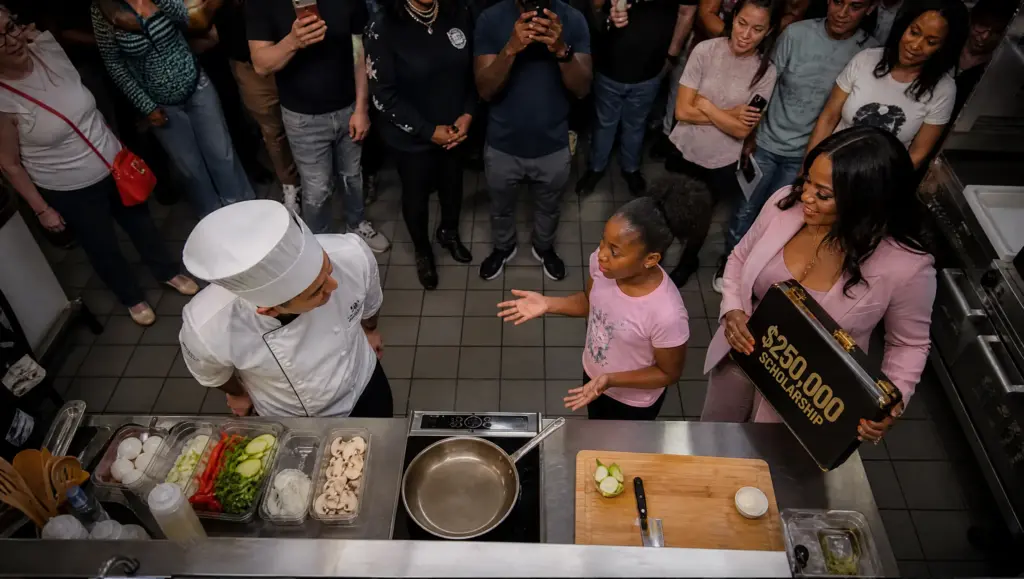
She did not feel magical. She felt hot, and careful, and oddly calm in the way she got calm during math tests when the first problem unlocked the rest. Her palms were damp inside the sleeves of her sweatshirt. She wiped them once on her jeans where no one would see and reached for what she needed without asking permission for each motion, because asking would spend the seconds she had requested.
Butter. Shallot, minced fine—Carmen’s board, Carmen’s knife, Carmen’s nod. White wine reduced clean. Stock warmed, not boiling. A bowl of cold cubes ready like a brake. Heat low enough that the butter could emulsify instead of fracture. Delia’s grandmother never used the word emulsify. She said, “Make it marry, baby. Don’t bully it.”
Delia bullied nothing. She coaxed. The whisk made soft circles. The sauce thickened into something glossy and pale gold. Theo murmured timing under his breath like a second hand. Carmen plated around the new reality without commentary. Rainer did not help and did not interfere. He watched as if scoring an audition he had not meant to hold.
At seventy-eight seconds the sauce held. At eighty-four it sheened correctly under the lamp. At ninety Delia stepped back half a pace, not claiming the pan as territory, simply returning it to the adults who owned the tickets and the liability and the night.
“There,” she said.
Rainer tasted with a clean spoon. His face did not soften into praise. It tightened into recognition, which was rarer and, in some ways, harder. He plated the corrected sauce himself onto the waiting fish, wiped the rim, and sent it. The runner vanished. The rail kept shouting in silent paper.
“Back to the office,” Rainer said, not unkindly, not kindly either. “Now.”
Delia went. Her braids brushed her sweatshirt. Her heart did a late, silly gallop in the hallway as if it had been waiting for permission. In the office she sat down hard in the visitor chair and stared at her science packet until the words swam. She had not meant to become a story. She had meant to stop a bitter taste from reaching a table.
Service did not pause for mythmaking. Emberwick had sixty-two covers on the books and a private party in the back room celebrating a patent approval with too many champagne toasts and not enough attention to the timing of the mains. Theo burned the next batch of mushrooms because he was still glancing toward the office door. Carmen snapped at a dishwasher for stacking wet pans, then apologized without looking up. Rainer moved through the line like a man who had swallowed a question and could not digest it mid-service.
Anika learned at 7:41 p.m., when Patricia Guillen swept out of the dining room with her tablet hugged to her chest and her mouth already shaped around management.
“Anika. A word. Privately.”
They stepped into the corridor. Patricia’s voice dropped into the register she used for health inspectors and difficult investors. “Your daughter was on the line.”
Anika’s stomach dropped so fast she tasted metal. “What?”
“She corrected a sauce. Rainer let her. Guests didn’t see—thank God—but half my staff is already whispering like it’s a sermon. I need you to understand the exposure. Minors. Hot line. Insurance. If anyone films—”
“No one is filming my child,” Anika said, sharp enough that Patricia blinked.
“I’m saying the risk exists whether we like it or not. And I’m also saying—carefully—that what she did was extraordinary. Rainer doesn’t hand pans to strangers. He barely hands pans to me.”
Anika was already moving toward the office. Delia looked up when the door opened fully, and the guilt on her face was so plain it almost undid Anika’s anger into something softer. Almost.
“I told you to stay here.”
“I know,” Delia said. “The butter smelled burned. Not burned-burned. Wrong-burned.”
“You do not go into that kitchen. You are eleven. Do you understand what could have happened to you? To this place? To my job?”
Delia’s eyes shone, but she did not cry. She hated crying in public almost as much as she hated being treated like she could not smell what she could smell. “I didn’t touch the stove without him there. He gave me the pan.”
“That does not make it safe,” Anika said. “That makes it a decision an adult should not have made.”
Patricia hovered in the doorway, sensing the temperature. “We can talk after close. All of us. Rainer included. For now, Delia stays put. Anika, I still need you on the floor. The patent table wants another round and the two-top by the window thinks their water glasses are sentient.”
Anika pressed her fingertips to her eyelids, counted to four, and straightened her blouse. “Delia. Homework. Door open. If you leave this chair for anything except the bathroom—with me—I will know.”
“Yes, ma’am.”
Anika returned to the host stand with a smile that felt like a mask glued on wet. She seated a couple celebrating six months. She found a high chair. She answered a phone reservation with perfect diction while her mind replayed Delia’s voice saying ninety seconds as if time itself were an ingredient she could portion.
In the kitchen, Rainer finished service without another public comment about the girl. Privately, between tickets, he asked Theo, “How long has she been smelling food like that?”
Theo shrugged, beard still flecked with a speck of parsley he hadn’t noticed. “I don’t know her. Anika’s kid. Comes sometimes when childcare falls apart. Quiet. Reads. Not a brat.”
Carmen plated dessert garnishes and said, without looking up, “My nephew can’t tell sugar from salt in a bowl. That girl clocked a break from the pass. Don’t turn it into a circus, Chef. Kids get used up fast when adults get excited.”





