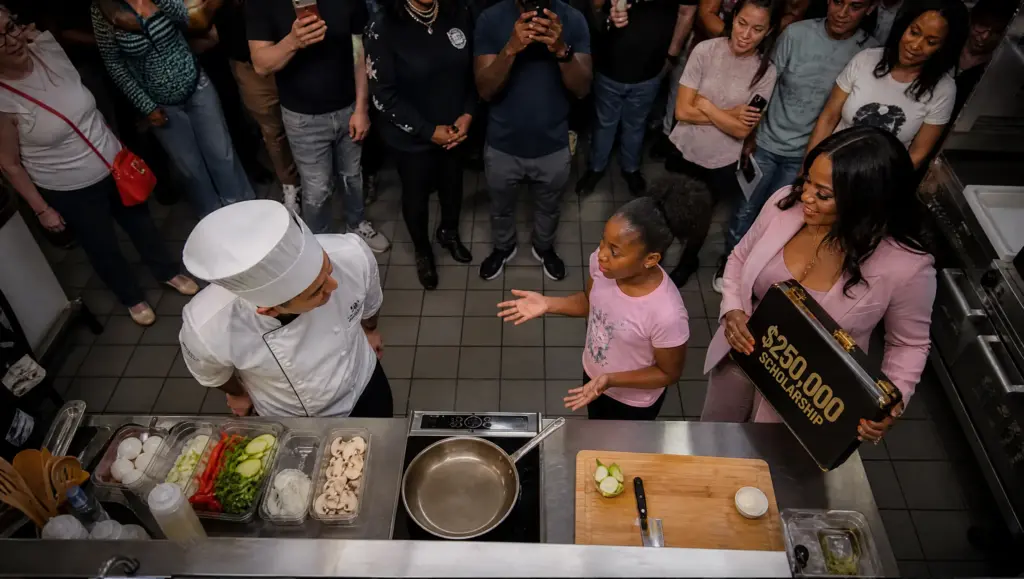
Rainer did not answer. He wiped down his station at the end of the night with the same severe care he always used, as if cleanliness could restore the hierarchy the evening had tilted.
Close came late. The dining room emptied into streetlight and leftover perfume. Anika collected Delia, whose science packet was only half finished and whose yellow sweatshirt now smelled faintly of shallot and hood grease. Patricia locked the front. Rainer met them in the small back office with his coat still on, knot buttons still immaculate, face less stern than thoughtful in a way that made Anika more wary, not less.
Patricia spoke first, because owners claimed first speech. “Tonight stays inside these walls. No posting. No cute anecdotes to friends who work at other restaurants. Health code is not a vibe. A minor on the hot line is a violation waiting for a story, and stories travel.”
“I agree,” Anika said.
Rainer nodded once. “I take responsibility for inviting her into the work. It won’t happen again like that.”
Delia sat very straight, hands folded, listening to adults decide the shape of her evening as if she were a chair being rearranged.
Patricia continued, “That said—Rainer and I talked for three minutes after the last ticket. Emberwick has a Saturday afternoon tasting slot we use for suppliers and sometimes for culinary students under supervision. Not employment. Not a stunt. Education, if the family wants it, with waivers, with Anika present, with no social media, with the stove treated like what it is.”
Anika laughed once, short and humorless. “You want to put my daughter back near a burner because the sauce looked pretty?”
“I want,” Rainer said carefully, “to see whether what I tasted was luck or craft. Luck is common. Craft in an eleven-year-old is… uncommon. I am not offering her a job. I am not a fool, and I am not a villain in a story about exploiting children. I am a cook who watched a child rebuild an emulsion under pressure and did not hate the result.”
Delia’s voice was small but clear. “It wasn’t luck. Miss Odette taught me. Low heat after the butter. Cold to stop it. Don’t rush the wine.”
Anika’s hand found Delia’s shoulder. “We are going home. We are not deciding anything in a back office at eleven at night while everyone is tired and smelling like fish stock.”
Patricia lifted both palms. “Fair. Sleep on it. The offer can wait a week. It can wait forever. I will not have this restaurant’s name attached to a child labor headline, and I will not have staff turning your daughter into a mascot. Rainer?”
“Agreed,” Rainer said. He looked at Delia then, and for the first time the intrigue in his face included something like respect without ownership. “You were right about the shallots. Thank you for saying it before the plate left.”
Delia nodded. “You’re welcome.”
Outside, the parking lot was damp from an earlier rain. Anika buckled nothing because Delia had been buckling herself for years, but she watched until the click sounded. In the car, jazz murmured low from the radio because Anika couldn’t stand silence when she was angry and couldn’t stand shouting when Delia was already brace-ready.
“I embarrassed you,” Delia said to the windshield.
“You scared me,” Anika corrected. “Those are different. You also put my job and that man’s license in a blender. Delia, baby, your nose is a gift. Your brain is a gift. Emberwick is not a classroom, and Rainer Holst is not Miss Odette.”
“I know.”
“Do you?”
Delia picked at a loose thread on her jeans. “I know enough to know the sauce was going to taste like regret. I didn’t think about insurance.”
Anika exhaled through her nose. “That’s why you have a mother.”
At home, their apartment on the third floor still smelled like this morning’s toast and the citrus cleaner Delia had used on the bathroom sink because she liked sinks that shone. Ellis was awake on the couch with his warehouse boots off and his socks mismatched, scrolling through nothing. He took one look at their faces and sat up.
“Who died?”
“Nobody,” Anika said. “Your daughter conducted a sauce intervention in a professional kitchen.”
Ellis blinked. Then, traitorously, he grinned. “That’s my girl.”
“Ellis.”
“I’m allowed one proud second before the lecture,” he said, and opened his arms. Delia walked into them and pressed her face into his shirt, which smelled like cardboard dust and the cheap soap from the warehouse locker room. He rubbed her back in slow circles. “Tell me from the beginning. And then tell me what your mother already told you about never doing it again without a plan.”
They told him. Somewhere in the telling, Delia’s calm cracked into exhausted giggles, then into a few tears she wiped angrily away. Ellis listened like a man filing information under both love and logistics. When they finished, he looked at Anika.
“Saturday tasting,” he said. “Not a job. You’re present. Waivers. No cameras. We talk to Miss Odette. We talk to Delia’s teacher if this becomes a time problem. We do not let a restaurant write our daughter’s childhood as content.”
“We haven’t said yes,” Anika said.
“I know,” Ellis said. “I’m saying we also haven’t said a panic no that ignores who she is. She isn’t a prop. She also isn’t a porcelain doll. There’s a middle, and we get to find it slowly.”
Delia wiped her nose with her sleeve, then grimaced because Miss Odette hated sleeve-wiping. “Can I go to bed?”
“Brush your teeth,” Anika said. “And Delia—thank you for telling the truth when I asked. Next time, find me before you find a pan.”
“Yes, ma’am.”





