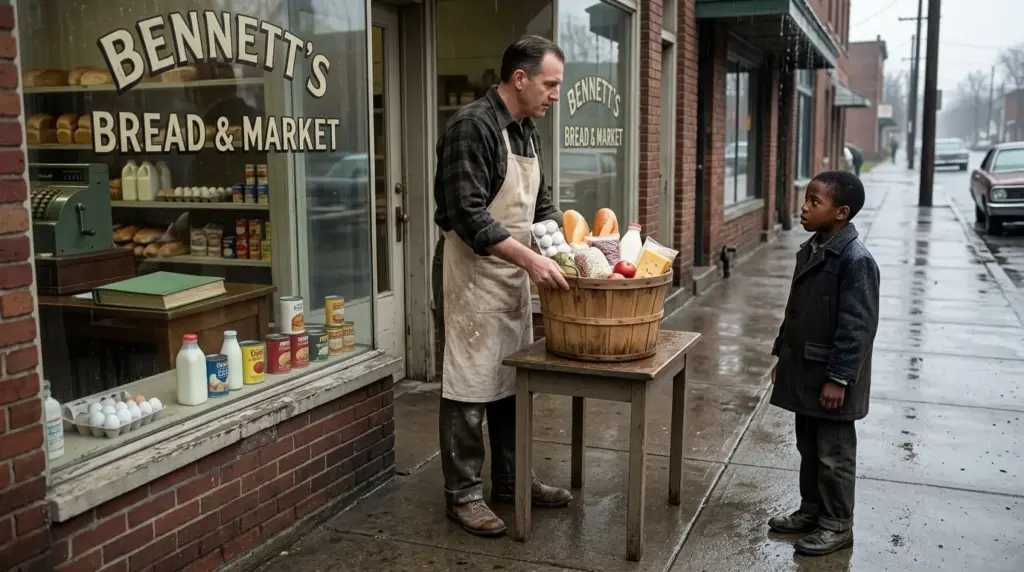
He did not look like the kind of customer who came to Bennett’s Bread & Market anymore. His shoes were too clean for Maple Avenue, his coat was tailored, and the silver watch at his wrist probably cost more than Henry had made in the last three months. He paused just inside the door, studying the nearly empty shelves, the handwritten price cards, the old pastry case with only two oatmeal cookies left, and the yellowed photographs on the wall.
Henry forced a smile from behind the counter. “Afraid you caught us at the end of the day. Not much left.”
The stranger looked toward the bread rack. “Looks like the end of more than a day.”
Henry’s smile faded.
Outside, rain slid down the front windows of the old brick storefront in narrow silver lines. A city bus hissed at the corner, then pulled away, leaving the street quiet again. Twenty-six years earlier, on another rainy afternoon, a ten-year-old boy had stood in almost the same spot with wet shoes, an empty stomach, and a promise Henry had long ago stopped expecting anyone to remember.
Back then, Bennett’s Bread & Market had been busy enough that Henry barely noticed the bell above the door when it rang. The bakery sat in a working-class neighborhood on the south side of Columbus, Ohio, wedged between a laundromat and a barber shop. Henry was thirty-eight, strong-backed, impatient with broken equipment, and still young enough to believe the bakery would always smell like fresh bread and warm cinnamon by six every morning.
His wife, Margaret, ran the register three days a week, and his father still came in every Sunday to complain that Henry shaped rolls too large. The shelves held flour, canned soup, eggs, rice, milk, vegetables, and basic groceries for families who did not want to take a bus to the larger supermarket. At the end of the counter sat a thick green ledger where Henry kept handwritten tabs for regular customers who came up short before payday.
He knew that ledger was bad business. His father reminded him constantly.
“You are running a store,” the older man would say. “Not a bank.”
Henry always answered the same way. “Banks charge interest.”
The boy who entered that rainy Tuesday was named Caleb Reed. Henry knew him by sight, though not well. Caleb’s mother, Teresa, had been shopping at the bakery for about a year. She cleaned offices at night and sometimes paid part of her grocery bill on Friday, then the rest the following week.
That afternoon Caleb stood near the door longer than most children did. His coat was too small at the wrists, and rain had darkened the shoulders. He kept one hand in his pocket and the other wrapped around a folded piece of notebook paper.
Henry glanced toward the street. “Your mother coming in?”
Caleb shook his head.
“You here for something?”
The boy approached the counter and placed the folded paper down carefully. “My mom said I should give you this.”
Henry opened it.
Mr. Bennett,
I am sorry. My hours were cut again. I cannot pay the rest of our account Friday. I understand if you cannot let us buy anything else until I catch up. I will pay what I owe. I just need a little more time.
Teresa Reed
Henry looked at the ledger. The Reed family owed thirty-seven dollars and fourteen cents.
It was not a large amount to most people. To Teresa Reed that week, it might as well have been three thousand.
Caleb stared at the floor. “She told me to say she’s not trying to steal from you.”
Henry folded the note once.
“I know that.”
“She said she is embarrassed.”
“She doesn’t need to be.”
The boy nodded but did not move.
Henry watched him for another moment. There was something wrong with his face. Not illness exactly. Hollowness. The kind a parent noticed faster than a businessman.
“Caleb.”
The boy looked up.
“What did you eat today?”
Caleb answered too quickly. “I’m fine.”
“That was not the question.”
Silence.
Henry came around the counter.
“Breakfast?”
Caleb’s eyes lowered.
“Lunch?”
Nothing.
Henry did not ask a third time.
He grabbed one of the wooden produce baskets stacked beneath the counter and walked toward the grocery shelves. Two loaves of sandwich bread went in first, then eggs, milk, rice, canned beans, apples, cheese, peanut butter, carrots, oatmeal, and a small package of ground beef Henry had planned to take home himself.
Caleb followed in alarm.
“Mr. Bennett, no.”
Henry kept moving.
“My mom said we can’t add anything else.”
“We are not.”
“But we owe you already.”
“I heard you.”
Henry added potatoes and a bag of flour.
Caleb stepped in front of the basket. “Please stop. She’ll be mad at me.”
Henry finally looked at him.
“For bringing home food?”
“For making the bill bigger.”
Henry carried the basket to the counter, opened the ledger, found Teresa Reed’s page, and rested his pen against the paper.
Caleb watched nervously.
Henry did not write down the groceries.
Instead, he drew a single line beneath the existing balance and closed the book.
“This is not going on the account.”
Caleb frowned. “Then what is it?”
“Dinner.”
“I don’t understand.”
“You do not have to.”
Henry slid the basket toward him.
“Take it home.”
Caleb’s eyes filled immediately, which made Henry uncomfortable in the way sincere gratitude sometimes did. He busied himself tearing two paper bags from a stack and dividing the groceries so the boy could carry them.
“Mr. Bennett, my mom is going to pay you.”
“Good. When she can.”
“And I’ll pay you too.”
Henry glanced at him. “You’re ten.”
“I can work.”
“Your job is school.”





