Henry looked at the folder.
“If this is the final lease notice, save the paper.”
Martin frowned.
“What final lease notice?”
“Do not play games with me.”
“Henry, I am not.”
Martin placed the folder on the counter.
“Meridian sold the building yesterday.”
Henry stared at him.
That was worse.
“To who?”
“A private holding company.”
Henry laughed without humor.
“So that’s it.”
“What?”
“New owner clears the block faster.”
Martin looked confused.
“Actually, the redevelopment plan has been withdrawn.”
Henry stopped.
“What?”
“New ownership terminated it last night.”
“Why?”
“I was hoping you could tell me.”
Martin pulled papers from the folder.
“Your outstanding rent has been paid through the end of next year.”
Henry stared.
“Say that again.”
“Paid.”
“By who?”
Martin continued as if reading from a list he still did not believe.
“Your overdue utility balance was cleared. Your supplier liens were paid this morning. The equipment note on the mixer has been satisfied.”
Henry put one hand on the counter.
“Stop.”
Martin did.
“Who?”
“I do not know the beneficial owner. The purchase was handled through counsel.”
Then he slid an envelope across the counter.
“But they told me to give you this.”
Henry’s hands shook as he opened it.
Inside was a single sheet of paper.
No letterhead.
No signature.
Only one sentence.
I told you I would come back.
Henry sat down on the stool behind the register.
Martin watched him.
“You know what that means?”
Henry could not answer.
The bell above the door rang.
Caleb Reed entered wearing no tie this time.
Behind him came a woman in her early sixties carrying a worn cardboard box and a younger man with a legal portfolio.
Henry stood slowly.
Caleb stopped several feet from the counter.
Neither man spoke.
Then Henry whispered, “Rainy Tuesday.”
Caleb smiled.
His eyes filled.
“You remember.”
Henry covered his mouth with one hand.
For a moment he did not see a CEO.
He saw wet hair.
A coat too small at the wrists.
Two grocery bags that were almost too heavy for a child.
“Caleb?”
Caleb nodded.
Henry came around the counter.
“My God.”
Caleb opened his arms.
Henry hugged him so hard the younger man laughed through tears.
“You got old,” Caleb said.
Henry pulled back. “You got expensive shoes.”
They both laughed.
Martin Kessler quietly stepped away.
Henry looked at the woman beside Caleb.
She was crying openly.
Caleb touched her shoulder.
“This is my mother.”
Henry stared.
Teresa Reed had gray hair now and moved with a cane, but when she smiled he recognized her immediately.
“Mrs. Reed.”
“You still calling me that?”
Henry laughed again.
Teresa placed the cardboard box on the counter.
“I kept something.”
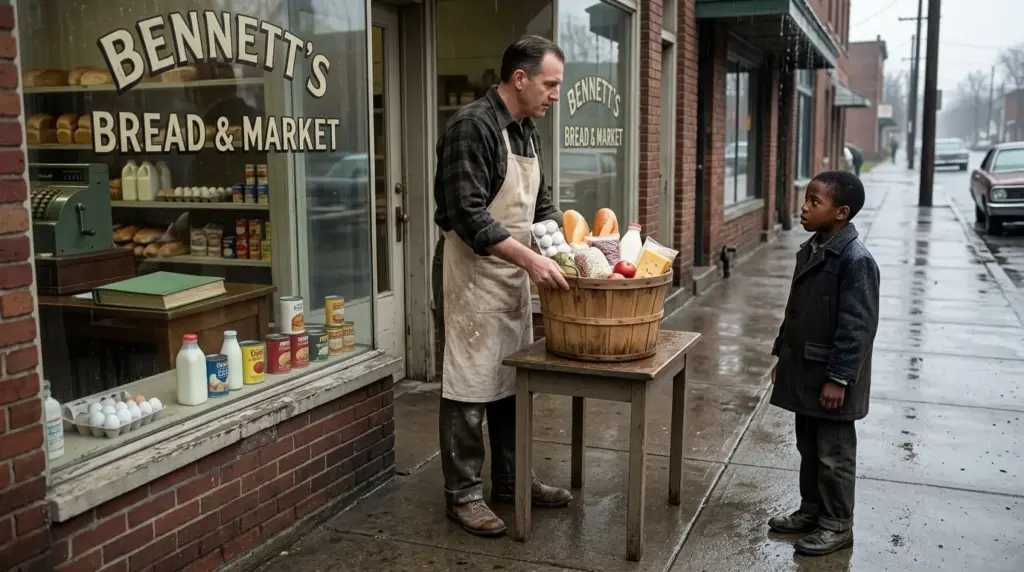
Inside were old papers, photographs, and a folded brown grocery bag flattened by time.
Henry touched it carefully.
Across one side, in faded blue marker, was his own handwriting.
DINNER. NOT DEBT.
He did not remember writing it.
Teresa did.
“You wrote that because I kept asking Caleb if you added the groceries to the account.”
Henry looked at Caleb.
Caleb nodded.
“Mom kept the bag in a drawer for twenty-six years.”
“Why?”
Teresa answered.
“Because that week was the lowest point of my life. I wanted to remember that somebody had seen us and did not make us ashamed.”
Henry sat again.
Caleb rested both hands on the counter.
“You told me to help someone someday. I did. But I never forgot that I also promised to come back here.”
Henry gestured toward the papers Martin had left.
“Caleb, what did you do?”
“Not enough yet.”
“Do not say that.”
The younger attorney stepped forward and opened the portfolio.
“Mr. Bennett, Harbor Table Community Holdings purchased the Maple Avenue property yesterday. The purchase includes this storefront, the vacant unit next door, and the two apartments above.”
Henry stared at Caleb.
“Why?”
“Because Meridian wanted the block for luxury redevelopment.”
“That does not answer why you bought it.”
Caleb looked around the bakery.
“Because this place should not disappear just because kindness is bad at maximizing rent per square foot.”
Henry shook his head.
“I cannot accept a building.”
“I am not giving you the building.”
Henry blinked.
Caleb smiled.
“You taught me to help without taking away somebody’s dignity. So I tried to remember that.”
The attorney slid a document forward.
It was a new lease.
Ten years.
One dollar per year.
Henry stared at the number.
“Absolutely not.”
Caleb leaned back.
“Here we go.”
“This is charity.”
“No. Charity was the basket. This is a partnership.”
Henry looked at him suspiciously.
Caleb pulled out a second document.
“Harbor Table supplies hospitals, schools, and senior centers. We need a small-batch bakery partner for our community meal program in central Ohio. You have a licensed kitchen, recipes people trust, and forty years of neighborhood relationships.”
Henry read the first page.
“You want me to bake for your company?”
“I want to pay your bakery to do work.”
“How much work?”
Caleb told him.
Henry looked up sharply.
The contract alone would keep the bakery solvent.
“You planned this.”
“Since last month.”
“You knew who I was before you walked in yesterday.”
Caleb nodded.
Henry pointed at him.
“You let me complain about you being from Meridian.”
“I wanted to hear you talk before I told you who I was.”
“Why?”
Caleb’s expression became serious.
“Because I needed to know if the man I remembered was still here.”
That hurt more than Henry expected.
Caleb continued.
“If you had become bitter, if you regretted helping people, if that old ledger had turned into something you hated yourself for, I still would have paid the rent. I owed you that.”
He touched the green ledger.
“But when you said money can be replaced and hunger has a clock on it, I knew you were still the same man.”
Henry looked away.
“I am not the same man.”
“No.”
Caleb smiled.
“You are slower.”
Teresa laughed.





