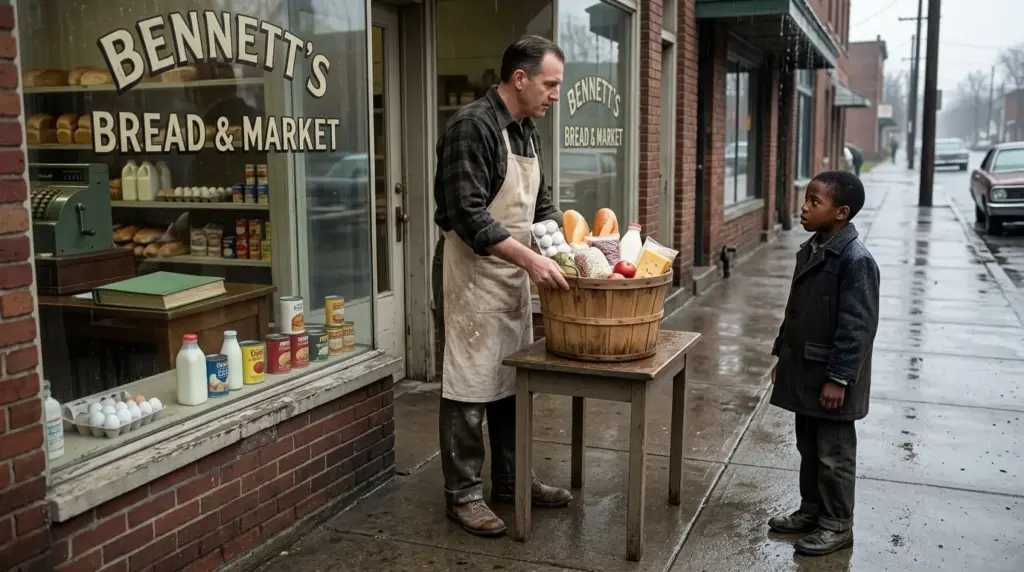
He could not pay it.
Worse, suppliers had started placing him on cash-only terms. His flour distributor wanted $8,200. The utility company had issued a shutoff warning. Property taxes tied to his equipment loan were overdue. The refrigerator compressor had begun making a grinding noise that sounded like another bill waiting to happen.
That was why the shelves were nearly empty when the man in the charcoal suit arrived.
Henry watched him walk slowly along the bread rack.
“You planning to buy one of those three loaves or audit them?”
The stranger smiled faintly.
“Maybe both.”
Henry did not like him immediately.
The man picked up a loaf, turned it over, and read the label.
“Still baked here?”
“Every morning.”
“Same recipes?”
Henry narrowed his eyes. “You from Meridian?”
The stranger looked at him.
That hesitation was enough.
Henry’s shoulders hardened.
“Tell them the answer is still no.”
“I did not ask you anything.”
“You people never do before showing up.”
The man set the loaf down.
“What makes you think I work for Meridian?”
“Shoes.”
For the first time, the stranger laughed.
“That’s fair.”
Henry did not.
“You here to measure walls? Tell me when the wrecking ball comes?”
“No.”
“Then what do you want?”
The stranger looked around the bakery again.
“To understand why a place this old is almost empty.”
Henry almost told him to leave.
Instead, exhaustion won.
He leaned against the counter.
“Everything costs more. People shop online. Big stores sell bread cheaper than I can buy flour. Then the building changed hands. Rent went up.”
The stranger nodded toward the green ledger.
“And that?”
Henry followed his gaze.
“Old habit.”
“Credit accounts?”
“Sometimes.”
“Even now?”
Henry’s tone sharpened. “You taking notes for somebody?”
“No.”
“Then why do you care?”
The man walked closer.
“Because if you are losing the business, that ledger may be part of the reason.”
Henry should have been offended.
Instead he opened it.
Dozens of pages showed names, dates, small balances, payments, crossed-out totals. Some debts were old enough that Henry had stopped expecting them.
The stranger turned a few pages carefully.
“How much is outstanding?”
“Too much.”
“People never pay?”
“Some do.”
“And the ones who don’t?”
Henry shrugged. “Usually means they couldn’t.”
The man looked up. “You regret it?”
Henry answered immediately.
“No.”
The stranger’s face changed.
Henry tapped the ledger.
“I regret bad inventory. I regret ignoring online ordering. I regret taking a loan for a mixer I did not need. But food on credit? No.”
“Even if it helped put you here?”
Henry studied him.
“Money can be replaced. Hunger has a clock on it.”
The stranger went still.
For a second, Henry thought he had said something wrong.
The man’s eyes moved toward the pastry case.
“Did you always believe that?”
“Long enough.”
The stranger swallowed.
Then he asked, “What happens in thirty days?”
Henry closed the ledger.
“I hand over the keys.”
“No way to refinance?”
“Not at my age with these numbers.”
“Family?”
Henry shook his head.
“No children. Margaret and I never had any.”
The stranger looked toward a framed photograph behind the counter. Henry and Margaret stood in front of the bakery on their twentieth anniversary, both covered in flour because an employee had thrown a handful at them during the picture.
“Your wife?”
“Twenty years gone.”
“I’m sorry.”
Henry nodded.
Rain tapped harder against the windows.
The stranger reached into his pocket and placed a business card face down on the counter.
Henry glanced at it.
“What’s that?”
“In case you need to reach me.”
“Why would I?”
The man smiled sadly.
“Maybe you won’t.”
He bought one loaf with cash.
When Henry handed him the change, the stranger did not take it.
“Keep it.”
Henry pushed the coins back toward him.
“I am broke, not begging.”
The man looked at the coins.
Then smiled in a way Henry found strangely familiar.
“Right. Sorry.”
He took the change.
At the door, Henry called after him.
“You never told me your name.”
The man stopped beneath the bell.
His hand tightened around the paper bread bag.
“Tomorrow,” he said.
Then he left.
Henry stared at the door long after it closed.
Only when he began wiping the counter did he notice the business card was still there.
He turned it over.
CALEB REED
FOUNDER AND CEO
HARBOR TABLE FOODS
Henry read the name twice.
Nothing happened.
Twenty-six years had changed too much.
The ten-year-old boy in his memory had a narrow face, wet hair, and shoes with cracked soles. The man who had just left wore a charcoal suit and ran a company Henry vaguely recognized from refrigerated meal kits sold in airports and hospitals.
Caleb was a common name.
Reed was a common name.
Henry slid the card beneath the register and forgot about it for almost an hour.
Then, while locking the back door, he stopped.
A sentence surfaced in his mind.
One day I’ll come back.
Henry turned around slowly.
He opened the drawer beneath the register where he kept old photographs, expired coupons, a screwdriver, and three decades of things he never needed until he threw them away.
At the bottom was the oldest section of the green ledger.
He found the R pages.
Teresa Reed.
Balance: 12.64.
Henry sat down.
“No,” he whispered.
He looked at the business card again.
Then at the closed door.
“No way.”
He did not sleep much that night.
At six the next morning, someone pounded on the bakery’s front window before Henry had unlocked the door.
It was Martin Kessler, the property manager from Meridian.
Henry’s stomach tightened.
Martin was not cruel, which somehow made the situation worse. He was a professional man in his fifties who delivered bad news with the careful tone of someone who did not personally enjoy it but intended to finish before his next meeting.
Henry unlocked the door.
“You’re early.”
Martin stepped inside carrying a leather folder.
“We need to talk.”





