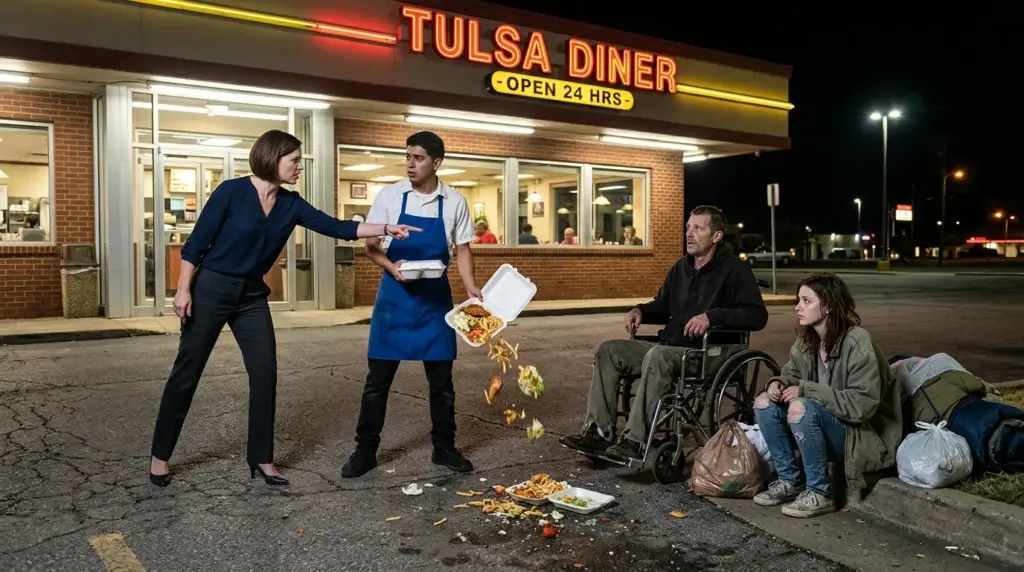
“Good morning, Grandpa,” Felix called softly.
Emilio shuffled into the doorway in a faded bathrobe, one hand braced against the wall, the other wrapped around the neck of an old ceramic mug. He had been strong once, the kind of man who could carry two grocery bags in each hand and still complain that the bus was too slow. Now his shoulders looked narrower every week, and the medicine bottles lined up on the kitchen counter seemed to multiply while their money disappeared. Still, he smiled at Felix as though nothing in the world was wrong. “Good morning, mijo. How’s it going?”
Felix tried to smile back. “It’s okay.” He glanced at the empty spot beside the orange prescription bottle. “I’m really sorry I couldn’t get your medication last night. By the time I got off work, the pharmacy was closed. Are you going to be okay until tonight?”
“I’ll be fine,” Emilio said quickly. “Don’t worry about me. You worry about getting to work before that woman starts barking again.”
Felix looked down at his shoes. The soles were thin, but he had scrubbed them clean the night before. He worked at Baker’s Table, a neighborhood restaurant on the east side of town, where people paid twenty-two dollars for roasted chicken and complained if the lemon slices were too thick. Felix worked in the back, cleaning floors, carrying boxes, washing dishes, and doing anything the manager threw at him. His paycheck was never enough, but it was the only steady money they had.
“I’ll try to pick up your medication after my shift,” Felix said. “If Angelica lets me leave on time.”
Emilio made a face. “Angelica. Some people are heartless.”
Felix sighed. “I wish I could quit this job so I could stop dealing with her. But rent is due next week, and you need the refill. I can’t risk it.”
Emilio stepped closer, gripping Felix’s shoulder with a trembling hand. “Listen to me. Don’t let cruel people make you cruel. You hear? You just keep working hard and being a good person. I promise everything is going to work out. It always does, even if it takes longer than we like.”
Felix wanted to believe him. He wanted to believe that goodness counted for something beyond exhaustion and unpaid overtime. He nodded anyway, because his grandfather needed him to. “Okay. I’ll see you later.”
“And tell me the score of the game when you get back,” Emilio added, pointing toward the television.
“I will,” Felix said, and closed the door behind him.
By six in the morning, Felix was already at Baker’s Table, unlocking the service entrance with the spare key Angelica kept on a bent ring near the dumpster. The kitchen was dark and cold. He turned on the lights one row at a time until stainless steel counters flashed awake and the tile floor revealed every footprint from the night before. He swept, mopped, emptied grease traps, hauled produce crates into the walk-in cooler, scrubbed the prep sink, and stacked clean plates along the line before the first cook arrived.
Angelica Cross came in at eight-thirty wearing a cream-colored blazer and the expression of someone already disappointed in the world. She was the manager, though she acted like she owned the building, the street, and the air around it. She had sharp nails, sharper heels, and a voice that could turn any sentence into an insult. Mr. Baker, the actual owner, rarely came in during the day anymore. He trusted Angelica to run the restaurant, and Angelica used that trust like a weapon.
“Felix,” she snapped before she had even put down her purse. “When you’re done with these floors, take out the trash, then clear all the leftover food from the fridge. Mr. Baker may stop by later, and everything needs to be perfect.”
Felix looked at the floor he had just finished mopping. “Yes, ma’am. I was just finishing up.”
Angelica walked across the tile, stopped, and looked down as if she had discovered a crime scene. “You call this clean?”
“No, ma’am. I mean, I was just getting started on the back hallway.”
“Are you complaining?”
“No,” Felix said quickly. “It’s just… I’ve worked five days straight, all overtime. I got here this morning at six, and yesterday I left at almost eleven. I was hoping maybe we could talk about a raise. I really need the money.”
Angelica stared at him. Then she laughed once, short and ugly. “A raise?”
Felix swallowed. “I was hoping to get paid what I’m worth.”
“What you’re worth?” Angelica repeated, slowly, as if tasting something rotten. “You can’t even clean a kitchen properly, and now you want to lecture me about worth?”
“I wasn’t lecturing you. I just–“
“Ridiculous,” she muttered.
Felix looked away. “This is ridiculous,” he said under his breath, too tired to stop himself.
Angelica’s head snapped up. “What did you say?”
“Nothing.”
“No, say it again. You said ridiculous.” She looked around the kitchen, then stepped to the prep table where a large plastic tub of flour sat open. Her mouth curled into a smile that made Felix’s stomach sink. “I’ll show you ridiculous.”





