Before he could move, she grabbed the tub and dumped it across the freshly mopped floor. A white cloud burst upward, coating the tiles, the lower cabinets, and the toes of Felix’s shoes. Then she picked up a container of sauce from the counter and poured a thick red streak through the flour like paint. It splattered against the baseboards and pooled near the drain.
Felix stared at the mess, speechless.
“There,” Angelica said. “Now you can show me what a hard worker you really are.”
“This is going to take forever to clean up.”
“Then you’d better get started.” She stepped close enough for him to smell her perfume. “And if I hear one more word about raises, overtime, or what you think you’re worth, you’re fired. Is that understood, you ungrateful little worm?”
Felix closed his eyes for half a second. He saw his grandfather’s empty prescription bottle. He saw the rent notice folded under a magnet on the fridge. “Yes, ma’am.”
“Good. And when you’re done with this, go outside and get rid of those disgusting homeless people behind the building. I saw a tent near the alley when I pulled in. I will not have Mr. Baker showing up to find vagrants camping behind my restaurant.”
Felix looked toward the back door. “Where are they supposed to go?”
“That’s not my problem,” Angelica said. “Just get it done.”
For the next two hours, Felix scrubbed the floor on his knees while the kitchen got louder around him. The lunch rush came and went. Orders shouted. Pans clanged. Angelica criticized everything from the garnish on a salad to the way Felix stacked empty boxes. By late afternoon, his back ached, his hands were raw from cleaner, and the smell of wasted food from the walk-in turned his hunger into nausea.
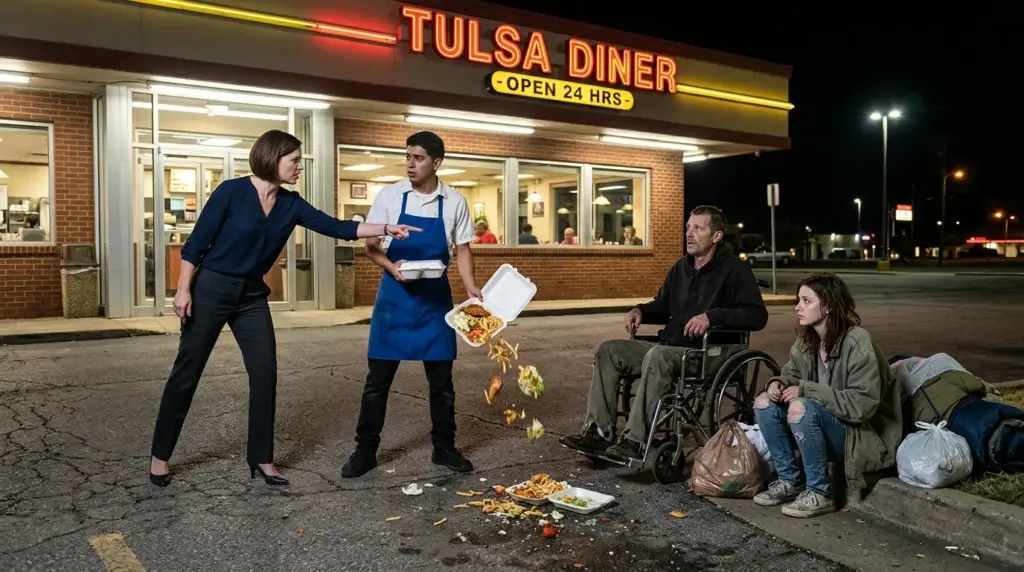
When the dinner prep slowed, Felix finally slipped out the rear door with two trash bags. The alley behind Baker’s Table was narrow and shaded by the brick walls of neighboring businesses. A blue dumpster leaned crookedly against the loading dock. At the far end, near a chain-link fence, a small tent had been set up beside a shopping cart covered with plastic bags.
A man sat in a wheelchair beside it, his hands folded over a thin blanket across his lap. He was maybe in his late forties, though hardship had carved extra years into his face. His beard was patchy, his jacket too light for the cool evening air. Beside him stood a girl around twelve years old with tangled brown hair, worn sneakers, and a guarded expression that made her look older than she was.
Felix approached slowly, raising one hand so he would not startle them. “Excuse me. Hello.”
The girl stepped in front of the man. “Can we help you?”
“Hi,” Felix said. “My name is Felix. I work at the restaurant.”
The man nodded politely. “I’m Tony. This is my daughter, June.”
“Nice to meet you both.” Felix shifted his weight, hating what he had to say. “Listen, my boss wants you to move your tent somewhere away from the restaurant.”
June’s face hardened immediately. “Are you serious?”
“June,” Tony said gently. “Don’t be rude.”
“No, Dad, I’m tired of people telling us to move like we’re garbage.” She looked at Felix. “We just set this up. My dad is in a wheelchair, in case you didn’t notice. He can’t help me carry everything. It’ll take me hours to break it down again.”
Felix looked at the tent, the cart, the folded blanket, the small pile of belongings that represented their whole life. He felt shame burn behind his eyes. “You’re right. I’m sorry. My boss can be really mean, and I have to do what she says, but… I can help you move it.”
Tony studied him. “You’d do that?”
“Yeah,” Felix said. “Of course.”
June’s anger softened a little, though suspicion stayed in her eyes. “Why are you still working for someone that mean?”
Felix bent to untie one of the tent loops. “I need the money. My grandfather is sick, and I have to pay for his medication.”
Tony’s expression changed. “I’m sorry to hear that.”
Felix shrugged, pretending it hurt less than it did. “We’re not homeless, but sometimes it feels like we’re standing right next to the edge. One wrong bill, one missed check, and we could be.”
June crouched to fold a tarp, but her hands shook as she lifted it. She paused, pressing a hand to her stomach. Tony looked at her sharply. “June?”
“I’m fine,” she said too quickly.
Felix noticed how pale she looked. “You don’t look fine. When did you last eat?”
June looked away. Tony lowered his head. “Two days ago,” he admitted. “A church gave us sandwiches, but that was before yesterday morning.”
“Two days?” Felix said. “You haven’t eaten in two days?”