Mr. Baker kept his promise. Tony and June were placed in temporary housing within three days, then moved into a small apartment through a nonprofit program two months later. June enrolled in school again. Tony worked at the restaurant entrance three afternoons a week, greeting customers with the warm patience of a man who understood what it meant to be invisible. He never took a plate of food for granted. Neither did Felix.
Angelica tried to file a complaint. The surveillance footage ended that quickly. When other former employees heard she was gone, they came forward with stories of unpaid hours, insults, and threats. Mr. Baker hired an outside accountant, corrected back wages, and issued apologies that sounded nothing like corporate statements because they were handwritten and signed by his own hand.
Felix did not become perfect overnight. He made mistakes with inventory, over-ordered tomatoes twice, and once accidentally scheduled two dishwashers for the same shift while leaving Sunday brunch short one server. But he learned. He listened. He apologized when he was wrong. More than anything, he remembered how it felt to be spoken to like a burden, and he refused to make anyone else feel that way under his watch.
One Saturday afternoon, three months after Angelica left, Emilio visited Baker’s Table for lunch. He walked slowly with a cane, but he walked. Felix met him at the door wearing a clean black manager’s shirt with his name stitched over the pocket. Tony stood beside the host stand in a neat blue sweater, and June sat at a corner booth doing homework between bites of soup.
Emilio looked around the room, taking in the warm lights, the crowded tables, the smell of bread, the sound of people eating and talking without fear. “So this is your place now,” he said.
Felix smiled. “Mr. Baker’s place. I just help take care of it.”
Emilio touched his arm. “That is what makes it yours.”
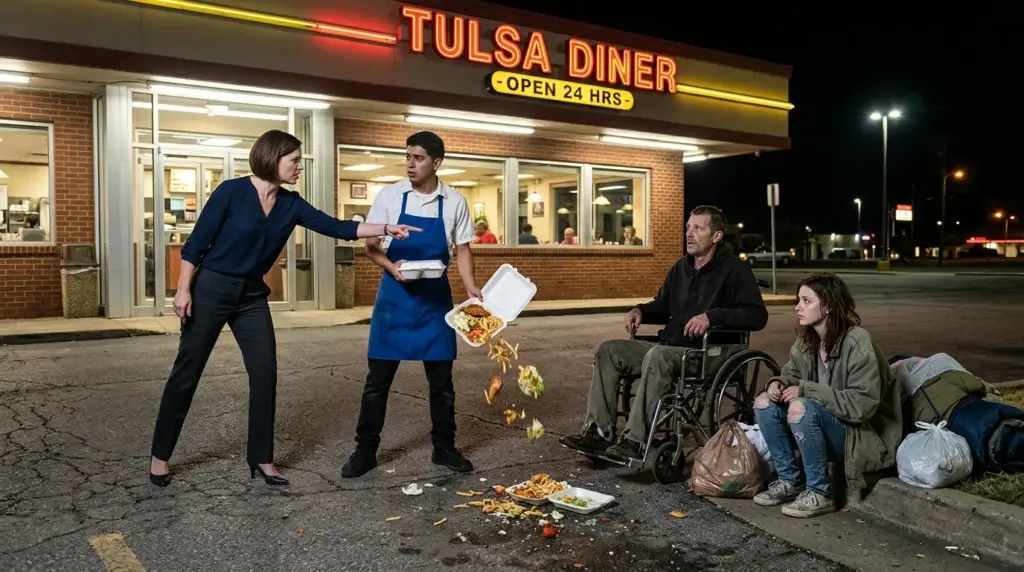
Later, near closing, Felix carried a tray of packaged meals to the back door. A volunteer van waited in the alley, its side panel marked with the name of the housing organization that had helped Tony and June. The pavement had been scrubbed clean months ago, but Felix still remembered the food scattered there, the soup on Tony’s wheel, June’s face as she watched kindness get thrown on the ground.
June came outside holding two more bags. “You forgot these,” she said.
Felix took them from her. “Thanks. How’s school?”
“Better,” she said. “I got an A on my history test.”
“I knew you would.”
She looked toward the place where their tent had once stood. “I used to hate this alley.”
Felix nodded. “Me too.”
“Now it feels different.”
“Yeah,” Felix said. “It does.”
The volunteer loaded the meals into the van. Tony rolled out behind them, locking the back door after the last cook left. Mr. Baker stood near the kitchen window, watching with a quiet smile.
Felix looked at the alley, at the people beside him, at the restaurant that had once nearly broken him and somehow became the place where his life changed. He thought of Angelica asking if he expected a handout. He thought of his grandfather telling him not to let cruelty change him. He thought of Tony’s trembling hands over a container of chicken and June eating a roll like it was the first safe thing she had held in days.
Kindness had not fixed everything in one night. It had not erased poverty, sickness, fear, or the long months Tony and June had spent outside. It had not made Felix rich. But it had opened one door, then another, then another. Sometimes that was how a life changed. Not with a miracle falling from the sky, but with one person refusing to throw away what could still feed someone.
Felix turned off the alley light, locked the back door, and stepped inside Baker’s Table, where warm air, clean floors, and the smell of fresh bread waited for him.