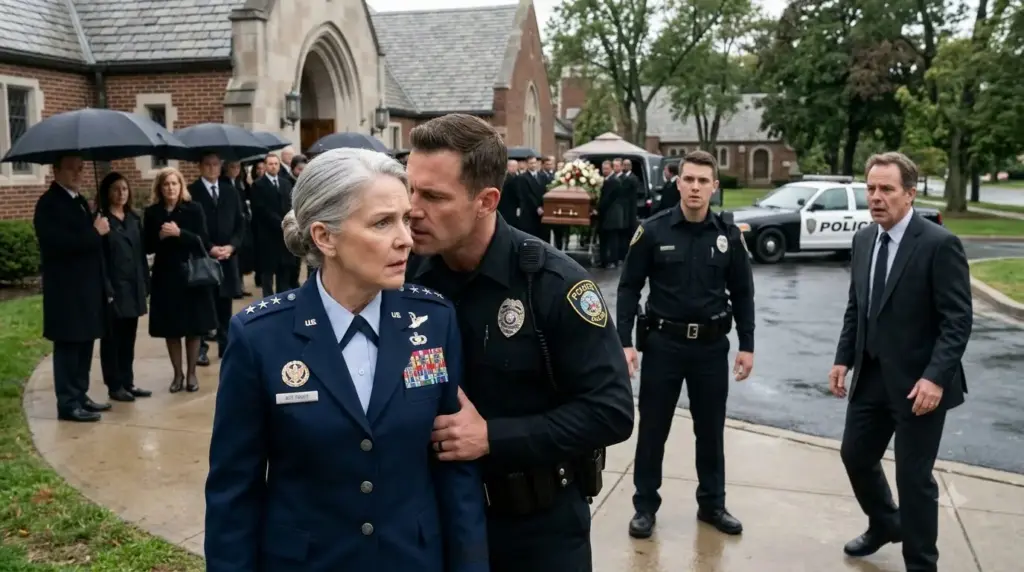
“In this town,” he whispered, tightening his grip around my arm, “I am the law.”
Then he twisted my right wrist behind my back.
The first cuff closed with a metallic snap.
The sound was small.
Yet standing twenty feet from my mother’s coffin, it seemed louder than the bells of Grace Memorial Chapel.
For several seconds, nobody moved.
Black umbrellas stood motionless along the stone walkway. White flowers surrounded the open doors of the chapel. Friends my mother had known for forty years stared from beneath the trees.
Some of them had been crying a minute earlier.
Now they simply looked stunned.
I was sixty-three years old.
For more than three decades, I had served in positions where losing control of my voice could have consequences far greater than embarrassment. I had sat across tables from people who wanted me angry. I had negotiated through crises where impatience could destroy months of work.
So when the officer pulled my other arm behind me, I did not fight him.
I inhaled.
Held it.
Exhaled slowly.
The second cuff closed.
He leaned toward my ear again.
“Not so important now, are you?”
I turned my head just enough to see him in the reflection of his cruiser window.
Short brown hair.
Square jaw.
Black patrol uniform.
The faint smile of a man enjoying an audience.
My own reflection appeared beside his.
Silver hair pulled into a low bun.
Deep-navy dress uniform.
Rows of ribbons above my left pocket.
Three polished silver stars on each shoulder.
My mother used to straighten those stars whenever she attended one of my ceremonies.
Even when I was fifty-seven.
Even when I outranked nearly everyone in the room.
She would stand in front of me, narrow her eyes, and adjust something that was already perfectly straight.
“You represent more than yourself when you wear this,” she would say.
I used to laugh.
That afternoon, my mother was lying inside a coffin less than twenty feet away.
And a local police officer was pushing my face toward the side of his cruiser.
“Officer,” I said, keeping my voice level, “I am asking you one final time to verify my identification before transporting me anywhere.”
He tightened his grip.
“You can explain yourself downtown.”
“My identification is inside my handbag beside the chapel entrance.”
“I heard you the first three times.”
“My brother can retrieve it.”
“No.”
“You can ask your partner to retrieve it.”
“No.”
“You can contact the duty desk listed on the identification.”
He pushed me harder against the cruiser.
“Stop telling me how to do my job.”
Behind us, my younger brother finally broke through the circle of mourners.
“She already told you who she is!”
The officer turned.
“Back up.”
My brother kept coming.
“She’s standing there in full uniform. Her identification is fifteen feet away. What exactly do you think she’s lying about?”
“Sir, back away from my scene.”
“Your scene?”
My brother pointed toward the chapel.
“That is our mother’s funeral!”
The officer shoved him.
Hard.
My brother stumbled backward against one of the low stone planters.
Several mourners shouted.
The pastor stepped forward.
A woman screamed my brother’s name.
Phones came up everywhere.
The officer pointed at the crowd.
“Everybody stay back.”
His partner still had not moved.
That concerned me more than the officer who was touching me.
The partner was younger, perhaps early thirties. He stood near the rear passenger door with one hand resting uncertainly near his belt.
He had looked at my uniform at least six times.
He had looked at the stars.
At the ribbons.
At my face.
Then at his partner.
Each time, his discomfort became more obvious.
I met his eyes.
“Officer.”
He swallowed.
“Yes, ma’am?”
The senior officer snapped:
“Don’t talk to her.”
The partner looked down.
That told me something.
Not enough.
But something.
The senior officer opened the rear cruiser door.
“Get in.”
“I cannot safely sit with my hands positioned like this while wearing this uniform jacket.”
“You’ll manage.”
“Loosen the cuffs one notch.”
“No.”
“They are unnecessarily tight.”
“You should’ve thought of that before resisting.”
“I have not resisted.”
He smiled.
“Body camera will decide that.”
I looked at the small camera clipped to the center of his uniform.
A tiny indicator light blinked.
Good.
Assuming it remained active.
The officer pushed my shoulder downward.
I ducked into the cruiser.
The door slammed behind me.
The tinted glass turned the funeral into something distant.
Outside, my brother argued with the officer.
The pastor stood between them now.
My mother’s closest friend remained near the chapel steps, one hand covering her mouth.
A folded flag rested beside the coffin.
White roses moved gently in the wind.
For the first time that afternoon, grief reached through the discipline I had been using as armor.
I had imagined leaving my mother’s funeral exhausted.
Empty.
Maybe relieved that the hardest part was over.
I had not imagined watching it from the back seat of a police cruiser.
My phone rested inside an inner pocket beneath my uniform jacket.
I had muted it before entering the chapel.
The device had been configured for my travel and command responsibilities. If I was forcibly detained and failed to answer a secure check-in sequence, an alert could be sent to the appropriate duty channels.
It was not some magical alarm that summoned aircraft every time someone touched me.
It existed because people in sensitive positions sometimes traveled in unstable environments.
The system was intentionally quiet.
No audible warning.
No flashing display.
No dramatic countdown.
The officer had no idea it had activated.
Neither did I, with absolute certainty.
I suspected it had.
That was all.
Outside, the senior officer seemed pleased with himself.
His partner did not.
The younger officer suddenly looked down at his own phone.
His expression changed.
He read something.
Then read it again.





