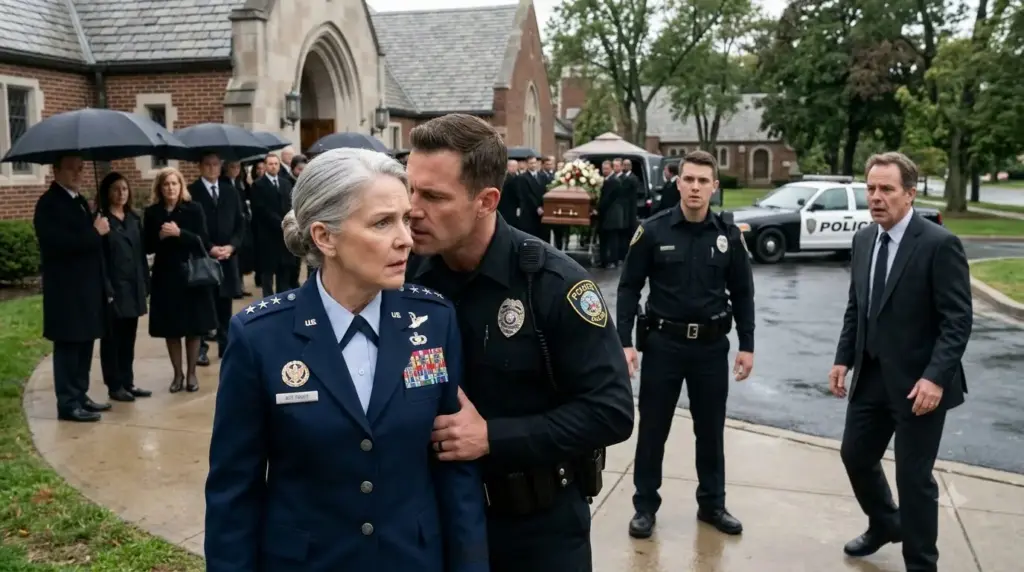
Same towing company.
Same officer?
The last pages contained my senior officer’s badge number.
Repeatedly.
My brother sat at my mother’s kitchen table reading.
His hands began shaking.
“She knew.”
I stood beside him.
“She suspected.”
“She should have told us.”
“She tried.”
“No.”
He looked at me angrily.
There is a blue account book in the old sewing cabinet. Do not give it to local police until you have spoken to someone outside town. I have copies elsewhere. Ask about the towing company. Ask why people pay cash to get cars released. Ask why citations disappear after payment. And ask why three widows on Cedar Street were threatened with code cases after refusing to sell.
My brother whispered:
“What?”
The sheriff looked pale.
I read the final lines.
Do not come home angry. Come home careful.
Love, Mom.
I folded the letter.
For several seconds, nobody spoke.
Then the sheriff asked:
“Where is the sewing cabinet?”
My brother answered.
“At the house.”
The sheriff nodded.
“We need to secure it.”
I looked at him.
“No local officer enters that house alone.”
He met my eyes.
“Agreed.”
My mother’s friend said:
“She made copies.”
“Do you know where?”
“No.”
The sheriff looked toward me.
“You understand this may become a criminal investigation.”
“It already became one the moment someone tried to arrest me under a false pretext.”
He did not disagree.
The blue ledger was still inside my mother’s sewing cabinet.
Hidden beneath a stack of fabric she had not touched in twenty years.
My brother found it while two county investigators and an attorney watched.
The ledger itself looked insignificant.
Blue cloth cover.
Elastic band.
Pages filled with names, dates, vehicle descriptions, citation numbers, amounts.
My mother had built a record for almost three years.
She had not been investigating corruption professionally.
She had been helping people.
That was how it began.
One neighbor’s grandson had his truck towed after a traffic stop.
The citation was later dismissed.
The towing company still demanded nearly nine hundred dollars.
Another elderly man paid cash to avoid “storage escalation.”
My mother noticed the receipt lacked a normal invoice number.
Then a widow from church told her that a local officer had threatened code enforcement against her home after she refused to sell property to a development company.
My mother wrote it down.
Another story.
Another.
Another.
She started asking questions.
The blue ledger grew.
Beside some entries she wrote simple notes.
Officer present before tow truck called.
Cash requested.
No receipt until asked twice.
Case later missing from online docket.
Same towing company.
Same officer?
The last pages contained my senior officer’s badge number.
Repeatedly.
My brother sat at my mother’s kitchen table reading.
His hands began shaking.
“She knew.”
I stood beside him.
“She suspected.”
“She should have told us.”
“She tried.”
“No.”
He looked at me angrily.
The supplemental description had no documented witness source.
The senior officer himself entered it.
The false pretext had been created before he arrived at the chapel.
The younger partner had not known.
That became clear quickly.
He voluntarily surrendered his body camera.
His recording captured him questioning the senior officer before approaching me.
“Dispatch cleared the vehicle.”
The senior officer answered:
“New information.”
“From who?”
“Don’t worry about it.”
The younger officer hesitated.
Then followed.
That choice haunted him.
He asked to meet me three weeks later.
I almost declined.
Then agreed.
We met in a conference room at the county administrative building.
No uniforms.
I wore a gray suit.
He wore jeans and a plain blue shirt.
He looked younger without the badge.
He sat across from me.
“I’m sorry.”
I waited.
He continued.
“I knew something was wrong.”
“When?”
“Before he touched you.”
“Then why did you allow it?”
His eyes dropped.
“He was my training officer.”
“That is not an answer.”
“No.”
He swallowed.
“I was scared of him.”
“Better.”
He looked up.
“I’d seen what happened to people who challenged him.”
“Other officers?”
“Yes.”
“Residents?”
“Yes.”
I leaned back.
“And you still followed him.”
“Yes.”
“Why?”
“Because every bad thing I saw came with an explanation.”
That sentence caught my attention.
He continued.
“A complaint disappeared because the complainant was unreliable.”
“A tow happened because the driver was difficult.”
“A body camera failed because batteries were old.”
“A citation got changed because dispatch entered it wrong.”
“A rookie transferred because he couldn’t handle pressure.”
“Every single thing had an explanation.”
He stared at the table.
“And if you look at one at a time, you can believe them.”
My mother’s blue ledger sat in county evidence.
One incident at a time.
Same pattern.
I asked:
“What changed at the funeral?”
“You.”
I almost objected.
He clarified.
“Not your rank.”
“Your behavior.”
“You didn’t do anything.”
“I watched him create reasons that weren’t happening.”
“You didn’t argue.”
“You didn’t threaten.”
“You kept asking him to verify.”
“He kept refusing.”
“And when your brother came over, he shoved him for no reason.”
The younger officer’s voice cracked.
“I knew.”
“Then my phone got the dispatch alert.”
“What did it say?”
He looked embarrassed.
“Identity confirmation.”
“Priority hold.”
“Do not transport pending supervisor verification.”
“And he told you to ignore it.”
“Yes.”
“What did you think?”
He laughed bitterly.





