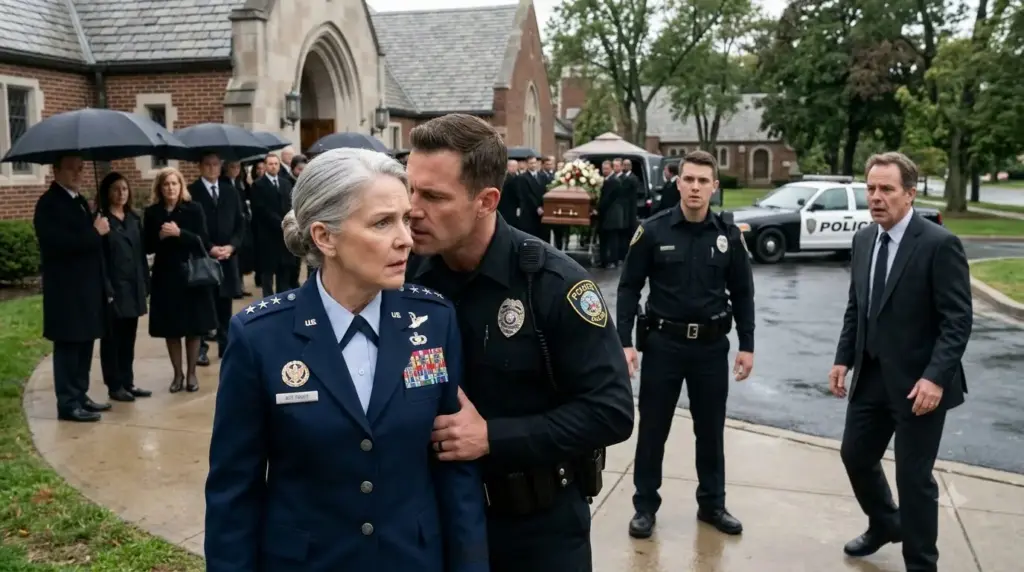
“What time?”
“Before noon.”
The sheriff looked at his watch.
It was nearly four.
Then at the senior officer.
“You stopped her over a vehicle from a report that was cleared four hours ago?”
The senior officer spoke quickly.
“We received an additional verbal update.”
“From who?”
Silence.
The sheriff waited.
The officer said:
“Dispatch.”
The younger partner shook his head.
Very slightly.
Enough.
The sheriff saw.
“So we’ll pull the dispatch recording.”
The senior officer’s face tightened.
“That’s fine.”
The sheriff nodded.
“Good.”
I should have felt satisfaction.
I did not.
My mother was still lying inside the chapel.
The entire afternoon had become about a man I had never met before that day.
That angered me more deeply than the handcuffs.
I turned toward the sheriff.
“My mother’s service has not concluded.”
He looked at me.
“I understand.”
“I would like to return to it.”
“Of course.”
The woman in the suit asked quietly:
“Would you like us to secure the area?”
I looked at the mourners.
Some frightened.
Some furious.
My brother still standing near the planter.
The pastor watching me.
“No.”
She seemed surprised.
“No?”
“This is a funeral.”
“I do not want it converted into a security operation unless there is a specific threat.”
She nodded.
“Understood.”
The sheriff said:
“We’ll remove him from the immediate area.”
The senior officer snapped:
“You’re removing me?”
The sheriff turned.
“Yes.”
“From a public church?”
“From this active scene.”
“I’m not under arrest.”
“No.”
“Then I’m leaving on my own.”
“Good.”
The officer started toward his cruiser.
The sheriff said:
“Not in that.”
The officer stopped.
“Excuse me?”
“County will secure the vehicle as part of the review.”
“For what reason?”
“Potential evidence.”
The officer laughed.
“This is insane.”
The younger partner looked down.
The sheriff continued:
“You can ride with my deputy.”
The senior officer stared at him for several seconds.
Then walked away.
No handcuffs.
No dramatic tackle.
No instant justice.
Just a man whose certainty had begun to crack.
My brother came to me.
He did not hug me immediately.
He looked at my wrists.
Then my face.
Then the officer walking away.
“I’m going to kill him.”
“No.”
“I’m serious.”
“I know.”
“He put you in cuffs at Mom’s funeral.”
“I noticed.”
“That isn’t funny.”
“I know.”
My brother’s face crumpled.
The anger disappeared.
He hugged me.
Hard.
For one second, I stopped being the woman in uniform.
I was simply an older sister whose mother had died.
I held him.
“I’m okay.”
“No, you’re not.”
“No.”
I looked toward the chapel.
“But we still have something to finish.”
The pastor waited near the doors.
My mother’s closest friend stood beside him.
I walked back toward the coffin.
The mourners made room.
Nobody spoke.
I could feel every eye on the marks around my wrists.
My mother’s closest friend touched my arm.
“He would have hated her.”
I blinked.
“Who?”
“Your mother.”
“She would’ve hated that man.”
Despite everything, I smiled.
“No.”
My mother’s friend looked confused.
“She would’ve invited him into the kitchen.”
“What?”
“And asked him questions until he wished she hated him.”
Her friend laughed through tears.
That sounded exactly right.
We resumed the funeral.
I stood beside my mother’s coffin and finished the eulogy I had begun twenty minutes earlier.
My prepared notes remained folded in my pocket.
I did not use them.
I looked at the people who had loved her.
Then said:
“My mother spent eighty-six years proving that authority and character are not the same thing.”
The crowd became completely still.
“She never held a rank.”
“She never commanded thousands of people.”
“She never needed to.”
“When she believed something was wrong, she asked why.”
“And when an answer didn’t make sense, she asked again.”
I looked toward the road where the senior officer had disappeared.
“Sometimes people mistake questions for disrespect.”
“My mother never did.”
“She believed any rule worth respecting should survive being understood.”
My brother lowered his head.
I continued.
“She taught me that dignity is not something another person gives you.”
“It is something you refuse to surrender when they fail to recognize it.”
I stopped.
My voice nearly broke.
For the first time that afternoon.
Then I looked at my mother.
“Everything good in me started with her.”
That was all.
We buried her beneath the old maple tree at the edge of the cemetery.
I placed one white rose on the casket.
My brother placed another.
The honor detail folded the flag.
When it was handed to me, my hands shook.
Not from the arrest.
From grief.
The funeral ended near sunset.
The black vehicles remained discreetly down the road.
The sheriff did not approach again until the last family friend had left.
Then he came alone.
“Ma’am.”
I turned.
“I owe you an apology.”
“You did not arrest me.”
“My department failed to recognize something was wrong quickly enough.”
“It wasn’t your department.”
“County dispatch supports local channels.”
I studied him.
He looked genuinely ashamed.
I said:
“I am less interested in apologies than records.”
His expression changed.
“Records?”
“Dispatch.”
“Body cameras.”
“Vehicle query history.”
“Any tow request connected to my vehicle.”
The sheriff stared.
“You think this was more than arrogance.”
“I don’t know.”
He waited.
I continued:
“But the explanation does not make sense.”
“The vehicle report was cleared hours earlier.”
“Yes.”
“He refused multiple easy identity checks.”
“Yes.”
“And he seemed unusually interested in transporting me quickly.”
The sheriff nodded slowly.
“There’s something else.”
“What?”
“Your vehicle had already been entered for tow.”
I stared.
“When?”
“Three minutes before he put you in the cruiser.”
“Basis?”
“Investigative hold.”
“For a cleared vehicle report?”
“That’s what we’re trying to understand.”
My brother approached.
“What are you talking about?”
The sheriff looked toward me.
I answered.
“They were preparing to tow my vehicle.”
My brother’s expression changed.
“Why?”
“I don’t know.”
Then my mother’s closest friend, who had been standing ten feet away, spoke.
“I might.”
We turned.





