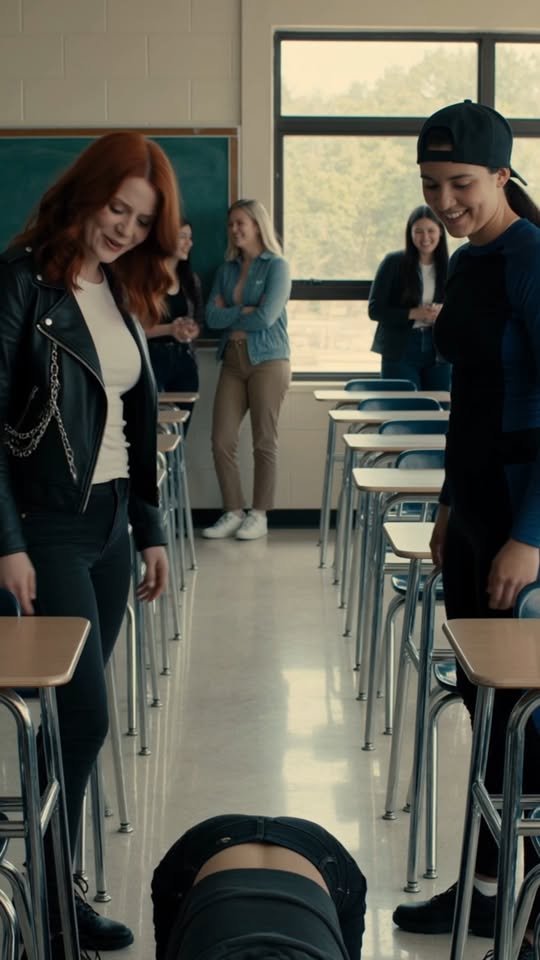
The radiators in the south wing of Saint Jude’s Academy had clanked since October, an arrhythmic, iron rattling that sounded like a fist knocking against frozen earth. It was mid-November now, and the tall, lead-lined lancet windows that looked out over the salt marshes of coastal Maine were filmed with salt-rime and gray frost. Between fourth and fifth periods, the corridor smelled of wet wool coats, cedar floor polish, and the hot, metallic breath of three hundred teenagers crushed between limestone walls.
Maya Lin kept her hands outside the pockets of her secondhand navy duffle coat.
It was an old habit, drilled into her through nine years in her grandfather’s garage dojo behind the lobster wharves in Rockland—never tuck your thumbs, never trap your wrists, never give away your center to an idle stance. Her fingers were short, the knuckles thickened slightly along the index and middle joints from thousands of strikes against canvas makiwara boards filled with dried split peas. But to anyone passing in the crowded hallway, she looked merely compact, quiet, and indistinct: the junior who had transferred mid-semester on an endowment scholarship, whose father worked the night shift at the Penobscot marine repair docks, and whose voice rarely rose above the level required to answer an attendance roll.
She carried her sketchbook tucked beneath her left elbow, close against her ribs. Between its thick, toothy pages lay two months of preliminary ink studies for the regional youth art fellowship—a four-year tuition stipend that represented her only viable path out of the county. The portfolio was due at three o’clock in the administrative office; her train ticket to the district portfolio review in Portland was pinned to the inside cover with a brass clip.
Ahead of her, near the double fire doors that led to the west stairwell, the crowd had begun to bunch up. It wasn’t the slow, clumsy friction of students trading textbooks. It had an edge to it—an unnatural widening of the circle, shoulders turning sideways, eyes darting toward the floor, the collective retreat of kids who had caught the scent of an impending execution and wanted neither to stop it nor to miss the view.
In the center of that opening stood Roxanne “Roxy” Sterling.
Roxy wore her varsity blazer unbuttoned over a tailored cashmere sweater the color of sour cream. Her family’s name was chiseled into the granite pediment above the school’s newly consecrated hockey pavilion, and her mother sat on the disciplinary board with the quiet, terrifying permanence of an obelisk. Flanking her was Lexi Vance, whose father ran the primary commercial bank in town, and a quiet, heavy-set senior named Miller who spent his afternoons operating the hydraulic lifts in the athletics shed.
Lexi was holding a half-eaten green apple, rolling it slowly between two manicured palms. Roxy had her thumbs hooked into the leather belt loops of her trousers, her weight shifted back on one boot, waiting with the relaxed, predatory boredom of someone who had never in her seventeen years been forced to account for a bruise.
“There she is,” Roxy said. She didn’t shout; she spoke at a conversational murmur, but the hallway, suddenly drained of its ambient hum, seemed to carry her words directly against the lime-washed walls. “The silent partner.”
Maya stopped three paces short of the threshold. She did not look at the ring of students around them. If you looked at the crowd, you accepted the cage.
“Excuse me, Roxy,” Maya said. Her voice was flat, level, carrying no higher than the space between their boots. “I have to get to the art annex before fifth bell.”
“The art annex,” Roxy repeated. She turned her head toward Lexi, smiling with the lazy, proprietary indulgence of an older sister humoring a toddler. “Did you hear that, Lex? The little diver wants to draw some more barnacles. She thinks the fellowship committee is looking for rust.”
A few nervous titters rose from the sophomore lockers along the lockers—dry, reflexive sounds, made by students who laughed early to ensure they wouldn’t be selected next.
Lexi took two steps forward, closing the perimeter. She was taller than Maya by three inches, broad-framed, her posture pitched forward in the classic, heavy-shouldered lean of someone accustomed to using weight to manufacture submission.
“You didn’t sign the petition, Lin,” Lexi murmured, her eyes flicking down to Maya’s worn leather satchel. “Every single junior on this corridor signed the waiver for the spring ski trip. Except the scholarship kid. The board says if the class doesn’t show one hundred percent participation, the charter bus gets canceled. You’re costing us our weekend because your daddy’s boat engine blew up.”
“The waiver requires a non-refundable six-hundred-dollar activity fee,” Maya said. Her chin remained level. She had not stepped back; neither had she braced. Her hips were square, her heels lightly kissing the floorboards through the thin rubber soles of her boots. “I don’t ski, Lexi. And I don’t sign contracts I can’t honor.”
Roxy’s smile didn’t fade, but it tightened, the thin skin around her nose blanching white. That was the real offense, and everyone in the hallway knew it: it wasn’t the six hundred dollars, and it wasn’t the ski trip. It was the fact that for six weeks, Maya Lin had moved through the corridors of Saint Jude’s without asking for permission to breathe. She hadn’t traded secrets in the lavatory; she hadn’t joined the whispering circles by the library terrace; she hadn’t flinched when Roxy’s crew took up the center table in the dining hall. She had simply existed outside their perimeter, an unmapped territory that made their private borders look small and ridiculous.





