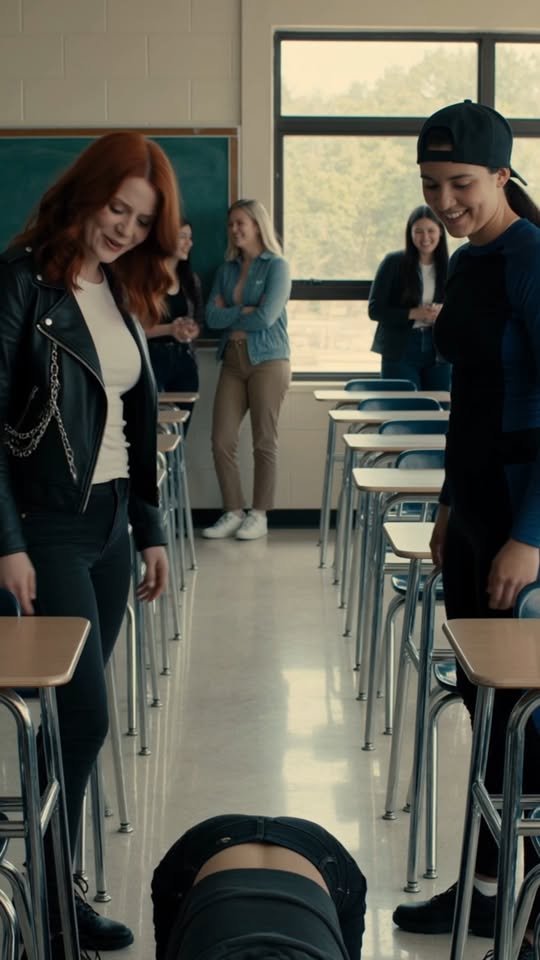
“You think you’re better than everyone here, don’t you?” Roxy said, stepping into the space beside Lexi. Her boots clicked against the worn fir flooring like small hammers. “You crawl out of the shipyard with your little charcoal sticks and your father’s grease under your nails, and you think because Mr. Alden likes your line work, you get to look through people.”
“I’m looking directly at you, Roxy,” Maya said.
The air in the stairwell seemed to drop five degrees.
From the corner of Maya’s eye, she caught the motion: Lexi shifting her weight to the ball of her right foot, her shoulder dropping two inches, her left elbow flaring out—the unmistakable, telegraphic precursor to an aggressive shove. It was the standard Saint Jude’s maneuver, perfected in dorm corridors and gym bleachers: a sudden strike to the chest, an off-balance stumble, a portfolio sent scattering across the dirty floorboards, followed by the inevitable chorus of “Watch where you’re going, it was an accident, why are you so clumsy?”
Lexi’s hands came up, palms flat, fingers spread wide to catch Maya’s shoulders and drive her backward into the heavy iron radiator.
She struck with full momentum, her teeth bared in an ugly, practiced grin.
Maya did not flinch. She did not swing her arms. She did not drop her sketchbook.
The exact millisecond Lexi’s fingers brushed the coarse wool of Maya’s lapels, Maya’s hips dropped two inches. It was an almost imperceptible settling of her mass—chinkuchi, her grandfather had called it, the rooting of the tree before the gale.
Maya did not resist the incoming force; she invited it.
With a micro-step of her left foot, she angled her torso thirty degrees off the line of attack, her left wrist rising like a curved wooden spar to make contact with the inside of Lexi’s right forearm. It was not a block. It was a guide. A simple, circular redirection of momentum using the palm-heel, sweeping across the vector of Lexi’s lunge with the effortless geometry of water finding a gutter.
Lexi’s hands found nothing but thin, cold air.
Because her center of gravity was already pitched four inches ahead of her knees, the sudden absence of resistance was catastrophic. The energy of her own two-handed thrust dragged her forward, her boots skidding across the wax-polished floor. Maya’s right hand rested for a fraction of a second against Lexi’s shoulder blade—not pushing, merely maintaining the circle, helping the girl’s own weight complete its natural trajectory.
Thump.
Lexi’s knees hit the oak boards with a hollow, concussive crack that rattled the radiator pipes. Her apple flew from her hand, bouncing down the first three steps of the stairwell with a wet, rhythmic clatter before coming to rest in the dirt by the landing. Her blazer twisted around her ribs, her hair pinned across her eyes by static, and she skidded forward on her palms, landing in a clumsy, undignified heap against the base of the fire door.
The hallway did not gasp.
It died.
It was the specific, terrifying silence that occurs when a physical law of the universe is suddenly reversed in public. The fifty-odd students lining the lockers did not whisper; they did not look at each other. They remained frozen in the postures of spectators who had come to watch a terrier shake a rat, only to find the rat had turned into an anvil.
Lexi stayed on the floor for three seconds, her palms flat against the cold wood, her breath coming in short, humiliated gasps. Her knee was scraped, her stockings torn at the hem, but she was unbroken. There was no blood, no twisted joint, no violent rupture. That was the most devastating part of the exchange: it had been so clean, so mathematically economical, that it was impossible to describe it as an assault. Lexi had simply thrown herself at the floorboards, and the floorboards had accepted her.
Roxy had frozen mid-stride.
The sneer had vanished from her lips so quickly that her mouth remained half-parted, caught in an ugly, lopsided rictus. Her hands, still hooked in her belt loops, twitched once, her fingers curling against the leather as if searching for a grip on something that had suddenly lost its friction. She looked down at Lexi, sprawled by the stairwell, and then her head snapped up toward Maya.
Maya had not moved from her marks.
Her feet were still planted eighteen inches apart, knees soft, shoulders low and square. Her breathing was so light, so deep within her belly, that the wool of her coat barely shifted against her ribs. Her right hand remained loose at her side, fingers curved naturally, holding nothing. Her left arm held the sketchbook firmly against her heart.
She looked at Roxy.
There was no triumph in Maya’s dark eyes. There was no pulse of adrenaline flushing her throat, no red flare of spite, no smugness waiting to be savored. It was an expression of terrifying, granite-still neutrality—the gaze of an adult observing an unruly child who had just knocked over a bowl of porridge in a fit of temper.
Roxy took half a step back, her left heel striking the edge of a locker base with a dull, hollow clink.
The silence stretched, expanding until the ticking of the brass clock above the drinking fountain sounded like a metronome in an empty chapel.
“Get up, Lexi,” Roxy whispered. Her voice had lost its dry, boardroom finish; it was thin, reedy, vibrating with a panic she didn’t possess the vocabulary to conceal.
Lexi scrambled to her knees. Her face was the color of a bruised beet, her fingers trembling as she yanked her blazer down to cover her waist. She didn’t look at Roxy. She didn’t look at the crowd. She kept her eyes fixed entirely on the scuffed tips of Maya’s boots, her breath hitching once, twice, like someone who had narrowly avoided stepping off a cliff in the dark.





