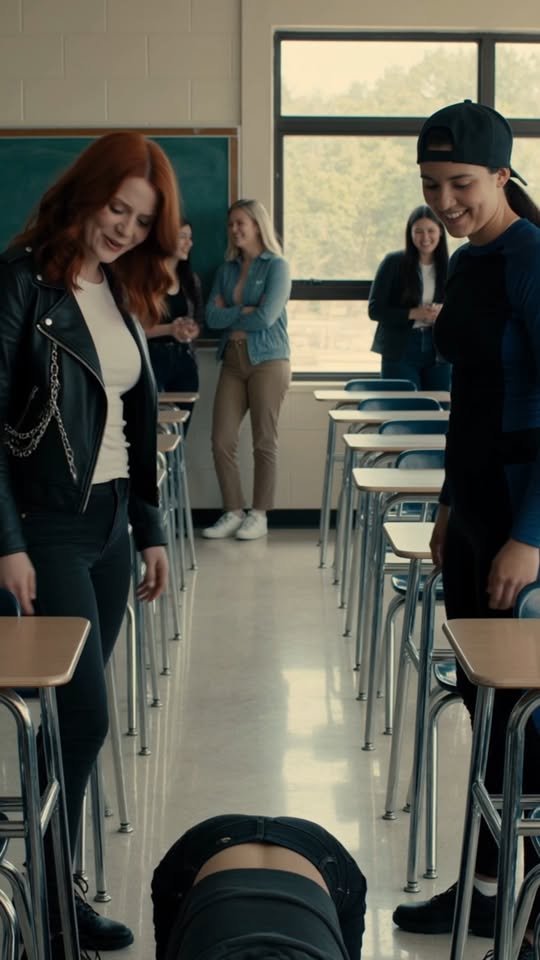
Roxy swallowed hard. The machinery of her authority—the three years of whispers, exclusions, carefully placed rumors, and administrative immunities—was spinning wildly in empty air. She looked around the corridor, searching for the familiar, encouraging smiles, the sycophants who usually laughed on cue, the boys who would step forward to turn a humiliation into a joke.
They were not looking at her.
They were looking at Maya.
And in their eyes was something far more fatal to a girl like Roxy Sterling than anger or hatred: they were looking at her with a profound, clinical embarrassment. They were watching a paper queen whose crown had just blown into the dirt.
Maya did not raise her voice. She did not advance. When she spoke, every word was measured, separated from the next by a beat of cold, clean air that carried down the full length of the south hall.
“I don’t look for trouble with anyone, Roxy,” Maya said.
The words did not drop like stones; they hung like steel cables.
“I come here to work. I come here to learn. But that does not give you permission to violate my space, and it does not give you permission to touch my dignity.”
She paused, her eyes shifting from Roxy’s pale face down to Lexi, who was now leaning against the wall, trying to stand without making a sound.
“Consider this a boundary,” Maya said.
No threats. No references to the principal’s office. No promise of what would happen if they tried again. Just the simple, immovable statement of an edge: Here is the line. You have seen what happens when you cross it. You may choose your next step.
Roxy’s lips moved, but nothing came out. The air in her lungs felt thick, like cold grease. For the first time in her life, she had encountered a human being who could not be reached through the lever of fear, because the human being before her did not value anything Roxy had the power to take.
Maya adjusted the strap of her satchel with a single, calm tug of her thumb.
She did not wait for an answer. She did not look back to see if Lexi had managed to stand. She turned her torso in a clean, ninety-degree pivot, her balance shifting without a wasted calorie, and stepped past them toward the open fire doors.
The crowd of forty students did not wait for her to ask. They parted instantly, pressing their backs against the metal lockers, drawing their elbows in, clearing an eight-foot corridor down the center of the stairwell as though an executive delegation were passing through.
Maya Lin descended the slate steps into the basement annex, her boots striking the treads in a steady, unhurried cadence: one… two… three… four.
Behind her, at the top of the stairs, the fifth-period bell finally screamed through the iron rafters, but on the fourth-floor corridor, nobody moved to pick up their books.
The art studio was thirty degrees colder than the rest of the school, housed in the old nineteenth-century stone masonry of the original boatwrights’ dormitory.
High, arched windows faced north, admitting the flat, shadowless light of the Gulf of Maine. The room smelled of linseed oil, turpentine, cold plaster, and the damp hemp of stretched canvases. It was the only room in Saint Jude’s where Maya felt her ribs fully expand.
Mr. Alden was seventy-one, with hands that shook until he picked up a sable-hair brush, at which point his fingers became as steady as a compass needle. He stood by the cast-iron drying rack, checking the humidity gauge with an expression of habitual pessimism.
“You’re six minutes late, Lin,” he said without turning around. “The committee courier arrives at two-fifteen. If your mounts aren’t dry-pressed by one-thirty, they won’t make the packet to Portland.”
Maya set her sketchbook on the long zinc-topped table between them. “The mounts are ready, Mr. Alden. The ink studies just need the fixative.”
The old man turned, his sharp, rheumy blue eyes moving over her face. He paused, his gaze lingering on the coarse weave of her coat, the clean line of her jaw, and then down to her knuckles.
“You have floor wax on your left heel,” he noted mildly.
“The hall was crowded.”
“Was it?”
“It usually is between fourth and fifth.”
Alden picked up a heavy bone folder, running the blunt ivory edge along the seam of a sheet of Dutch rag paper. “The headmaster’s secretary was down here ten minutes ago. Looking for your attendance sheet. She seemed… distressed. Mentioned something about an incident near the west stairs.”
Maya opened the portfolio case, untying the black cotton ribbons with steady fingers. “There was an accident on the landing. Someone lost their footing.”
Alden stopped his work. He looked at her over the silver half-rims of his spectacles, his brow creasing into deep, ancient furrows. He had taught at Saint Jude’s for forty years; he had seen three generations of Sterlings and Vances move through these corridors, leaving behind them a long, silent wake of broken spirits, quiet transfers, and checks written to settle civil liabilities out of court.
“Maya,” he said, his voice dropping an octave, carrying the dry, rasping authority of an old sailor who knew every shoal in the bay. “Roxy Sterling’s mother doesn’t just sit on the disciplinary council. Her family holds the primary mortgage on the fellowship trust. If Roxy goes home with a scrape on her knee and tells her father that an endowment student pushed her friend down the stairs, the committee won’t even open your folder. They will shred it to preserve the harmony of the academy.”
Maya laid her final ink drawing flat on the zinc.





