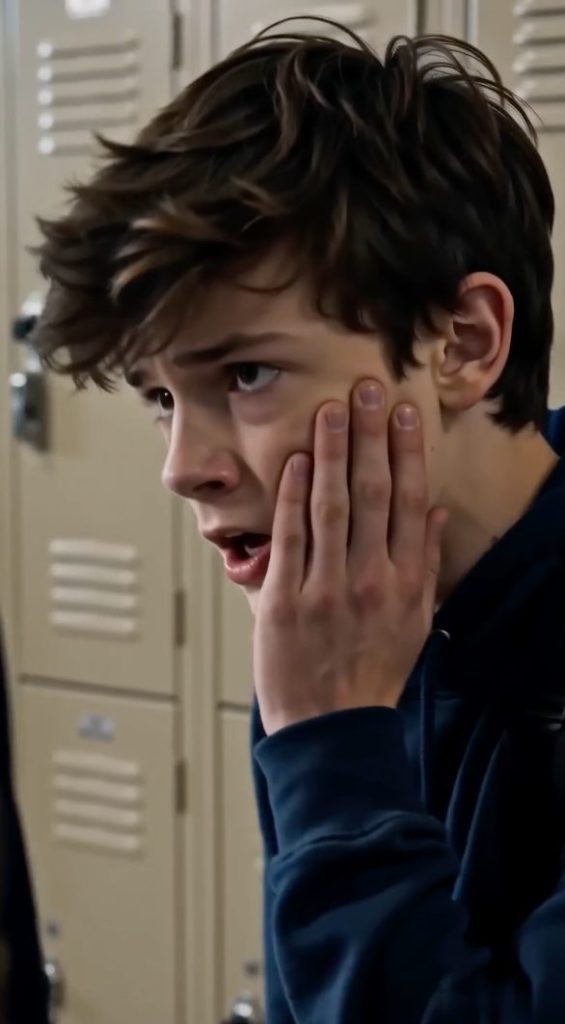
The slap cracked through the hallway outside the principal’s office before anyone had time to stop it.
Sixteen-year-old Ethan Cole felt his head snap sideways, his cheek burning as the sound bounced off the polished floors and beige walls of the school building.
For one terrible moment, he heard nothing except the pounding of his own heartbeat.
When he lifted his eyes again, Tyler Grady was standing in front of him with the same arrogant smile that had frightened students for years.
Several teachers stood nearby, clutching folders against their chests as though the papers might somehow protect them from what they had just witnessed.
A secretary behind the reception counter stopped typing.
Two students beside the water fountain stared at Ethan, their faces reflecting the same frightened disbelief he had seen so many times in the eyes of classmates who crossed Tyler’s path.
Nobody stepped forward, and nobody told Tyler that what he had done was wrong.
Ethan touched the corner of his mouth.
His lip had caught against his tooth, leaving a small trace of blood on his thumb.
He stared at it briefly, not because the injury was serious, but because something about seeing the blood made the entire situation suddenly undeniable.
This wasn’t a rumor whispered in a cafeteria or another incident quietly dismissed as a misunderstanding.
It had happened in front of adults who were supposed to protect him.
“Still think you’re a reporter?”
Tyler asked, his smile widening.
Ethan looked beyond him toward the open doorway of the principal’s office.
Dean of Students Marcus Vance stood there in his carefully pressed suit, watching with an expression that revealed neither surprise nor concern.
Ethan had spent three days gathering evidence about the school’s most feared bully, and now he understood why so many students had stopped trying to report what happened to them.
The danger wasn’t simply that Tyler could hurt someone.
It was that the people responsible for stopping him had learned how to look away.
Three days earlier, Ethan had been sitting in the school newspaper room with a notebook open across his knees, trying to decide how to write the first sentence of an article that might change his life.
The room smelled faintly of old paper and printer toner, and late-afternoon sunlight fell across desks crowded with unfinished drafts.
A few copies of the previous month’s newspaper rested near the window.
On the top page, beneath a photograph of smiling students at a school event, was a headline about the importance of building a respectful community.
Ethan had read that headline several times since the incident behind the gym.
Each time, it had troubled him a little more.
He believed in the words, which was exactly why he could no longer ignore the distance between what the school said about itself and what frightened students experienced when nobody was looking.
A school could fill its walls with posters about kindness, he thought, while still allowing cruelty to settle into its daily routine.

He had been involved with the newspaper since his freshman year.
At first, he had wanted the ordinary pleasures of seeing his name printed beneath a story and learning how photographs, interviews, and scattered notes could become something other people cared about reading.
By junior year, he had become one of the editors, trusted to check facts, revise awkward sentences, and remind younger reporters that a claim was not the same thing as evidence.
He took those responsibilities seriously, even when his friends teased him for carrying a notebook almost everywhere.
His grandfather had once told him that writing something down was a promise to remember it accurately.
Ethan had been younger then, sitting at the kitchen table in the little brick house where his grandfather lived, watching the old man carefully copy a list of supplies needed for the garden.
At the time, Ethan had laughed and asked why anyone needed to be so particular about ordinary things.
His grandfather had smiled without looking up and said that the small things were usually where a person learned whether they could be trusted with the large ones.
Ethan hadn’t thought much about that conversation until he began investigating what had happened behind the gym.
By then, the advice had become more than a pleasant childhood memory.
It was the reason he checked each interview twice and kept his original handwritten notes even after transferring important quotations to his computer.
He wanted to be certain that if anyone challenged his article, he could explain exactly where every important sentence had come from.
The incident itself had begun during the ordinary confusion of an afternoon when students were moving between activities.
Ethan had not witnessed the beginning of the confrontation, and he refused to write as though he had.
What he knew came from students who had been nearby and from the injured boy who eventually agreed to speak with him.
According to their accounts, Tyler had cornered the younger student behind the gym, an area partly hidden from the main walkway by the building’s long brick wall.
The students’ descriptions differed in small ways.
One remembered Tyler stepping directly into the younger boy’s path, while another thought the argument had started several feet away.
One recalled a backpack falling to the ground, and another remembered hearing it strike the pavement before turning around.
Ethan wrote down those differences rather than forcing the witnesses to agree.
What mattered was that their accounts supported the same central fact: Tyler had physically attacked a student who had not been trying to fight him.
When Ethan first approached the injured boy, he found him sitting alone at the end of a hallway after school.
The boy’s backpack rested between his shoes, and a darkening bruise near his cheekbone made it difficult to ignore what had happened.
He looked up when Ethan introduced himself, then lowered his eyes toward his hands.





