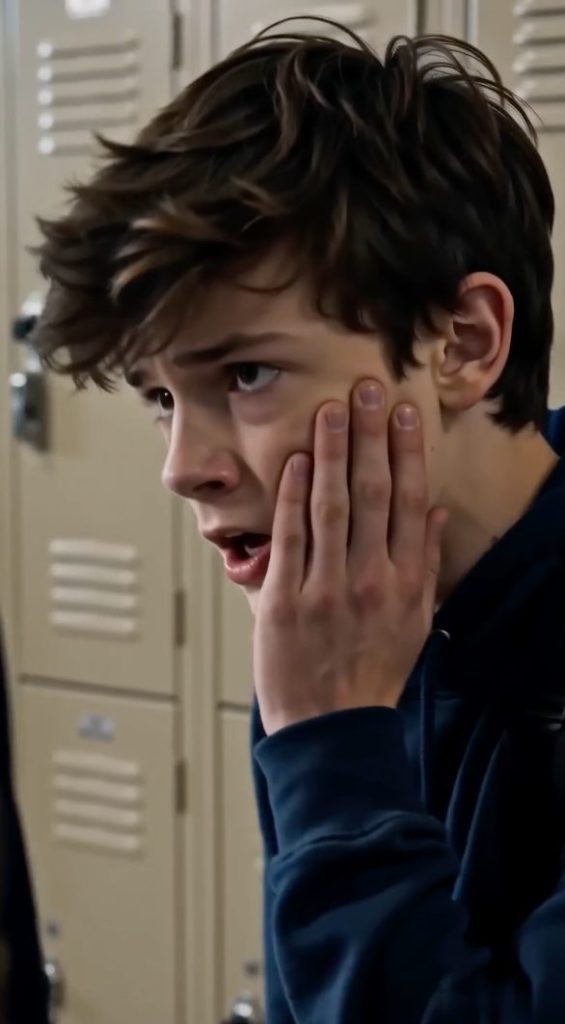
What bothered him was how often those reasonable explanations seemed to leave the frightened student carrying the entire burden of the incident.
At home that evening, Ethan spread his notes across the small desk in his bedroom.
He read each account again, marking agreements in one color and unresolved details in another.

His article was supposed to be about the attack behind the gym, but the information in front of him was beginning to raise a broader question.
If students repeatedly reported the same person and the results were repeatedly minimized, was the problem a series of mistakes or a decision someone had learned to make?
His grandfather was working in the garden when Ethan came downstairs for a break.
Through the kitchen window, he could see the old man kneeling beside a row of roses near the brick wall, wearing his familiar green canvas jacket and scuffed brown boots.
There was something comforting about the steadiness of those movements.
The man who had taught Ethan to repair a loose gate, sharpen a pencil with a pocketknife, and take pride in doing a job properly was now carefully lifting dead leaves from beneath a rosebush.
Ethan stepped outside and stood beside him.
The air carried the smell of damp soil, and the evening light caught the silver hair near his grandfather’s temples.
For a while, neither spoke.
Ethan had always liked that about him.
The old man never filled silence simply because another person might find it uncomfortable.
“You’ve been quiet,” his grandfather observed.
“I’ve been working on something.”
“Something for the paper?”
Ethan nodded.
“A boy got hurt at school.
I’m trying to write about it.”
His grandfather removed a dry leaf from the base of a rosebush and set it beside him.
“That’s important work, if you’re careful with it.”
“I am being careful.”
“I believe you.”
The old man looked up.
“But sometimes being careful means asking whether the person who tells you a story will be all right after everyone else hears it.”
Ethan looked toward the house.
He thought about the younger student’s nervous glances and the mother’s tired voice on the telephone.
It was one thing to want the truth published; it was another to consider what attention might cost the people involved.
His grandfather seemed to understand that difference without needing to know any of the details.
“I’m worried about him,” Ethan admitted.
“He thinks telling the truth will make things worse.”
His grandfather rested his forearms across his knees.
“He may have good reasons for thinking that.”
“Then what am I supposed to do?”
“Listen to him.
Do the work properly.
Don’t promise what you can’t guarantee.”
The old man paused before adding, “And don’t mistake being frightened for being wrong.”
Ethan stood still for a moment.
He had expected reassurance that everything would work out, perhaps because that was what adults often said when they didn’t know how to help.
Instead, his grandfather had given him something less comfortable and more useful.
The truth could matter even when speaking it carried a cost, but that didn’t excuse carelessness with other people’s lives.
They worked together among the roses until the light began to fade.
Ethan gathered the leaves his grandfather trimmed and carried them to a small garden bin, taking comfort in the ordinary rhythm of the task.

He could not fix the situation at school with his hands, but he could clear a patch of earth and see the difference.
When he finally returned inside, the notebook on his desk no longer seemed quite so overwhelming.
That night, he revised the article again.
He removed a detail that might unnecessarily expose one of the younger witnesses and made sure the injured student’s account was identified accurately.
He retained the mother’s statement because she had given informed permission and because it described something the disciplinary paperwork could not capture: how fear had followed her son home.
Before closing his laptop, Ethan wrote a final question at the top of a fresh page: What happened to the reports?
He had not yet imagined how dangerous that question would become.
The following morning, Ethan began asking questions that had little to do with the incident itself and everything to do with what happened afterward.
He did not have access to confidential disciplinary files, nor did he pretend that he did.
Instead, he went back to people who had already spoken with him and asked what they had been told, whether they had submitted written statements, and whether they had been informed of any decision.
He discovered that the answers were often more confusing than the original events.
One student remembered being asked to write down what he had seen during an earlier confrontation involving Tyler.
He had spent nearly an entire lunch period preparing the statement, trying to be precise because he was afraid of being accused of lying.
Several days later, when his parents asked about the incident, they were told there was not enough reliable information to take further action.
The boy didn’t understand how his written account could have made so little difference.
Another student described an incident that had initially been discussed as grounds for suspension.
Later, according to what the family had been told, the matter was handled through an informal conference.
Ethan couldn’t independently establish every step of that process, and he made a careful note of the limitation.
But he was struck by how frequently strong initial concerns seemed to become much smaller once Dean Vance became involved.
Ethan made a chart in his notebook.
He drew separate columns for the original incident, the available witnesses, the description given to parents, and the outcome that could be verified.
He left spaces blank when he didn’t know something instead of guessing.
The chart looked incomplete, but the gaps themselves were becoming important.





