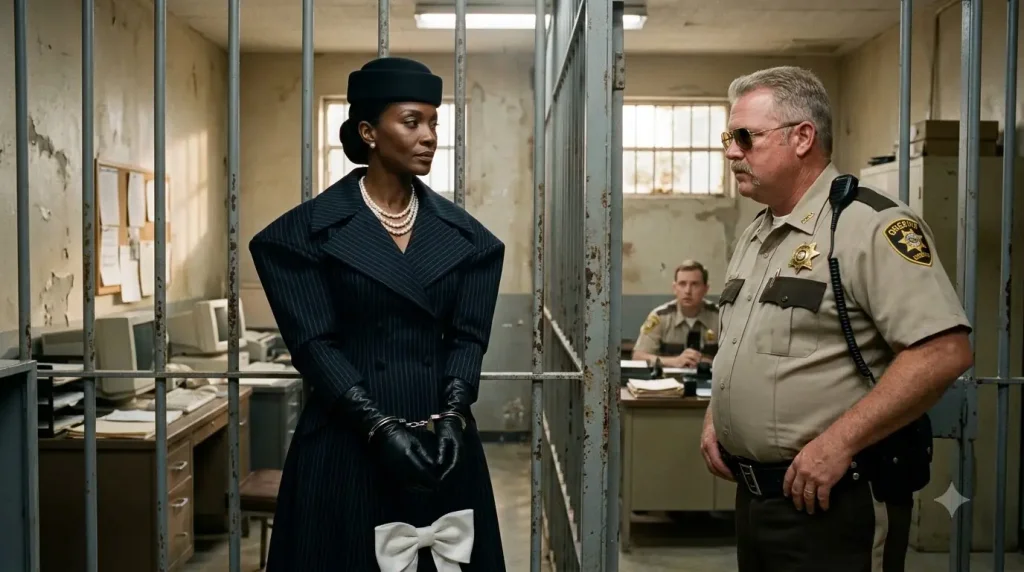
She had stopped asking questions.
She had stopped requesting an attorney.
She was no longer demanding that he state the lawful basis for her detention.
She simply sat on the narrow steel bench with her back straight, her cuffed hands resting calmly in front of her, watching everything.
That silence pleased him.
Ryker had spent nineteen years in law enforcement and almost twelve of them as sheriff of Oak Haven County, Georgia. He believed silence meant surrender. He believed a person became manageable once they understood that his badge, his jail, and his paperwork could turn his version of events into the only version that mattered.
The woman in Cell Four did not look particularly manageable.
That irritated him.
She was forty-eight, tall and striking, with deep brown skin, refined features, and dark eyes that appeared to notice details other people missed. Her sleek black hair had been pulled neatly beneath a structured black pillbox hat when Ryker first stopped her.
The hat was now sitting in a plastic property bin.
So were her pearl necklaces, gold earrings, black crocodile handbag, leather gloves, and a matte-black electronic device Ryker had not been able to identify.
She still wore an extraordinary dark navy-black pinstripe coat-dress with oversized architectural shoulders and a wide sculpted collar. A large white bow detail near the lower hem contrasted sharply against sheer black stockings and pointed heels.
She looked as though someone had taken a woman from the entrance of a diplomatic reception and dropped her into a rural holding cell.
Ryker hated that too.
People brought into his jail were supposed to look smaller once the door closed.
Sarah Hayes somehow looked more important.
Not because of anything she said.
Because she was studying him.
The security camera above Cell Four.
The hallway mirror.
The booking desk twenty-six feet away.
Deputy Jared Miller’s badge number.
Dispatcher Brenda Lawson’s position behind the front counter.
The evidence-room keypad.
The location of the county radio.
The red telephone mounted under a dusty plastic shield beside Ryker’s office.
She had looked at every one of them.
Ryker mistook observation for arrogance.
He had made similar mistakes all afternoon.
“Comfortable?” he asked.
Sarah looked at him.
“Would the answer affect whether I am allowed counsel?”
Ryker smiled.
“There it is.”
“What?”
“That attitude.”
Sarah glanced at the ceiling camera.
“Please repeat that.”
The smile faded slightly.
“You think the camera scares me?”
“No.”
“What are you doing, then?”
“Preserving context.”
Ryker laughed.
“You people from Washington love words.”
Sarah’s expression did not change.
“You keep saying ‘you people.’”
“I mean bureaucrats.”
“Of course.”
He stepped closer to the bars.
“You know what your problem is?”
“I suspect you’re going to tell me.”
“You think because you got money and fancy clothes, you can roll through a small town and tell local police how things work.”
Sarah looked down at the silver handcuffs.
“Sheriff, you arrested me after I asked why you were searching a vehicle without consent.”
“You interfered with an investigation.”
“You had no investigation.”
“You crossed the center line.”
“No.”
“You refused a lawful order.”
“I exited the vehicle when ordered.”
“You resisted.”
“I placed both hands on the roof exactly as instructed.”
Ryker grinned.
“You see? Always got an answer.”
Sarah leaned back against the wall.
“A question usually invites one.”
He stared for another moment.
Then walked away.
Behind him Sarah looked toward the red telephone again.
She knew something Ryker did not.
It was about to ring.
Seventy-five minutes earlier, Sarah Hayes had been traveling south on Route 119 beneath a Georgia sky so bright it made the asphalt shimmer.
She had not intended to stop in Oak Haven.
At least not publicly.
Her official itinerary said she was driving from a secure logistics facility outside Atlanta toward Savannah before catching a military flight north the following morning.
The itinerary was true.
It simply was not complete.
Sarah was a major general in the United States Army and deputy director of a joint Department of Defense logistics-security task force.
For the previous seventy-two hours she had slept fewer than nine hours combined.
Three high-security communications modules had disappeared during military transit over the past fourteen months.
None of the losses initially appeared connected.
One shipment experienced mechanical failure.
Another was diverted after a highway accident.
The third passed through civilian storage during severe weather.
Different contractors.
Different dates.
Different destinations.
One common geographical thread eventually emerged.
All three routes passed within thirty miles of Oak Haven.
Then investigators found something stranger.
Every damaged or delayed truck had been handled by the same towing company.
Ryker Recovery & Transport.
Owned by Sheriff Thomas Ryker’s older brother.
The first missing module was worth several hundred thousand dollars.
Its financial value was irrelevant.
The technology inside it was not.
The hardened communications architecture was designed to function in environments where ordinary networks failed or could not be trusted.
In friendly hands, it kept commanders connected.
In hostile hands, parts of it could help engineers understand how American secure systems authenticated, isolated, and protected battlefield communication.
The Pentagon wanted the modules recovered.
Sarah wanted something else first.
She wanted to know how they had disappeared.
A task force could arrest thieves.
It could seize warehouses.
It could intercept freight.
But if the system that allowed theft remained intact, somebody else would replace the thieves six months later.
Four weeks earlier, analysts found a pattern in Oak Haven towing reports.
Vehicles belonging to outsiders were dramatically more likely to be impounded for minor violations.
Military contractors were not the only targets.
Business owners.
Travelers carrying cash.
Rental vehicles.
People from outside the county.
And disproportionately, according to the limited demographic data available, Black and Latino drivers.
Sarah had read twenty-three complaints.
One stayed with her.





