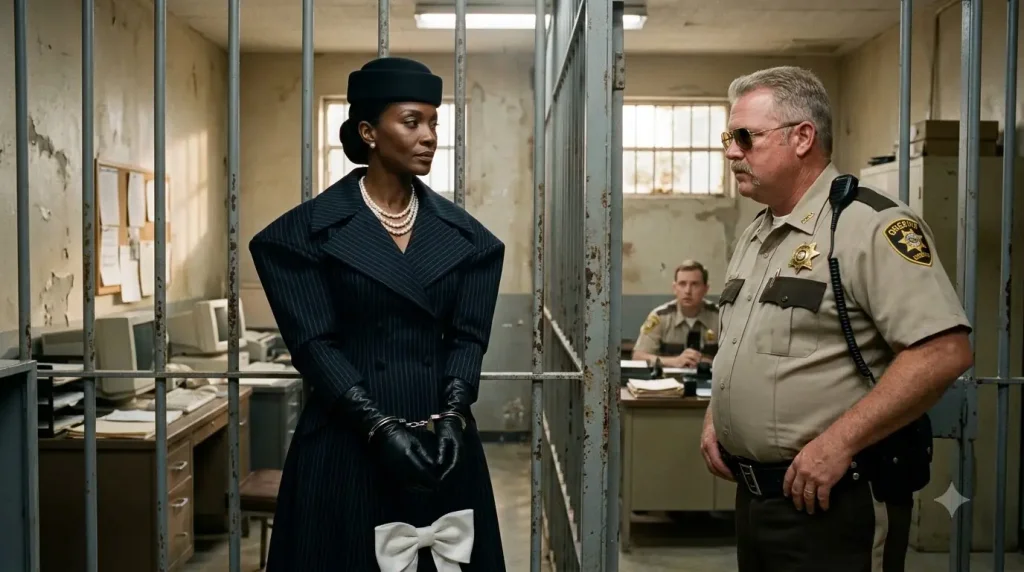
She had stopped asking him to articulate probable cause. She had stopped calmly requesting access to counsel. She had ceased demanding a signed inventory receipt for the property he had dumped across his booking desk twenty minutes earlier.
Instead, she sat on the narrow bolted bench with the immaculate posture of a concert pianist waiting for the orchestra conductor’s downbeat. Her wrists were still bound in front of her by nicked steel peerless cuffs, resting lightly atop the navy-black wool of her coat-dress. She was not weeping, pacing, or rattling the bars the way out-of-state motorists usually did once the heavy electronic lock engaged with its final, hollow thud. She was simply watching.
Ryker mistook her stillness for submission. In nineteen years of wearing a star—twelve of them as the supreme legal authority across four hundred square miles of pine timber and red clay—he had learned that silence was the precursor to compliance. Every arrogant traveler passing down Route 119 eventually realized that the Constitution was a distant, abstract document in Washington, whereas Thomas Ryker was right here, holding the keys, the impound manifest, and the pen that wrote the arrest narrative. Once a prisoner understood that his paperwork became the unassailable truth, they shrank.
Yet the woman in Cell Four refused to shrink. That small, lingering defiance prickled beneath Ryker’s collar like heat rash.
She was forty-eight years old, tall and striking, with deep mahogany skin, sharp cheekbones, and dark, unblinking eyes that moved with unsettling precision. When he had first flagged her sleek black sedan down past the county line billboard, her hair had been tucked neatly beneath a structured black pillbox hat. That hat now sat crushed beside a pair of butter-soft leather gloves, two strands of heavy pearls, a black crocodile handbag, and a dense, matte-black rectangular electronic slab inside a scuffed gray plastic property tub. Even stripped of her accessories, she looked absurdly out of place. Her tailored pinstripe coat-dress featured crisp architectural shoulders and a stark white silk bow near the hem, dropping down to sheer stockings and pointed black heels that clicked like rifle bolts against his linoleum. She looked as though she had stepped out of an embassy reception in Geneva and materialized inside a backwoods holding facility.
Worse, she was cataloging him. Ryker had seen state auditors look at ledgers the way this woman looked at his jailhouse. Her gaze traveled from the dome camera above Cell Four to the convex mirror at the corridor junction, then twenty-six feet down the hall to the booking desk where Deputy Jared Miller sat hunched over an intake terminal. She had studied Miller’s nameplate, noted Dispatcher Brenda Lawson’s sightlines behind the scratched Lexan partition, measured the three-digit keypad on the evidence closet, and lingered on the dusty red emergency telephone mounted beneath a yellowed acrylic cover beside Ryker’s private office door.
Ryker shifted his weight, letting his boots squeak against the floor. “Getting comfortable in there?”
Sarah Hayes raised her chin half an inch. “Would an honest answer accelerate my access to legal counsel, Sheriff?”
A slow, humorless grin spread across Ryker’s sunburned face. “There it is. Right on cue.”
“There is what?”
“That metropolitan attitude.”
Sarah’s eyes flicked deliberately toward the dark plastic dome mounted in the acoustic ceiling tile above his head, where a tiny emerald diode pulsed. “Would you mind repeating that characterization a bit louder? The condenser microphones in those older Pelco units tend to struggle with low frequencies over the air-conditioning hum.”
The grin stiffened on Ryker’s mouth. “You think my own security system worries me?”
“No,” Sarah said, her voice level and devoid of inflection. “I think men who haven’t been audited in a decade forget how permanent magnetic storage actually is. I am merely preserving context for the transcript.”
Ryker let out a short, barking laugh to cover a sudden flash of irritation. “You people from Washington love hiding behind five-dollar words.”
“You have used the phrase ‘you people’ three times since mile marker fourteen, Sheriff.”
“I mean federal pencil-pushers,” Ryker snapped, stepping close enough to wrap his thick fingers around the cold vertical iron. “Bureaucrats who think a fat wallet and an expensive wardrobe give them a pass to roll through my jurisdiction and lecture local law enforcement on procedure.”
Sarah looked down at the silver chain linking her wrists, then back up into his flushed face. “I asked why you were rummaging through my vehicle without a warrant or probable cause.”
“You obstructed a roadside safety inspection.”
“You articulated no safety violation.”
“Your left tires clipped the double yellow line coming off the curve.”
“My vehicle remained dead-center in the northbound lane at forty-four miles per hour, recorded simultaneously by two independent onboard optical sensors and an encrypted military telemetry transponder.”
“You resisted a lawful directive to vacate the vehicle.”
“I unbuckled, opened the door, and stepped onto the gravel within four seconds of your command.”
“You tensed up when I went to secure you.”
“I placed both palms flat against the roof of the sedan while you twisted my right arm behind my shoulder blade.”
Ryker bared his teeth. “See? Always got a slick comeback for everything.”
Sarah leaned her shoulder blades gently against the painted cinderblock wall. “When a public official fabricates a sequence of events in real time, Sheriff, correction is not attitude. It is hygiene.”
For three heavy seconds, Ryker debated unlocking the cell door and teaching her what happened to mouthy detainees who didn’t respect the uniform. Then he caught Deputy Jared Miller watching them from the booking terminal with a pale, tight-lipped expression. Ryker spat a curse under his breath, pivoted on his heel, and stalked back toward his office.





