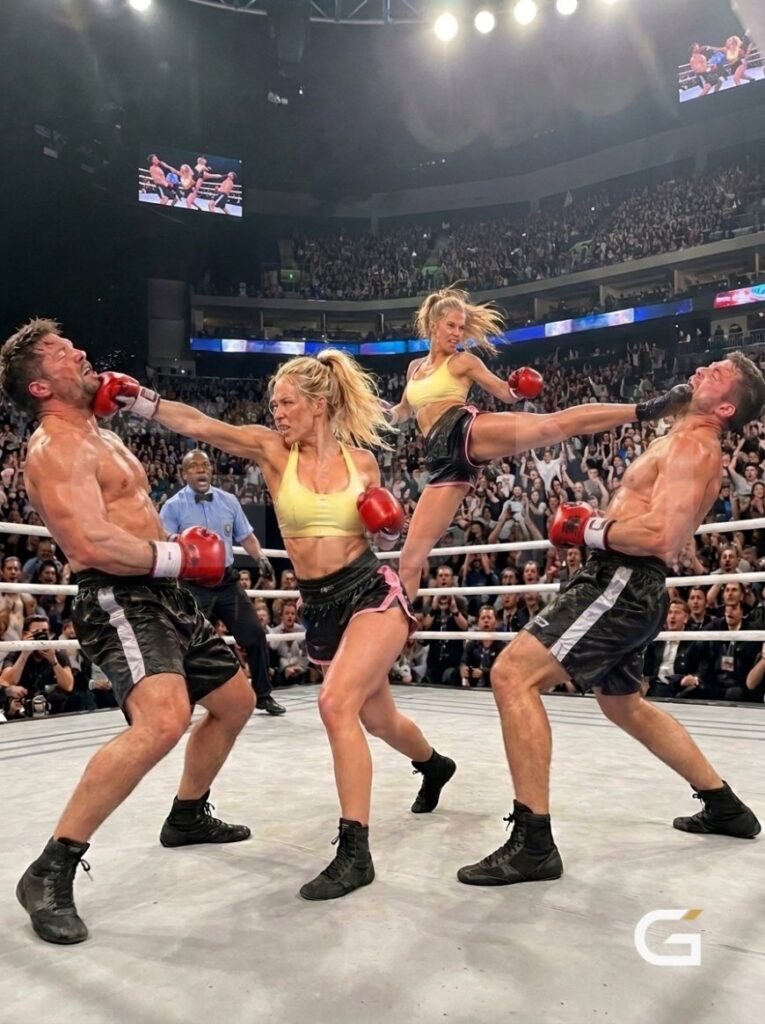

The whistle’s echo hadn’t even died against the rafters before Ran Kane came at me.
He moved the way heavyweights move when they’ve never been made to respect distance—straight lines, heavy feet, a jab that announced itself a full half-second before it arrived. My grandfather’s voice surfaced in my head, calm as a Sunday morning.
*Watch the shoulder. The punch starts there, not at the glove.*
I stepped back a half-beat. Not far. Just enough that his jab tasted nothing but air, and his own momentum dragged him one heavy step past where I’d been standing.
A sound moved through the crowd. Low. Almost like a wave pulling back from shore.
Bridget stood on the apron with her arms folded, watching me the way she’d watched me our whole lives. No signal passed between us. None needed to.
Ran reset his feet. Something flickered behind his eyes—not anger yet. Confusion. The way a man looks when a door he expected to be locked swings open on its own.
*Two seconds.*
He came again, faster this time. A one-two, snaps of real intention behind them, though exhibition rules kept his hands honest. I slipped the first. Rolled my shoulder under the second. My feet barely seemed to move at all.
That was the trick of it. The thing my grandfather spent fifteen years drilling into us on this exact floor, under this exact buzzing light. Footwork isn’t dancing. Footwork is deciding where the danger is allowed to exist, and then standing somewhere else.
*Four seconds.*
Pete Vance called it out from the corner, his voice cracking like old ice. He’d never refereed anything bigger than a middle school wrestling match in his life.
Ran’s jaw tightened. He’d expected a joke. A photo. Two young women flinching and covering their faces while the whole town laughed along with him.
Instead the room had gone dead quiet, and he was the one starting to sweat.
He planted his feet and threw a real combination now—harder than exhibition rules technically allowed, driven more by pride than strategy. A jab, then a hook meant to rattle me even if it didn’t land clean.
I read it before his shoulder finished turning.
Ducked under the hook. Dropped my level for half a second. Came back up just outside his reach—close enough that the crowd gasped, thinking contact was inevitable, far enough that it never came.
*Seven seconds.*
Dot Mercer pressed both hands flat over her mouth. Ida Kowalchic leaned forward so far I thought she might tip right out of her chair. Karin Ashworth had forgotten the vote, the clock, the folder waiting on her desk.
Miss Portoris, the retired schoolteacher who’d taught half the adults in that room their multiplication tables, gripped the arm of the young man beside her and didn’t seem to notice she’d done it.
Harlon stood halfway out of his seat, one hand braced on his wife’s shoulder. He couldn’t sit still through a real fight card. He hadn’t been able to sit still for thirty years.
Ran swung again. Wide and heavy now. The kind of punch a man throws when his pride has taken over for his training—the punch of somebody who’s stopped thinking and started reacting. Those two things rarely serve a fighter well.
I saw the whole thing coming from three feet away.
Shifted my weight onto my back foot. Turned my hip just enough. Let his own momentum do what my hands never needed to.
His fist swept through empty space where I used to be. His balance, already leaning hard into the punch, had nowhere left to go but forward.
His feet tangled beneath him. He stumbled two full steps, arms pinwheeling. Went down hard onto one knee at the center of the ring. One open palm caught the canvas before his face could follow.
Nobody in that gym made a sound.
Then the whole building seemed to exhale at once—a sound somewhere between a gasp and a laugh, one nobody quite let all the way out.
Pete stood frozen, whistle still raised, staring at a regional heavyweight champion on one knee in front of two hundred people. Put there without ever being touched.
“Ten,” he finally managed, voice barely above a croak.
Ran pushed himself back up. His face had gone past red into something closer to purple—the color of a man whose entire identity had just taken a body shot.
“Eleven.”
Mave hadn’t moved more than a few feet the entire time. She stood exactly where she’d started, weight settled evenly, hands still loose at her sides. The same place she’d been standing when this began.
Near the back, Sully leaned over and murmured something to his son. The retired postal worker who’d boxed him earlier that night for the photograph. His son’s eyes had gone wide. It was the first time he’d ever seen his father move like that. Quiet and weak, he was realizing, were never the same thing.
“Twelve.”
Pete’s whistle rose to his lips and blew—long and shaking. The sound hung in the rafters longer than it should have.
For a moment, nobody moved. Nobody clapped. Nobody breathed too loud. As if the whole gym was afraid of shattering something fragile that had just settled into place.
Then somebody in the back row started clapping. Slow and uncertain at first. It spread through the crowd like fire finding dry wood. Within seconds, the whole building was on its feet.
Bridget slipped through the ropes and crossed to me. Wrapped an arm around my shoulder. Neither of us smiled much. This had never been about a show.
Ran stood in the center of the ring, chest heaving, staring at the two of us like a man who’d just watched his own reflection lie to him.
Twelve seconds. That was all it had taken.
—





