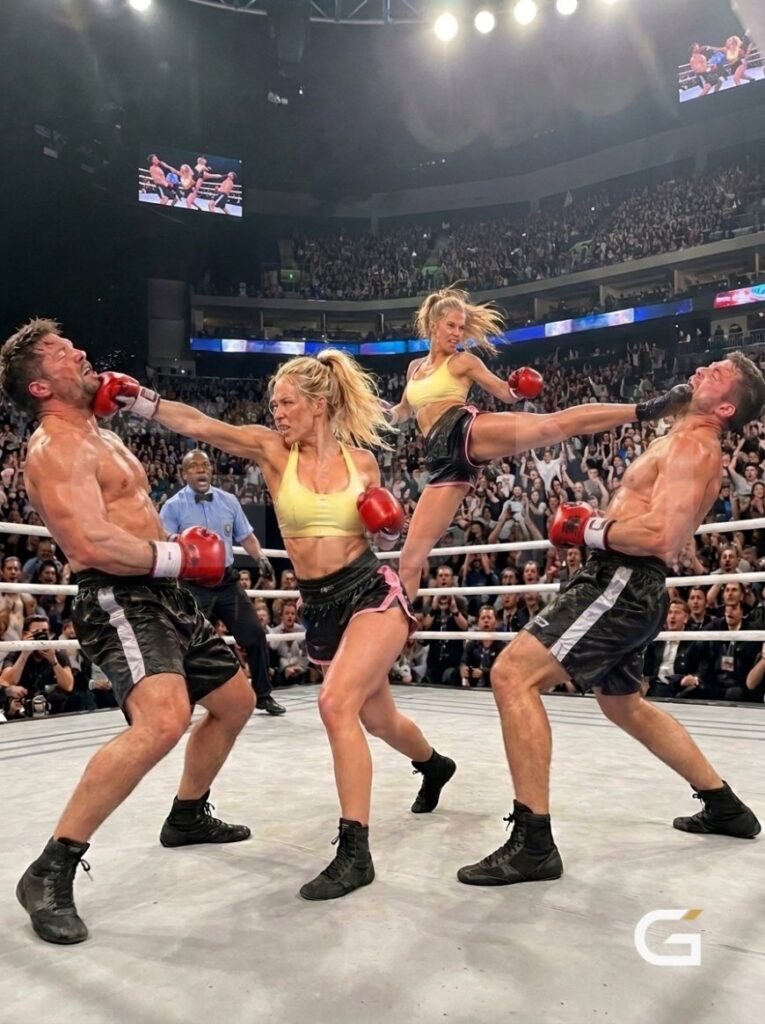
Theirs had been the look that promised this story a place at every future Thanksgiving table. The husband’s grandfather had sparred with Mack Doyle once, decades ago, back when both men were young enough to still believe boxing could be a straight road to somewhere better.
He’d grown up hearing Mack’s name spoken with a strange sadness in his own family. A sadness nobody had ever fully accounted for until tonight. Some griefs, it turned out, get passed down quietly through a whole town—waiting patiently for someone brave enough to finally name them out loud.
Ran tried to laugh it off, though it came out thin and unconvincing.
“This is insane,” he said, looking around at the crowd like he expected somebody to back him up. Nobody did. “You’re going to believe some old man’s fairy tale over thirty-five years of record books?”
“Record books only tell you who the judges said won,” Harlon called out from his seat. “They don’t tell you who actually did.”
A few people clapped at that. Not many—just enough to make it clear which way the room had started leaning.
Silas stood very still beside his brother, staring at nothing in particular. Something had shifted behind his eyes. It looked less like anger now, more like a man doing quiet arithmetic he didn’t like the answer to.
Karin Ashworth rose slowly from her folding chair, gripping the back of it with one hand.
“If any part of that’s true,” she said, addressing the room more than either brother, “it changes a great deal about what this council was set to decide tonight.”
“It doesn’t change anything,” Ran snapped, some of his old fire returning now that a target other than me had presented itself. “It’s an old story from an old woman who probably barely remembers what year it is.”
Ida didn’t flinch.
“I remember exactly what year it was,” she said, calm as still water. “I remember because it was the same year my husband came home from the mill for the last time. Laid off, same as half this town. Grief has a way of stamping a date into you permanently.”
She looked at him steadily.
“Young man, you’ll understand that better someday. If you’re lucky enough to live long enough to grieve something real.”
That landed harder than anything else said all night. Even Ran didn’t have an answer for it.
It might have ended there—quietly, with the truth simply sitting in the room for people to absorb. But Desmond Kane’s sons hadn’t built their lives around losing gracefully.
Pride, wounded enough, tends to reach for the nearest thing to hurt.
Dot Mercer was still standing behind her raffle table, jaw set tight, eyes wet. She’d watched the whole exchange without saying a word. Then she spoke up, unable to help herself any longer.
“Well,” she said, “I always did wonder why Desmond Kane never once came to a single one of these charity nights himself. Guess now we know why.”
It wasn’t much. A small comment born of decades of quiet loyalty to a man who’d once handed her son a key when nobody else would.
But Silas Kane, still reeling, was looking for somewhere to put the pressure building behind his ribs. He turned on her.
“Nobody asked you, old lady,” he said, voice sharp enough to cut through the murmur of the crowd.
“Maybe worry about your raffle tickets and leave the grown-up conversation to people who actually matter.”
The room went cold in an instant.
Dot Mercer, seventy-eight years old, had never once raised her voice at a single soul. Not in six years of running that table. She straightened her spine now and said nothing at all. She didn’t need to. Her face said enough.
But Silas wasn’t finished.
He stepped toward the table. Close enough that Dot instinctively pulled her raffle box nearer to her body—the way you’d shield something you loved.
“What?” Silas said, an ugly grin creeping across his face now, some of his brother’s cruelty finally surfacing in him too.
“You scared of me, Grandma?”
He reached out and shoved the edge of her folding table hard—just to make a point. The table tipped. Raffle tickets scattered across the floor like startled birds.
Dot Mercer stumbled back a step, catching herself against the wall behind her, one hand pressed to her chest.
For one terrible second, the whole gym seemed to freeze in place.
Then it broke wide open.
—
Harlon was on his feet before anyone else, moving faster than a man his age had any business moving. One hand went up—not in a fist, just raised. The universal signal for *enough*.
“That’s quite enough out of you, son,” he said, his voice carrying an authority that hadn’t been there a moment earlier. “I don’t care whose boy you are. You don’t put your hands anywhere near a woman old enough to be your grandmother. Not in this town. Not while I’m still breathing.”
Two other men near the back had risen too. Not aggressive—just present. The way a town shows up around something it’s decided to protect.
Silas took a half step back. Some of the bravado drained out of him fast. He was realizing, all at once, that the room had stopped being afraid of him.
For just a moment, something flickered across his face that looked almost like relief—as though some small buried part of him had been waiting years for somebody, anybody, to finally tell him to stop.
He didn’t examine that feeling any more than he ever did.
He just stood there, silent.
Bridget was through the ropes before anybody else in that room had finished registering what happened. She didn’t run. She didn’t need to. She simply moved fast and direct and was at Dot Mercer’s side within seconds.





