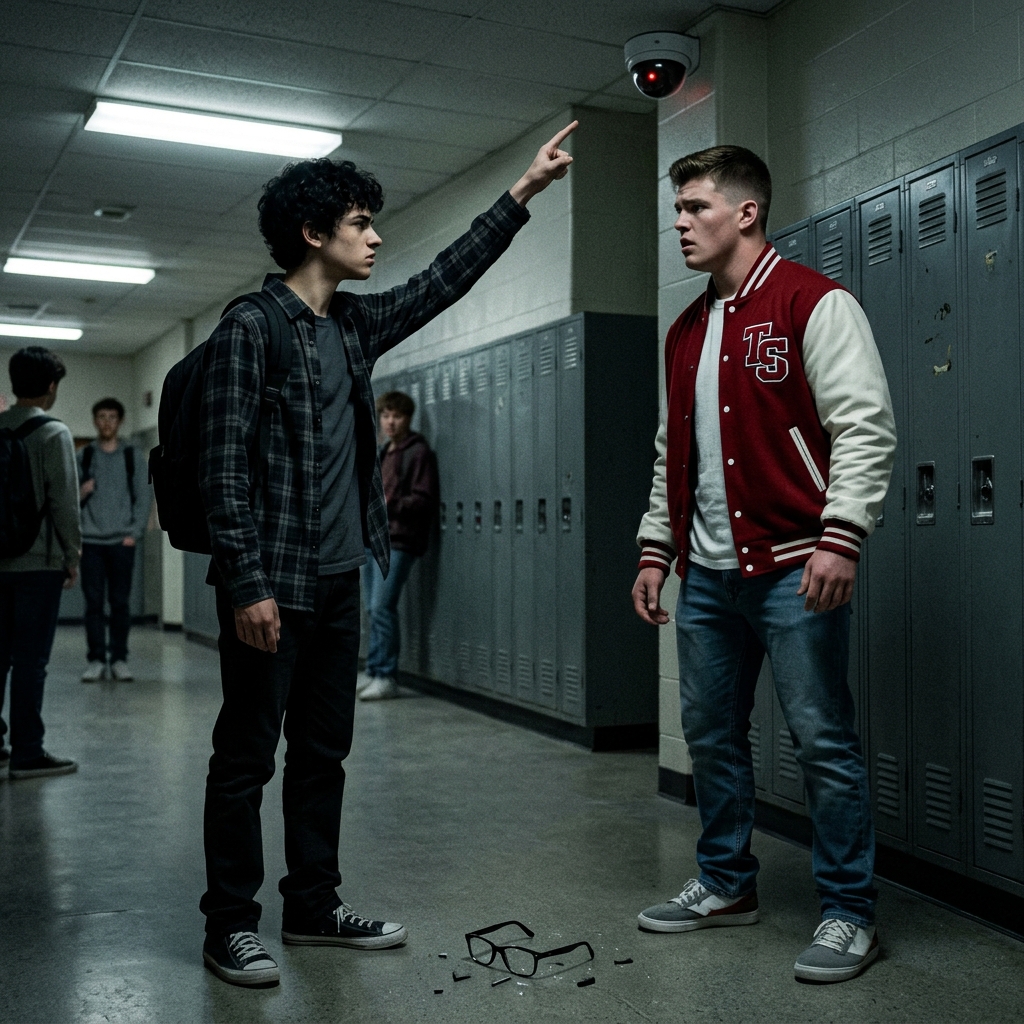
Tyler didn’t answer. He turned on his heel, his rubber cleats clicking against the gray terrazzo, and shoved through the exterior doors out into the dark.
The main corridor of St. Jude High was laid out in 1928 according to the Lancasterian model: eighty yards of unyielding concrete finished with gray aggregate terrazzo, lined on either side by three tiers of olive-green steel lockers, and lit by high, wire-reinforced industrial windows that faced the north harbor.
At eight-fifteen on Thursday morning, it was an echo chamber of wet soles, locker doors slamming with the concussive crack of small arms, and seven hundred teenagers trying to shed their raincoats before the morning inspection bell.
Daniel was thinking about a pocket watch.
It was an A. Lange & Söhne, 1890, belonging to an old judge on Queen Anne Hill. The center wheel had a five-micron burr on the underside of the leaf, and Daniel had spent two hours before midnight calculating the exact angle of the lap required to dress it down without reducing the depth of engagement.
He was carrying his canvas satchel on his right shoulder. His black shoes were damp from the walk up the Dravus Street hill.
He had just crossed the brass line that marked the expansion joint between the old 1928 wing and the 1974 science annex when the world ceased to have a floor.
A heavy, leather-gloved forearm struck him between the shoulder blades from behind. The blow was not meant to knock him down; it was meant to lift his chin, to jolt the cervical vertebrae until the head snapped back.
Daniel’s mouth opened in an involuntary gasp.
Before his lungs could draw air, two thick fingers—smelling of damp pigskin and wet grass—hooked behind the temple pieces of his glasses.
“Hey!” Daniel cried.
The frame was ripped sideways off his face.
The steel hinges tore against the cartilage of his left ear with a sharp, burning scrape. The right earpiece caught in his hair for a fraction of a second before it was wrenched free with a dry, plastic snap.
Then, darkness.
Not night—daylight without form.
The corridor instantly became a smear of gray and dirty yellow. The high lockers dissolved into a continuous, vibrating wall of swamp-green; the students forty feet away became long, gray cylinders drifting across a gray pond; the floor lost its perspective, rising toward his chest like a vertical slab of wet cement.
“Give those back!” Daniel’s voice came out high, thin, stripped of all the courtroom weight it had held forty-eight hours earlier.
He lunged forward, his hands out, his fingers spread wide like a man who has fallen through ice into a dark river. His left hand struck cold steel—a locker door—with a flat, metallic clang that sent a spike of pain through his wrist.
To his right, four feet away, a voice laughed.
It was Tyler. It was the same chest-deep, brassy chuckle that had commanded thirty thousand people from the fifty-yard line at Memorial Stadium.
“Look at him,” Tyler’s voice said, echoing off the metal doors. “Look at the lawyer.”
Crack.
The sound was distinct from the locker doors. It was the sharp, crystalline snap of seven-millimeter CR-39 resin under forty pounds of downward shear pressure, followed immediately by the dry, metallic crunch of an acetate-and-wire frame flattening against unyielding aggregate concrete.
“Tyler!” someone yelled from the crowd. A girl’s voice. “Don’t!”
Crunch.
A second time. The heel of a heavy athletic shoe twisting forty-five degrees to the right, grinding the shards into the lime mortar of the floor.
Daniel dropped to his knees.
He didn’t think about his trousers. He didn’t think about the wet dirt tracked in from the Dravus Street mud. His palms hit the floor, his skin sliding across the gritty stone until his right index finger touched something cold, sharp, and curved like the rim of a watch crystal.
Pain bit into the pad of his thumb—a thin, clean slice that smelled immediately of copper.
“Let’s see you win the state final without those, Brooks,” Tyler said. His voice was directly above Daniel now, heavy with the humid scent of damp jersey and the minty wax he used on his mouthguard. “Read your little cards now, genius.”
Around them, the hallway had gone so quiet that Daniel could hear the hum of the fluorescent transformer sixty feet away above the water fountain.
“Tyler, man, let’s go,” another voice whispered—Marcus Brody, the right guard. “The bell’s going to ring.”
“He’s fine,” Tyler said. His shoe nudged Daniel’s canvas bag, kicking it six inches across the floor until the buckle struck a metal baseboard. “He’s just looking for his brains.”
Daniel didn’t move.
He remained on his hands and knees, his thumb pressed against the cold fragment of his right lens. The blood was welling up, hot and sticky between his fingers, but he didn’t pull back. Through the milky, shapeless blur of his vision, he saw two blobs of dark red and white—Tyler’s Nike Air Zoom trainers, the ones with the red lateral swooshes and the bespoke carbon-fiber shank-plates that Vance Paving had purchased for the entire starting eleven.
He wanted to rise. He wanted to drive his shoulder into the red-and-white smear, to use the low-center leverage his grandfather had used on the dry docks in Bremerton, to feel the heavy boy hit the terrazzo with the same sickening thud his glasses had made.
A loose jewel will ruin the whole train, Kroll’s voice rasped in his ear. If you force the arbor, you break the pivot.
Daniel pulled his hands back. He didn’t wipe the blood on his jeans. He lifted his head toward the gray cylinder that was Tyler Vance.
“Don’t touch the floor,” Daniel said.
His voice didn’t shake. It was the same tone he had used to cite the 1997 reversal of Miller.
Tyler paused. “What?”





