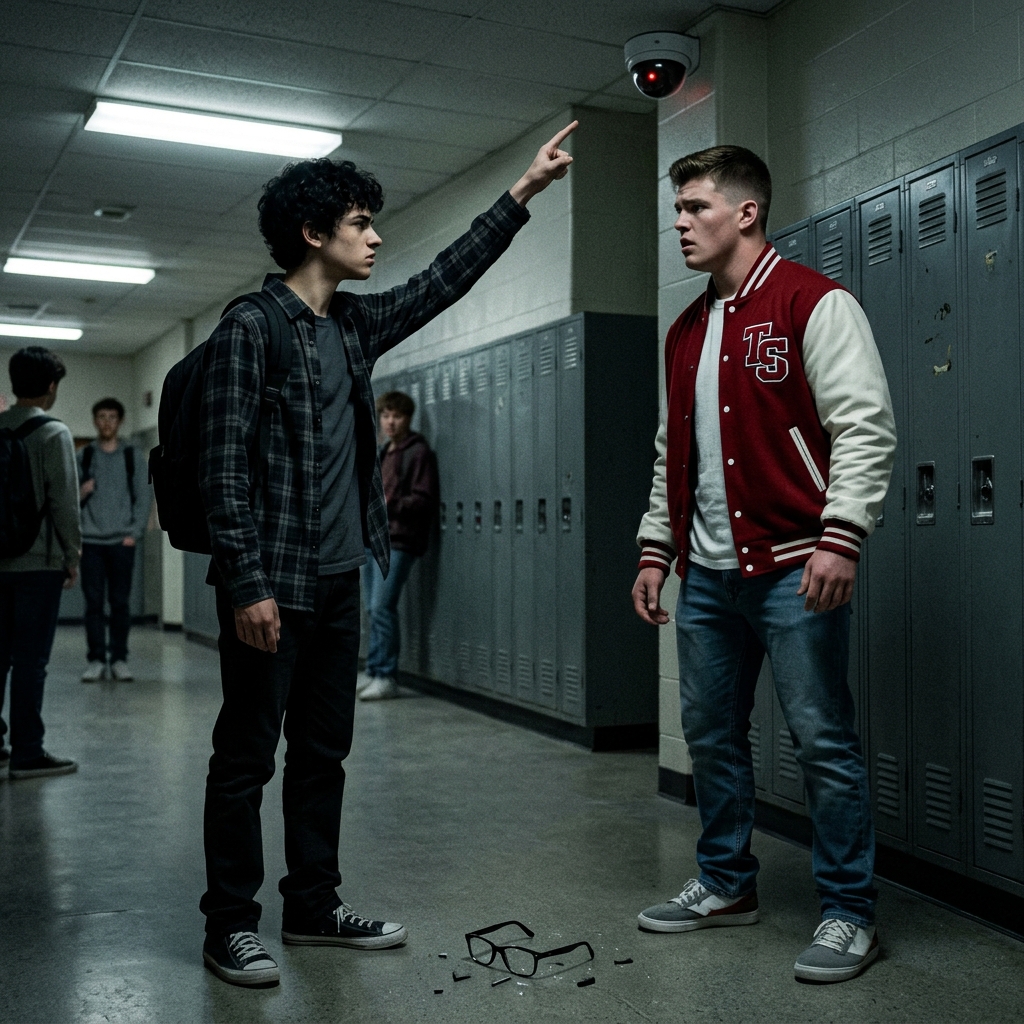
“It’s always about the check, kid,” Richard Vance said, his gray eyes cold as quarry slate. “Everything in this town is about the check.”
“Run the tape, Arthur,” the lawyer said. “Let’s see what we’re actually talking about.”
Dr. Sterling nodded to the technician.
The screen flickered. The wide-angle lens of the Axis dome showed the Hall B corridor from twenty feet up. The high-definition sensor had rendered the rainy morning with terrifying clarity: the yellow reflection of the ceiling tubes on the gray aggregate, the condensation on the high windows, the lockers gleaming like rows of green teeth.
At 08:14:31, Daniel Brooks entered the frame from the left.
He was carrying his canvas bag, his head tilted down, his gait rhythmic and unhurried. He was twenty feet from the library doors.
At 08:14:34, Tyler Vance appeared behind him.
He was not carrying a gym bag. He was not looking at the ceiling. He was moving with the low, balanced stride of an outside linebacker tracking a slot receiver across the flat. His shoulders were set; his arms were out from his sides; his chin was tucked.
“Pause,” Daniel said.
The technician tapped the spacebar.
“Notice the distance,” Daniel said. “Seven feet. Mr. Vance’s lateral vector is forty-five degrees off the normal line of transit for Hall B. He had to cross two expansion joints to reach my shoulder.”
“Play,” Richard Vance muttered.
The video jumped forward.
On the screen, Tyler closed the distance in three long, driving strides. There was no hesitation. His left hand did not drop to tap Daniel’s shoulder; it rose directly to the level of Daniel’s ear.
The frame rate was high enough to catch the individual fingers uncurling. The thumb hooked beneath the black acetate bridge. The index finger hooked behind the left temple-piece.
With a violent, upward jerk of his forearm, Tyler ripped the frames from Daniel’s face.
The screen showed Daniel’s head snap back, his chin lifting toward the high lights, his arms flying outward in the blind, sickening panic of a man whose world has been extinguished in a tenth of a second.
Then, the drop.
Tyler didn’t let them fall. His arm drove downward, hurling the spectacles against the aggregate floor like a man spiking an interception.
Then, the foot.
The red-and-white trainer lifted twelve inches off the floor. It came down with the full, driving weight of Tyler’s two-hundred-and-ten-pound frame.
Crack.
Even through the compressed audio of the ceiling microphone, the sound was distinct: the dry, explosive snap of the lenses, followed by the wet crunch of the frame.
The video continued.
On the screen, Daniel was on his knees, his hands sliding through the gray dirt, searching the floor like a drowning man clutching at weeds.
Above him stood Tyler Vance.
The camera caught his face in three-quarter profile: his head thrown back, his mouth wide, his chest heaving with laughter. He pointed down at Daniel’s head. He looked at Marcus Brody, who had stopped by the lockers, and made a circle with his thumb and forefinger—zero.
Then Tyler took his right foot, set the ball of the trainer directly on the shattered bridge of the frames, and ground it into the stone with a slow, deliberate twist of his hip.
“Stop it,” Richard Vance said.
His voice was barely louder than the hum of the transformer.
The technician paused the video.
The frame was frozen on Tyler’s face: the wide, triumphant grin, the foot planted on the broken glass, Daniel on his hands and knees six inches below his cleats.
The room had ceased to breathe.
Mr. Miller looked down at his clipboard, his face dark with an ugly, mottled flush. Dr. Sterling had his thumb pressed hard against his forehead, his eyes closed.
Richard Vance slowly turned his head to look at his son.
Tyler was no longer leaning back. His elbows were on the table, his fingers clawing at the collar of his white polo shirt, his breath coming in short, shallow hitches.
“Dad,” Tyler whispered. “He… he started it at the debate. He was talking about the company—”
“Shut up,” Richard Vance said.
The lawyer had already closed his briefcase. He didn’t look at Tyler; he didn’t look at the principal. He was staring at the legal pad in front of him, his pencil drawing neat, parallel lines across the margin.
“Arthur,” Richard Vance said, his voice dropping into a register of cold, unvarnished business. “What are the administrative options?”
Dr. Sterling opened his eyes. He looked at Daniel, whose wire aviators were still reflecting the blue light of the frozen monitor.
“Under the district policy,” Sterling said, “this is a Level Four disciplinary event: intentional assault resulting in the destruction of an essential medical device. The mandatory minimum penalty is a ten-day suspension, removal from all interscholastic athletic participation for the remainder of the semester, and a formal referral to the juvenile division of the King County Prosecutor’s Office.”
“No,” Tyler choked out, his voice cracking into a high, childish sob. “The playoffs are next week! Dad, the scouts from Boise are coming on Friday!”
“I said shut up,” his father repeated, without looking at him.
Richard Vance turned to Daniel.
The arrogance was gone from the older man’s face, replaced by that ancient, wary respect that one contractor gives to another when he realizes the ditch has been dug six feet deeper than the blueprint called for.
“How much were the glasses, son?”
“The replacement cost is three hundred and forty-two dollars and sixteen cents,” Daniel said. He drew a receipt from his blue folder—the original thermal printout from Pine Street Optical—and laid it in the center of the table. “Plus seventy dollars for the clinic examination. Plus fifteen dollars for the emergency frames I am currently wearing.”
“I’ll write a check for five thousand,” Richard Vance said. “You take the top-of-the-line frames. Titanium. The ones with the thin glass. And we drop the referral to the prosecutor.”





