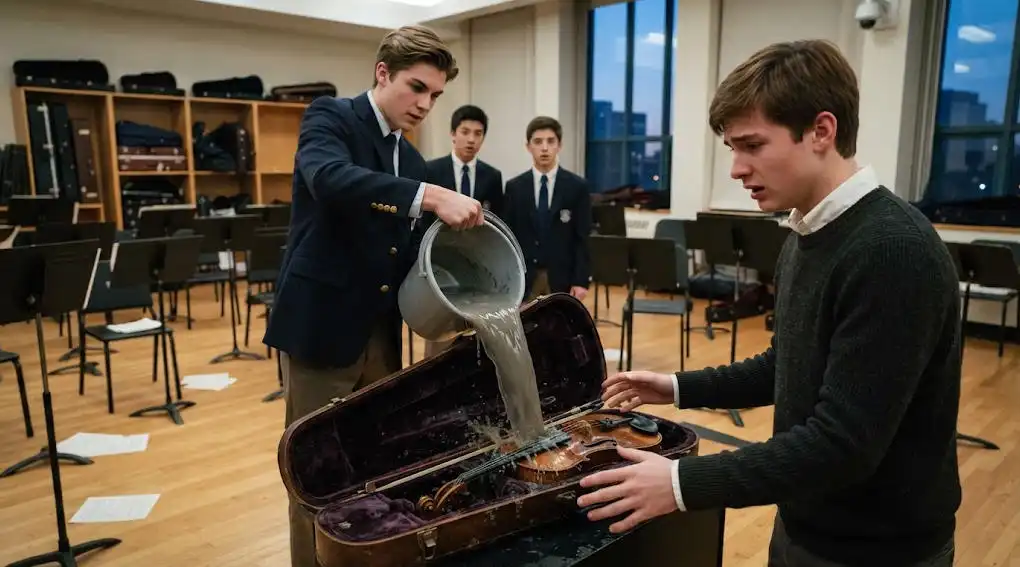
There is a specific scent to a dying instrument. It is the smell of aged spruce splintering, of oxidized varnish flaking into dust, of centuries-old hide glue turning brittle and giving way. It is a scent I had grown intimately familiar with.
For three years, I spent every afternoon in the subterranean workshop of Elias Thorne, a master luthier whose storefront sat tucked into the damp, historic cobblestones of Boston’s Beacon Hill. While my classmates at the prestigious St. Jude’s Conservatory were attending private galas or being ferried home in European sedans, I was inhaling sawdust. I swept the floors, organized the specialized clamps, and carefully rehaired bows for musicians who could afford to casually drop a thousand dollars on a repair. I didn’t mind the work. In fact, I needed it. The wages covered the rest of my tuition that my merit scholarship didn’t, and the education I received at Elias’s workbench was worth more than any masterclass.
It was in that basement that I found my violin.
It wasn’t a Stradivarius or a Guarneri. It was an unnamed, late-nineteenth-century Tyrolean instrument that had been brought in a literal cardboard box, shattered into seventeen pieces by a careless airline baggage handler. The owner had abandoned it, taking the insurance payout instead. Elias had allowed me to claim the wreckage. For two years, I painstakingly rebuilt it. I carved a new soundpost, repaired the cracked ribs, carefully clamped and glued the spruce top, and French-polished the amber varnish until it glowed like dark honey.
When I finally strung it up and drew my bow across the strings, the sound that poured out of it was a revelation. It was dark, resonant, and profoundly human. It had the voice of something that had been broken and put back together. It was my voice. I was a seventeen-year-old kid from the wrong side of the Charles River, navigating a school populated by the heirs to pharmaceutical fortunes and banking empires. My clothes were bought off clearance racks, and my hands were perpetually stained with ebony dust and rosin. But when I held that Tyrolean under my chin, I belonged. I was untouchable. My dream was the Juilliard School, and that violin was the vessel that was going to carry me there.
Then came the Massachusetts State Solo Competition.
St. Jude’s Conservatory had a strict hierarchy, and sitting at the very apex of it was Grant Whitaker. Grant was our orchestra’s concertmaster. He possessed the kind of effortless, golden-boy handsome face that seemed pre-stamped for Ivy League brochures. He played a modern Italian masterwork on loan from his father’s private foundation. His father, Richard Whitaker, was not only a titan of Boston real estate, but he also sat on the Conservatory’s Board of Trustees. Grant’s name was practically etched into the limestone of the campus architecture.
For three years, Grant had won every accolade, taken every solo, and occupied the first chair without challenge. The teachers deferred to him; the students orbited him. He was accustomed to a world that smoothed the pavement before he even took a step.
The State Competition was supposed to be a formality, a stepping stone on Grant’s inevitable procession to Juilliard. But music is the great equalizer. When the judges—blinded by a screen to ensure absolute impartiality—tallied their scores, they didn’t see a trust fund or a bespoke tuxedo. They only heard the music.
I played the Sibelius Violin Concerto in D minor. I poured every ounce of my history, my late nights at the workbench, and my desperate, clawing ambition into the strings. When the results were posted on the heavy oak doors of the auditorium, Grant Whitaker’s name was not at the top of the list. Mine was. I took the gold medal.
The victory wasn’t just a piece of paper. It guaranteed the winner the featured solo placement at the upcoming All-American Music Festival in New York—a performance that would be attended by the admissions board of every major conservatory in the country. It was the golden ticket.
For the first time in St. Jude’s history, the campus wasn’t talking about Grant. They were talking about the luthier’s apprentice.
The atmosphere in the orchestra room soured immediately. Grant’s usual arrogant charm curdled into a cold, simmering resentment. He began finding reasons to bump into me in the halls. He would loudly critique my intonation during rehearsals. He approached me three separate times, suggesting—first with feigned concern, then with barely concealed venom—that I was “out of my depth” and should step aside, allowing him to take the New York solo for the “good of the school’s reputation.”
“You’re a section player, Cole,” Grant had whispered to me during a break in rehearsal, his eyes dark and flat. “You’re more comfortable in the back. Let the people who were born for the stage stand in front of it.”
I had looked him dead in the eye. “I earned the placement, Grant. If you were born for the stage, you should have played better.”
I saw a muscle feather in his jaw. He didn’t say anything else. He just turned and walked away. I thought I had won the battle. I was naive enough to believe that talent was a shield. I didn’t yet understand the lengths to which a person raised with absolute power will go when they are finally told “no.”
The reckoning happened on a Thursday evening, two weeks before the New York festival.
Rehearsal had ended at five-thirty. The massive, acoustically treated orchestra room was quickly abandoned by the students eager to escape the relentless Boston rain. I stayed behind, volunteering to organize the chaotic scatter of sheet music and fold the heavy metal music stands. It was quiet, the only sound the rhythmic patter of rain against the soaring cathedral windows.





