I stopped. I forced myself to breathe. I forced my analytical mind, the mind of a luthier who diagnoses fractures and tension, to take control of my body.
I didn’t look at Grant. Instead, I slowly raised my eyes to the upper corner of the orchestra room.
Mounted high on the century-old crown molding, tucked discreetly behind a velvet acoustic baffle, was a sleek, black dome. A Pan-Tilt-Zoom infrared security camera. The school had installed them three months prior after a series of thefts from the instrument lockers. A tiny, unblinking red LED light glowed in the darkness.
It had been staring at us the entire time.
I lowered my gaze back to Grant. The rage in my chest cooled into a razor-sharp, glacial calm.
“I want the recording,” I said. My voice was perfectly flat.
Grant frowned. He followed my line of sight up to the corner of the ceiling. He saw the black dome. He saw the red light.
For the very first time since I had met him, I saw genuine fear flash across Grant Whitaker’s face. The smug satisfaction vanished, replaced by the sudden, horrifying realization that his untouchable reality had just collided with undeniable, objective truth.
He took a step back from the case. Davis and Hayes looked nervously at the ceiling, suddenly acutely aware of their complicity.
I didn’t say another word to them. I didn’t need to. Grant turned on his heel and fast-walked out of the room, his two shadows hurrying after him.
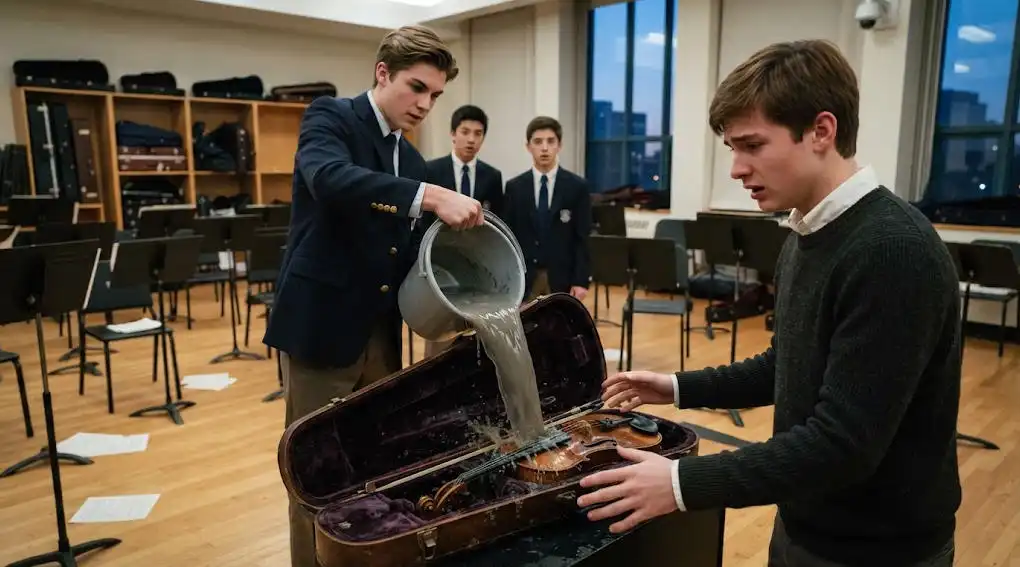
I waited until the heavy doors clicked shut. Then, my composure broke. I collapsed onto my knees beside the chair. The smell of the chemicals and the wet, rotting wood was overwhelming. I reached into the filthy water and gently lifted the Tyrolean. Water poured out of the f-holes in a dark stream. The back plate was peeling away like dead skin. The varnish was already clouding, turning a sickly, opaque white. I held the ruined, splintered wood to my chest, soaking my shirt, and I wept.
Ten minutes later, I had photographed every inch of the crime scene with my phone. I carefully wrapped the dripping corpse of my violin in a plastic trash bag, cradled it in my arms, and ran.
I ran two miles through the pouring Boston rain. I didn’t stop until I reached the cobblestones of Beacon Hill. I pounded on the glass of Elias’s shop, long after the “Closed” sign had been turned outward.
Elias, wearing his heavy leather apron, unlocked the door. He took one look at my soaked clothes, my tear-streaked face, and the plastic bag in my arms, and rushed me to the main workbench.
Under the bright, clinical light of the halogen lamps, Elias carefully unrolled the plastic. He didn’t speak. He put on his magnifying loupe and examined the wreckage with the grim, solemn reverence of a coroner conducting an autopsy.
He probed the open seams with a palette knife. He checked the warping of the ribs. He examined the cloudy, ruined varnish.
“The chemicals in that water accelerated the degradation,” Elias finally said, his voice gravelly and thick with sorrow. “The hide glue has completely failed. The soundpost collapsed, taking a chunk of the spruce top with it. The wood is saturated. If it dries too fast, it will warp permanently. If it dries too slow, it will rot.”
“Can you fix it?” I asked, my voice barely a whisper.
Elias looked up at me. “It will take months. It will have to be completely disassembled, dried in a humidor over weeks, re-carved, re-glued, and re-varnished. It is a full restoration, Ethan. It will cost upwards of ten thousand dollars in labor and materials.”
“Document it,” I said, my voice hardening. “Write down every crack, every hour of labor required, and every cent it will cost. I need an itemized damage assessment. On your official letterhead.”
Elias saw the look in my eye. He didn’t ask questions. He pulled out a legal pad and began to write.
By the time I left his shop, the rain had stopped. I held a waterproof folder containing Elias’s forensic assessment, the photographs I had taken, and my official State Competition Gold Certificate.
The next morning, the machine tried to crush me.
Before first period, I was summoned to the Dean’s office. When I walked in, Dean Aris was sitting behind his massive mahogany desk. Sitting in a leather armchair across from him was Richard Whitaker. Grant’s father.
Richard Whitaker was a man who exuded wealth the way a radiator exudes heat. He wore a bespoke charcoal suit and a Patek Philippe watch that likely cost more than Elias’s entire storefront.
“Ah, Mr. Cole,” Dean Aris said, looking deeply uncomfortable. “Please, sit.”
I remained standing.
“Ethan,” Richard Whitaker began, his tone dripping with practiced, paternal sympathy. “Grant told me about the unfortunate accident in the rehearsal room yesterday. I cannot express how deeply sorry we are. Grant feels terrible. He was trying to help clean the room, and he tripped. A terrible, clumsy tragedy.”
He reached into his breast pocket, pulled out a pristine checkbook, and placed a heavy gold fountain pen on the desk.
“I understand the instrument was damaged,” Richard continued smoothly. “I am a patron of the arts. I abhor the destruction of music. I would like to write you a check right now for fifteen thousand dollars. You can buy yourself a brand-new, modern instrument. Something far superior to whatever antique you were playing. In exchange, we simply sign a standard non-disclosure agreement acknowledging this was an accident. And, given that you will be breaking in a new instrument, it would be best for you to withdraw your name from the New York festival. Give yourself time to adjust.”
It was a masterclass in manipulation. A bribe wrapped in a threat. Take the money, drop the solo, and keep your mouth shut, or go to war with a titan.





